
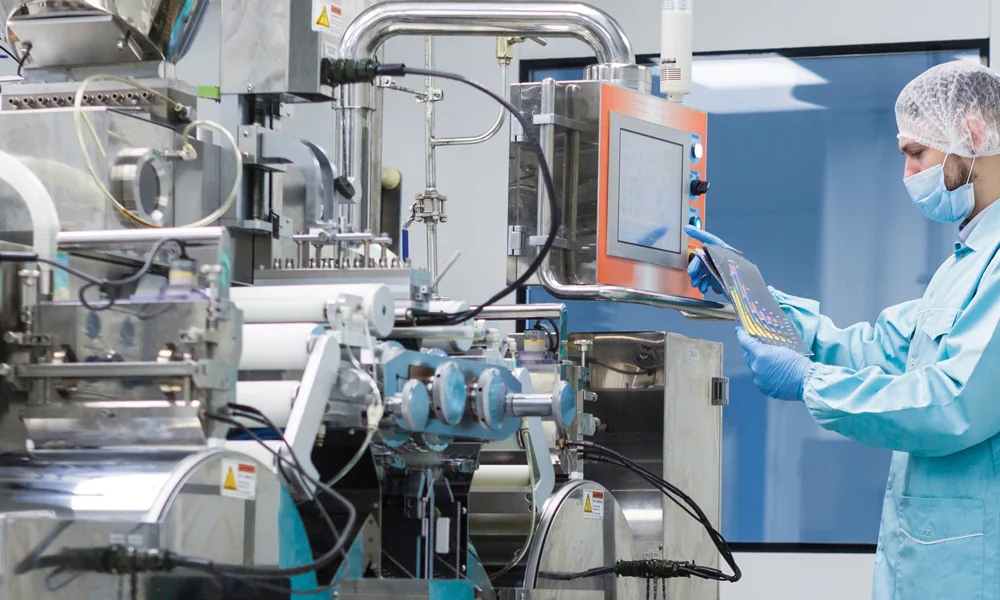
Manufacturing IT has a constraint most sectors don't: production equipment that can't be patched, can't be rebooted on demand, and was never designed to be on a network at all.Manufacturing IT Assessment
Tell us what you run and where downtime hurts most. We'll be straight about what we'd address first.
We won't sell your data or send you marketing you didn't ask for.
Manufacturers and industrial clients we support
A provider who treats your PLCs like laptops will eventually push an update during a production run. The two environments need different handling and a controlled boundary between them.
The boundary between them is where most manufacturing breaches happen — and where most plants have no control at all.
Office PCs, PLCs, and the vending machine on the same VLAN. A phished laptop can then reach the production line.
Exactly when finance needs it. Usually a database that has never been maintained or a server sized for a smaller company.
Running Windows XP, unsupported, essential, and controlling equipment worth more than the IT budget.
Dust, heat, and vibration kill consumer-grade hardware. Then a shift runs on paper and the data is entered twice.
The ERP is backed up. The CNC programs and machine configurations, often the harder thing to recreate, are not.
An equipment supplier's permanent VPN into your plant is convenient for them and an unmonitored door for everyone else.
An IT outage in manufacturing doesn't just pause work. It ripples into shipping windows, customer commitments, and next month's forecast.
Operators can't retrieve work orders or record output. The line either idles or runs blind.
No labels, no packing lists, no ASN to the customer. Trucks wait or leave empty.
A missed shipping window becomes a missed customer delivery date — and a conversation with procurement.
OEM supplier scorecards weight on-time delivery heavily. Recovery takes months of clean performance.
The pattern, not a prediction — how far it travels depends on your buffer stock and customer terms. Worth modelling against your own numbers before deciding what resilience is worth.
SAP, Dynamics 365 Business Central, Sage 300, Epicor, Infor — sized, tuned, and backed up so month end and MRP runs don't crawl.
The single highest-value change in most plants: production separated from office traffic, with a controlled and monitored boundary.
Isolated, imaged, and documented — so an unpatchable XP box controlling a press is contained and recoverable rather than ignored.
Panel PCs, rugged terminals, and industrial switches rated for the temperature, dust, and vibration they'll actually meet.
Coverage across the floor and the yard for scanners and tablets, engineered around metal racking and interference.
CNC programs, PLC configurations, and recipes backed up alongside the ERP, with restores actually tested.
ISO 9001, IATF 16949, BRC and HACCP all require records you can produce on demand — batch genealogy, calibration history, deviation reports, training records. When those live on a share nobody backs up, a disk failure becomes a nonconformance.
We treat quality records as regulated data: retention that matches your standard, access control that preserves the audit trail, and restores that have actually been tested.
Retention periods vary by standard, customer contract, and product — your quality manager sets them. We build the environment to enforce whatever they specify.
Segmentation done badly stops production. We stage it around your planned downtime, in an order where each step is useful on its own.
A passive inventory of every device on the network — which for most plants surfaces equipment nobody knew was reachable.
The single highest-value change: a controlled boundary so a phished laptop can't reach a PLC.
Replace standing supplier VPNs with requested, time-limited, logged sessions scoped to their own equipment.
Segment by cell or line, so a problem in one area is contained rather than spreading across production.
Stage one requires no downtime at all — and for most plants it's the first accurate inventory of what's actually connected to the network.
If you supply automotive, aerospace, defence, or a large OEM, security requirements now arrive with the purchase agreement. A supplier who can't answer them is a supply chain risk to be managed — or replaced.
Manufacturers are also attacked as a route into larger customers, because you hold their drawings, specifications, and forecast data.
NetFusion Designs has been a godsend for our IT needs. The responsiveness of their team is incredible, and we have not had any downtime since they took over!
Isolate them rather than try to update them. Patching a machine PC often voids the equipment vendor's support or breaks the control software, so the answer is segmentation: the machine can talk to what it must and nothing else, with a documented recovery image so a dead hard drive is a few hours rather than a few weeks.
Usually yes. Slow ERP is more often an unmaintained database, an undersized server, or a storage bottleneck than the application itself. We'd measure before recommending anything — replacing an ERP because the disks are slow is an expensive mistake.
Yes — both are common in Canadian manufacturing, and we support the environments they run in: server sizing, database maintenance, integration, and backup. Same for SAP, Epicor, and Infor. We're not the software vendor, but we take the vendor call rather than handing you a number.For one multi-location Ontario manufacturer we went further and built a custom job management application integrated directly with Sage 300.
It's one of the most common weaknesses we find. Vendors need access, but it should be brokered — time-limited, requested, logged, and scoped to their equipment rather than a standing tunnel into your plant network that nobody monitors.
Yes, and it's a frequent reason manufacturers call us. We work through it, tell you honestly which answers are currently 'no', and prioritise the gaps that actually threaten the contract rather than trying to satisfy every line at once.
That's the baseline expectation, not a favour. Maintenance windows follow your shift patterns and planned downtime — including if that means a Sunday. A provider who patches on their own schedule will eventually do it during a run.
Tell us what's on your plant floor and where downtime hurts. We'll tell you what we'd change and roughly what it costs — before you commit to anything.
%20(1).avif)
%201.avif)





