IT support for professional services is defined as the comprehensive management and protection of technology environments specifically designed to meet the operational, security, and compliance demands of firms such as accounting, legal, and consulting practices. Unlike general IT support for businesses, this specialised model incorporates managed services, proactive monitoring, multifactor authentication (MFA), Written Information Security Plan (WISP) documentation, and a dedicated IT helpdesk for professionals. NetFusion Designs Inc delivers this type of support to small and mid-sized firms across Ontario and Canada, combining SOC 2 Type 2 attestation with a 24/7 Network Operations Centre. The difference between generic IT and professional IT services is not cosmetic. It is the difference between a provider who reacts to problems and one who prevents them.
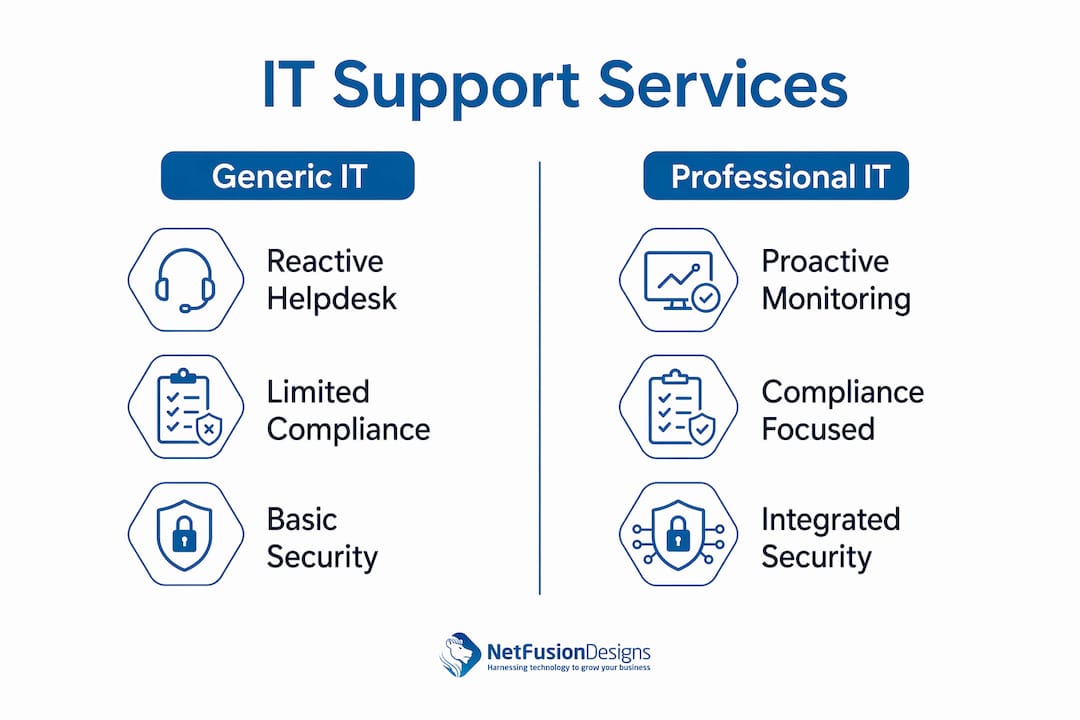
IT support for professional services is the industry term for managed IT services tailored to firms where billable time, client confidentiality, and regulatory compliance are non-negotiable. General IT support fixes broken computers. Professional IT services manage your entire technology environment as a business function. The scope includes cloud and security management, endpoint protection, backup validation, and collaboration tools such as Microsoft 365. The goal is predictable performance with fewer surprises, factoring in hybrid work and security needs that are unique to client-facing firms.
Professional services firms face pressures that most IT providers are not built to handle. A law firm cannot afford a data breach that exposes client files. An accounting practice cannot have its systems go down during tax season. These are not hypothetical risks. They are the daily operating reality that shapes what professional IT assistance must deliver.
Managed IT support for professional services covers a broader scope than a standard helpdesk ticket system. The table below outlines the core service categories and what each delivers.

| Service category | What it delivers |
|---|---|
| 24/7 proactive monitoring | Detects failing hardware or cyber threats before they affect productivity |
| IT helpdesk for professionals | Fast resolution of day-to-day technical issues without disrupting billable work |
| Endpoint protection and MFA | Prevents unauthorised access to client data and firm systems |
| Cloud and Microsoft 365 management | Keeps collaboration tools running reliably for in-office and remote staff |
| Backup testing and validation | Confirms that data can actually be recovered when needed |
| Compliance and audit support | Maintains documentation required by regulators and cyber insurers |
Proactive monitoring detects failing hardware or cyber threats before they impact productivity. That distinction matters because reactive support costs firms billable hours every time a problem escalates into a crisis.
Pro Tip: Ask any prospective IT service provider for a sample monitoring report. A provider who cannot show you what they are watching is not watching much.
Security controls such as MFA and endpoint protection are not optional add-ons. Effective IT support integrates MFA, endpoint protection, and incident response as part of everyday operations, not as separate tasks. Firms that treat security as a checklist item rather than a continuous process are the ones that appear in breach notifications.
Compliance is where professional IT services diverge most sharply from generic managed IT. Accounting and legal firms operate under data protection obligations, cyber insurance requirements, and audit standards that demand documented evidence, not just good intentions.
Compliance-heavy firms must have verified backup testing, documented incident response plans, and rigorous security controls including MFA. Each of these is a verifiable deliverable, not a verbal assurance. A WISP documents how your firm handles sensitive data, who is responsible for security decisions, and what steps are taken when a breach occurs. Without one, your firm is exposed to both regulatory penalties and insurance claim denials.
A compliance-ready IT support programme for professional services firms covers:
Not all managed IT agreements provide the same level of service. Firms must demand evidence of compliance documentation and backup testing. A provider who cannot produce these records is not meeting the standard your firm needs.
Pro Tip: Before signing any IT support contract, ask your provider to show you the last three backup test results. If they cannot, your data recovery plan exists only on paper.
Cloud backup practices deserve particular attention. Firms that want to understand systematic backup testing in depth will find that the gap between a scheduled backup and a validated recovery is where most firms discover their vulnerabilities.
The productivity argument for professional IT services is direct. When your systems work reliably, your staff bill more hours and serve clients better. When they do not, you pay twice: once for the downtime and once for the recovery.
IT is no longer a back-office expense but a central enabler of client interactions and flexible work environments. Firms that treat IT as overhead miss the compounding return that comes from well-managed technology. A firm where lawyers can work securely from any location, where accountants can access client files without delays, and where meetings run on reliable video infrastructure is a firm that retains clients and attracts talent.
Operational benefits that professional services firms consistently report include:
Best IT support partnerships explicitly schedule maintenance to avoid disrupting peak productivity periods such as tax season. This alignment with billable utilisation pressures is a hallmark of a provider who understands professional services, not just technology.
The most damaging misconception is that all managed IT services are equivalent. They are not. A provider who manages retail point-of-sale systems operates in a fundamentally different risk and compliance environment than one who supports a regulated accounting or legal practice.
Accountability and communication are the key evaluation factors for IT support, with ownership of incidents until resolution being the defining test. Ask any prospective provider: “Who owns an incident from the moment it is reported until it is fully resolved?” A vague answer is a clear signal.
The table below contrasts generic managed IT with IT support tailored to professional services.
| Evaluation area | Generic managed IT | Tailored professional IT services |
|---|---|---|
| Compliance documentation | Rarely included | WISP, risk assessments, audit support included |
| Backup validation | Scheduled, rarely tested | Tested recovery procedures with documented results |
| Incident ownership | Shared or unclear | Single point of accountability until resolution |
| Maintenance scheduling | Provider-driven | Aligned with firm’s peak billing periods |
| Security controls | Standard antivirus | MFA, endpoint protection, incident response plans |
A thorough IT onboarding includes network assessment, gap analysis, documentation, and a 90-day improvement plan. Providers who skip this step create long-term service failures that are expensive to correct. Skipping onboarding is not a cost saving. It is a deferred problem.
Pro Tip: Request a written onboarding plan before your contract starts. If the provider cannot describe the first 90 days in detail, they are not ready to manage your environment.
The demands on professional IT services are growing faster than most firms realise. Three forces are reshaping what IT support must deliver in 2026 and beyond.
AI tool governance is the newest pressure. Firms are adopting AI writing assistants, document review tools, and client communication platforms without always understanding the data risks involved. IT support now includes governing which AI tools are permitted, how data flows through them, and what audit trails exist. Without this governance, firms expose client data to third-party AI systems with unknown retention policies.
Hybrid workplace infrastructure has moved from temporary accommodation to permanent requirement. Hybrid managed services and consulting models are increasingly common to address these evolving needs. Supporting a lawyer working from a client site, an accountant at home, and a partner in the office simultaneously requires consistent security controls across every endpoint, not just the ones inside your office walls.
Rising cyber insurance requirements are forcing firms to document security controls they may have previously handled informally. Insurers now require evidence of MFA, backup testing, and incident response plans before issuing or renewing policies. IT support providers who understand this environment help firms meet these requirements proactively rather than scrambling at renewal time.
Firms evaluating their financial and insurance IT needs will find that the compliance and security requirements in those sectors mirror what all professional services firms now face.
IT support for professional services is the most direct path from technology risk to operational confidence for small and mid-sized firms operating under compliance and billable-time pressures.
| Point | Details |
|---|---|
| Definition matters | Professional IT services differ from generic IT by including compliance, WISP, and accountability structures. |
| Compliance is verifiable | Demand documented backup tests, incident response plans, and WISP records from any provider. |
| Productivity is measurable | Proactive monitoring and scheduled maintenance reduce unplanned downtime and protect billable hours. |
| Onboarding predicts outcomes | A provider without a structured 90-day onboarding plan will create long-term service problems. |
| AI governance is now part of IT | Firms adopting AI tools need IT support that governs data flow and audit trails across those platforms. |
The firms that get the most from their IT support share one trait: they treat their IT provider as a business partner, not a vendor. That sounds straightforward, but it requires something most firms resist. You have to give your provider enough context about your business to let them make good decisions on your behalf.
I have seen firms sign IT contracts based entirely on price, then spend the next two years managing their IT provider instead of their clients. The provider did not understand tax season. They did not know which systems were critical at month-end. They scheduled updates at the worst possible times and called it standard practice.
IT strategy must align with regulatory and utilisation pressures specific to professional services. That alignment does not happen automatically. It requires a provider who asks the right questions during onboarding and revisits them as your firm grows.
Trust in an IT provider grows from their understanding of your business model and their consistent, predictive response to issues. The providers worth working with are the ones who call you before you call them. They see the problem forming in the monitoring data and act on it. That is the standard your firm deserves.
— Geeshan
NetFusion Designs Inc delivers managed IT services built specifically for small and mid-sized professional services firms across Ontario and Canada. The service model covers 24/7 monitoring, IT helpdesk for professionals, endpoint security, MFA enforcement, WISP documentation, and Microsoft 365 management, all under a single accountable provider.
Firms in Kitchener-Waterloo, Toronto, Mississauga, Markham, Montréal, and Winnipeg work with NetFusion Designs Inc because the team understands compliance pressures, billable utilisation demands, and the cost of unplanned downtime. NetFusion Designs Inc is SOC 2 Type 2 attested, which means the security controls protecting your firm have been independently verified. Contact NetFusion Designs Inc for a no-obligation assessment of your current IT environment and a clear picture of where your risks sit.
IT support for professional services is a managed technology service model that covers security, compliance documentation, proactive monitoring, and helpdesk support tailored to the regulatory and operational demands of firms such as accounting, legal, and consulting practices.
A standard IT helpdesk resolves individual technical issues reactively. Managed IT support includes continuous monitoring, compliance management, backup validation, and security controls that prevent problems before they affect your firm.
Your IT provider should maintain a Written Information Security Plan (WISP), documented risk assessments, tested backup recovery records, and an incident response plan with clear escalation paths.
Ask who owns an incident until it is fully resolved, request the last three backup test results, and confirm that onboarding includes a network assessment, gap analysis, and a 90-day improvement plan.
Yes. Professional IT services now include AI tool governance, covering which platforms are permitted, how client data flows through them, and what audit trails are maintained to meet compliance obligations.
%20(1).avif)
%201.avif)