Managed IT services are defined as the practice of outsourcing your IT infrastructure, security, and support to a third-party provider under a fixed monthly contract. Toronto businesses that adopt this model gain predictable costs, proactive cybersecurity, and access to a full IT team without carrying the overhead of in-house staff. Canadian privacy law under PIPEDA requires businesses to protect personal data, and a qualified managed service provider (MSP) builds that compliance into daily operations. NetFusion Designs Inc, a SOC 2 Type 2-certified provider with offices in Toronto, Mississauga, and Markham, delivers exactly this kind of fully managed IT support to small and mid-sized businesses across Ontario.
The cost argument for managed IT services is straightforward. Per-user monthly costs for managed IT services in Toronto run between $180 and $250. A single in-house IT professional in the GTA earns between $65,000 and $85,000 annually, before benefits, training, and equipment. That gap widens considerably once you factor in vacation coverage and turnover costs.
Beyond the raw numbers, managed IT services shift your spending from capital expenditure (CapEx) to operating expenditure (OpEx). You replace unpredictable repair bills and hardware purchases with a fixed monthly fee that simplifies budgeting. For a business owner planning a quarter ahead, that predictability is worth as much as the savings themselves.
The financial benefits extend beyond the IT budget line:
Manufacturers in Brampton and professional services firms in Mississauga report the same pattern: the moment they move from reactive IT spending to a managed model, their annual IT budget becomes a known number rather than a source of anxiety.
Cybersecurity is the benefit Toronto business owners underestimate until they need it. A qualified MSP delivers 24/7 monitoring, multi-factor authentication (MFA), malware removal, and PIPEDA compliance support as standard features, not add-ons. That means a security analyst is watching your network at 2:00 AM on a Sunday, even when your office is dark.

The compliance dimension matters as much as the threat detection. PIPEDA requires Canadian businesses to implement reasonable safeguards for personal information. An MSP that understands Canadian privacy law builds those safeguards into your systems from day one. NetFusion Designs Inc, for example, holds SOC 2 Type 2 attestation, which means its security controls are independently audited on an ongoing basis.
Proactive security services typically include:
Pro Tip: Ask any MSP you evaluate to show you their most recent penetration test report. A provider that cannot produce one is not doing proactive security work.
The cybersecurity and compliance layer is where managed IT services deliver the clearest risk reduction. A single ransomware incident can cost a Toronto SMB weeks of downtime and significant recovery expense. Preventing that incident costs a fraction of recovering from it.
Operational efficiency in IT comes down to one thing: less downtime. Proactive monitoring catches failing hardware, degraded network performance, and software conflicts before they become outages. Your staff keeps working, and you never know the problem existed.
Local MSPs provide faster onsite emergency support, which is critical for minimising downtime in Toronto’s business environment. Guaranteed response times and physical proximity mean a technician can be on-site for hardware repairs when remote resolution is not enough. A provider based in Mississauga or Markham reaches your Toronto office far faster than a national call centre routes a ticket.
Operational improvements follow a clear sequence:
Toronto MSPs often bundle cloud, cybersecurity, helpdesk, and digital marketing services under one contract. That consolidation removes the finger-pointing that happens when your internet provider blames your firewall vendor and your firewall vendor blames your ISP. One accountable partner resolves the issue.
Choosing an MSP is a business decision, not a technology decision. The wrong provider costs you more in downtime and frustration than you save on the monthly fee. Four criteria separate a strategic partner from a low-cost vendor.
Response time guarantees. A service level agreement (SLA) that commits to response within 15 minutes for critical issues is the baseline. Any SLA that measures response in business hours is not adequate for a business that operates outside 9-to-5.
Local presence. Remote support resolves most issues, but hardware failures, network outages, and physical security incidents require a technician on-site. A provider with a Toronto or GTA office delivers that capability reliably. You can review key selection criteria for Toronto manufacturers to see how this plays out in practice.
Service breadth. An MSP that covers only helpdesk tickets forces you to manage separate vendors for cloud, security, and backup. Look for a provider that handles all of these under one agreement.
Proven industry experience. Ask for references from businesses in your sector. A provider that has supported healthcare, finance, or manufacturing clients understands the compliance requirements and operational rhythms that apply to your business.
Pro Tip: Request a copy of the provider’s SLA before signing anything. Compare the guaranteed response times, escalation paths, and remedies for missed targets. Vague language in an SLA is a warning sign.
Managed IT services are not a single product. Providers structure their offerings in tiers that match the complexity and budget of different organisations. A 10-person professional services firm needs different coverage than a 200-person manufacturer in Brampton.
Scalability is a core MSP advantage: providers grow cloud infrastructure and user support alongside your business without the lag of internal hiring. That matters most during rapid growth phases, when IT demand spikes faster than a recruiting process can respond.
Sector-specific needs shape the service package:
Small businesses across Toronto consistently find that the compliance and monitoring capabilities of an MSP are the features they use most, not the helpdesk tickets. Preventing a data breach or a regulatory fine delivers more value than fixing a printer.
For growing businesses exploring how managed IT fits their expansion plans, scalable IT solutions designed for growing organisations offer a useful reference point for what a tiered service model looks like in practice.
Managed IT services deliver the greatest value to Toronto businesses when the provider combines local presence, proactive security, and a fixed-fee model that replaces unpredictable IT spending.
| Point | Details |
|---|---|
| Predictable cost model | Monthly per-user pricing between $180 and $250 replaces costly in-house IT salaries. |
| Proactive cybersecurity | 24/7 monitoring, MFA, and PIPEDA compliance support reduce breach risk significantly. |
| Faster issue resolution | Local MSPs with SLA-backed response times minimise downtime for Toronto businesses. |
| Sector-specific coverage | Healthcare, finance, and manufacturing each require tailored compliance and monitoring. |
| Scalable without hiring | MSPs add users and services as your business grows, without recruitment delays. |
I have worked with Toronto business owners who chose the lowest-cost MSP they could find, usually a national provider with a remote helpdesk and no local presence. The savings looked real on paper. Then a server failed on a Friday afternoon, and the nearest technician was four hours away.
The managed IT services benefits Toronto businesses actually realise depend heavily on whether the provider understands the local market. That means knowing which internet carriers serve which neighbourhoods, understanding the compliance landscape for Ontario-based businesses, and being able to send someone onsite within the hour when it matters.
What I find most undervalued in these conversations is the strategic dimension. A good MSP does not just keep your systems running. It tells you when your infrastructure is becoming a growth constraint, when your security posture needs to change, and when a technology investment will pay off. That kind of advice requires a provider who knows your business, not just your ticket history.
The businesses I see get the most from managed IT are the ones that treat their MSP as an extension of their leadership team, not a vendor they call when something breaks. That shift in mindset changes what you ask for, what you get, and what you pay for it.
— Geeshan
NetFusion Designs Inc serves Toronto, Mississauga, Markham, and the broader GTA with fully managed IT that covers security, cloud, helpdesk, and Microsoft 365 under one fixed monthly agreement.
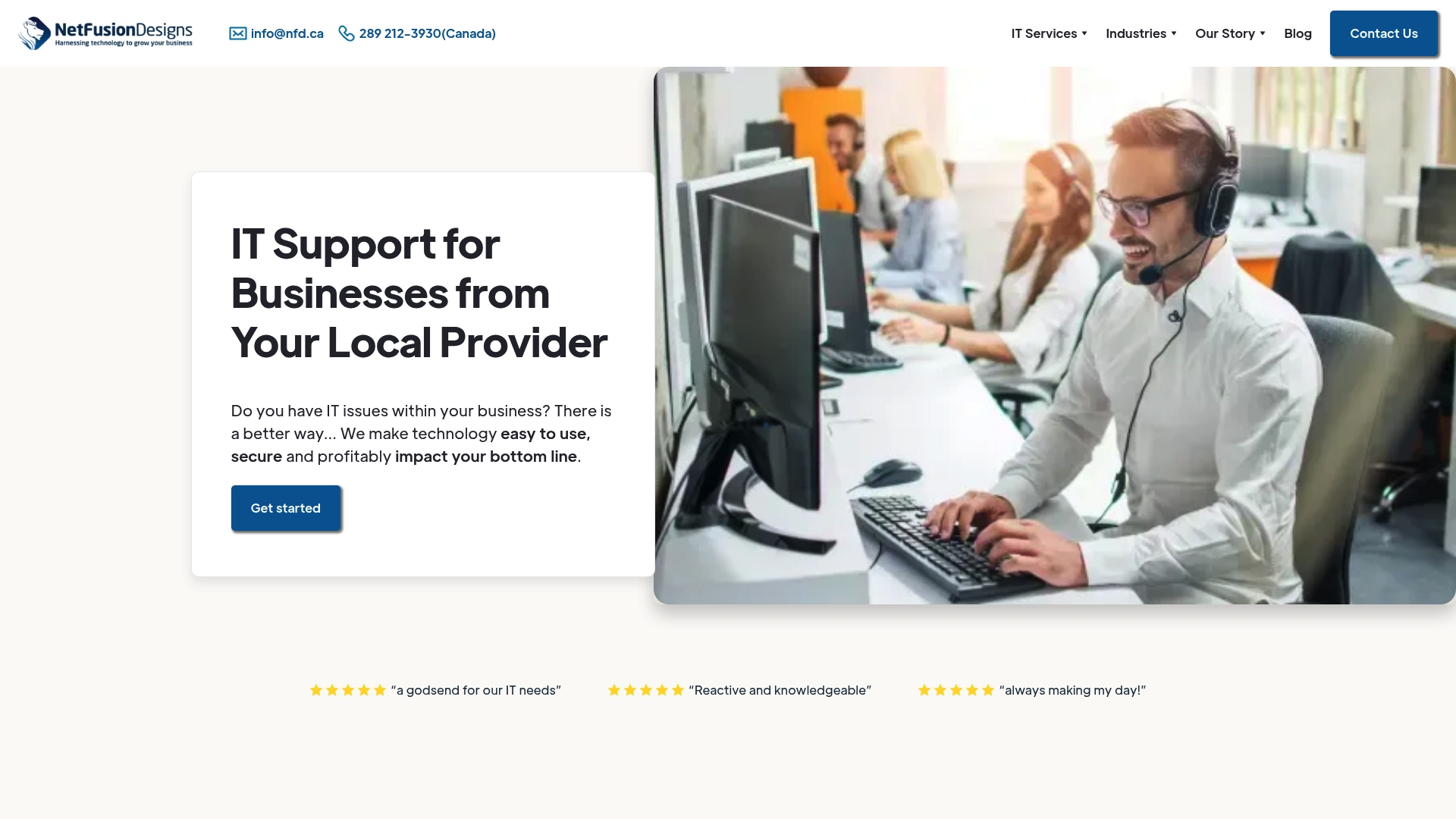
Whether you need emergency IT support with a guaranteed response time or a complete managed IT services package built around your business size and sector, NetFusion Designs Inc has the local presence and SOC 2 Type 2-certified security controls to back it up. Businesses across the GTA also benefit from IT services in Mississauga and the full range of Toronto IT support options available through NetFusion Designs Inc. Contact the team to get a clear picture of what managed IT costs and delivers for a business like yours.
Managed IT services in Toronto cost between $180 and $250 per user per month, compared to $65,000 to $85,000 annually for a single in-house IT professional in the GTA.
A qualified MSP implements encrypted storage, access controls, and data handling policies that satisfy PIPEDA requirements, and conducts regular audits to maintain that compliance over time.
A strong service level agreement commits to a response within 15 minutes for critical issues. Any SLA that measures response only during business hours is not adequate for most Toronto businesses.
MSPs scale cloud infrastructure and user support as your headcount and operations expand, without the delays associated with recruiting and training internal IT staff.
Small businesses, including dental clinics, professional services firms, and manufacturers, benefit directly from MSP compliance support, automated backups, and 24/7 monitoring that would be unaffordable to build internally.
%20(1).avif)
%201.avif)