Managed IT services are defined as the practice of outsourcing your technology management to a third-party provider who monitors, maintains, and secures your systems proactively, rather than waiting for something to break. For Ontario small and mid-sized businesses, the role of managed services goes well beyond fixing computers. It covers cybersecurity, compliance, cloud infrastructure, helpdesk support, and disaster recovery, all under a predictable monthly cost. With cyber threats rising and compliance requirements tightening under frameworks like SOC 2 and PIPEDA, Ontario SMBs face real pressure to get IT right. The question is no longer whether to take IT seriously. It is whether you can afford to manage it alone.
The financial case for managed IT services is direct. Hiring a single full-time IT professional in Toronto costs between $65,000 and $80,000 annually, before you add benefits, training, and overhead. That figure buys you one person with one skill set, no redundancy, and no coverage when they are sick or on vacation.
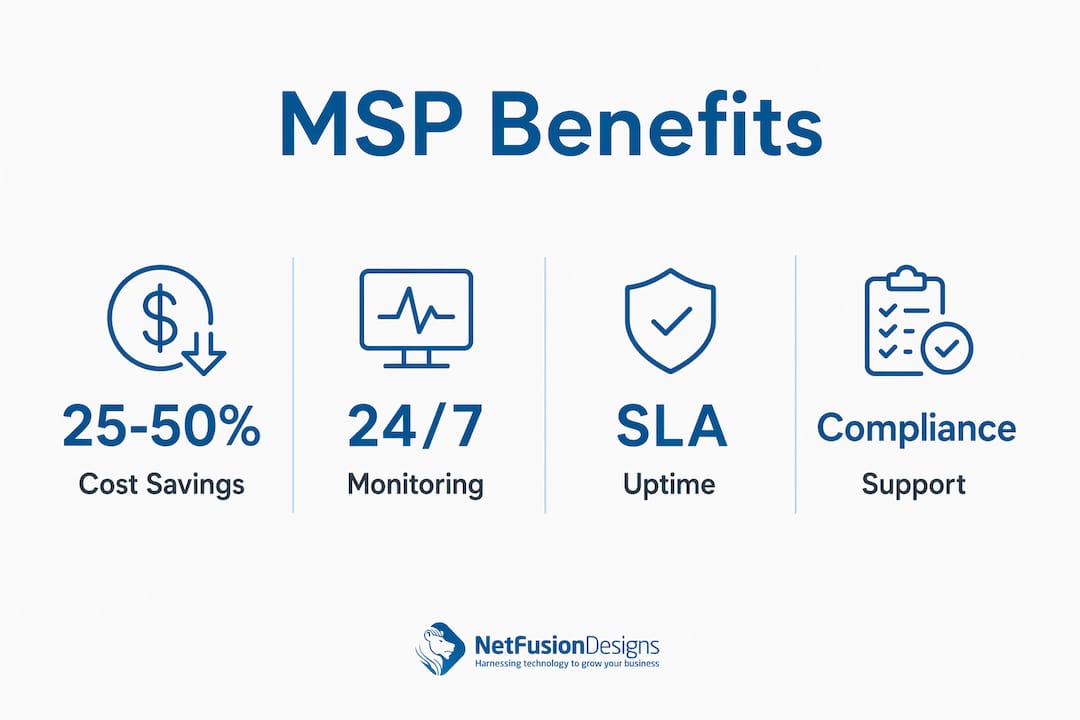
A managed services provider gives you an entire team for a fraction of that cost. Switching to managed IT yields 25–50% annual savings compared to in-house IT once you account for salary, benefits, and emergency repair costs. Those savings compound quickly for businesses with 10 to 100 employees.

The budget model also changes in your favour. In-house IT spending is unpredictable. A server failure or ransomware attack can generate a five-figure bill overnight. Managed services shift your IT spending from capital expenditure to a fixed monthly operating cost. You know exactly what you are paying each month, which makes financial planning far easier.
| Cost Category | In-House IT | Managed IT Services |
|---|---|---|
| Annual staffing cost | $65,000–$80,000+ per hire | Included in monthly fee |
| Emergency repair costs | Unpredictable, often high | Covered under service plan |
| Training and certifications | Additional budget required | Provided by MSP team |
| After-hours coverage | Requires extra staff or overtime | Included with 24/7 NOC |
Pro Tip: Ask any MSP candidate to show you a sample monthly report. If they cannot demonstrate what they monitor and how they report it, they are not truly managing your IT.
Cybersecurity is the area where managed IT delivers the clearest advantage over reactive support. A proactive managed services provider does not wait for a breach to act. They put controls in place before incidents happen.
The core security measures in a well-run managed IT programme include:
Disaster recovery is another area where managed IT pays off financially. Planning IT disaster recovery through managed services costs 60–80% less than reacting to an incident after it happens. That gap exists because reactive recovery requires emergency vendor fees, data reconstruction, and extended downtime costs that a tested recovery plan eliminates.
Compliance is a growing pressure for Ontario SMBs in sectors like healthcare, finance, and professional services. PIPEDA governs how personal data is handled. Sector-specific rules add further requirements. A managed services provider maps your systems against these frameworks, documents your controls, and keeps your policies current as regulations change.
Pro Tip: Insist that your MSP runs quarterly restoration drills on your backups. Many businesses discover their backups are corrupted or incomplete only after a ransomware attack. A drill finds the problem before it becomes a crisis.
Not every business needs the same level of IT support. The right model depends on your size, your technology dependence, and your compliance obligations.
Managed IT is designed for businesses where technology is critical, internal teams are distracted by IT issues, or compliance pressure is high. Full managed services make the most sense when:
Co-managed IT is the right fit when you already have an internal IT person or small team but need additional depth. Your internal staff handle day-to-day requests while the MSP covers security monitoring, after-hours support, and specialised projects. The co-managed IT benefits include retaining institutional knowledge inside your business while gaining access to a broader team.
Basic hourly or break-fix support works only when technology is truly peripheral to your operations, your data carries minimal sensitivity, and downtime is tolerable. For most Ontario SMBs operating in 2026, that description fits very few businesses.
Growth creates IT complexity. Adding employees, opening a second location, or migrating to cloud services all generate IT work that pulls your team away from revenue-generating activity. Managed IT removes that friction.
Managed IT services scale easily to onboard new users, devices, and locations without requiring new contracts or hiring internal IT staff. That means when you add five employees in Mississauga or open an office in Kitchener, your MSP handles the setup, configuration, and security without you managing the project yourself.
Service level agreements (SLAs) are the mechanism that makes this reliable. An SLA defines guaranteed response times, uptime commitments, and escalation paths. When your systems go down, you are not waiting on hold hoping someone picks up. You have a contractual commitment that response begins within a defined window.
Continuous monitoring also prevents the slow degradation that kills productivity quietly. Servers that are running hot, storage that is filling up, or network switches showing errors are caught and addressed before they cause outages. Business owners who partner with a managed services provider consistently report spending less time dealing with IT problems and more time on their actual work.
Pro Tip: When reviewing an SLA, focus on resolution time, not just response time. A provider might respond in 15 minutes but take 8 hours to resolve the issue. Both numbers matter.
Selecting the right managed services provider is a business decision, not just a technical one. The wrong choice costs you time, money, and security exposure.
Pro Tip: Treat the MSP selection process like hiring a senior employee. Check references from clients in your industry and ask those references specifically about how the provider handled a crisis, not just routine support.
Managed IT services are the most cost-effective and security-conscious way for Ontario SMBs to handle technology, provided you choose a provider with local presence, verified certifications, and a clear SLA.
| Point | Details |
|---|---|
| Cost savings are measurable | Managed IT saves 25–50% annually compared to in-house IT staffing costs. |
| Security requires proactive controls | EDR, MFA, email filtering, and quarterly backup drills prevent most incidents. |
| Model selection matters | Full managed, co-managed, or break-fix each suit different SMB scenarios. |
| SLAs protect your operations | Resolution time commitments in writing are what make managed services reliable. |
| Local presence improves outcomes | Ontario-based MSPs offer accountability and on-site response that remote providers cannot. |
Most Ontario SMB owners I speak with come to managed IT after a painful event. A ransomware attack. A server failure during their busiest week. A compliance audit that revealed gaps they did not know existed. The pattern is consistent, and it is entirely avoidable.
The most common misconception I encounter is that managed IT is an expense. It is not. Managed IT is an investment that enables better security and scalability. The businesses that treat it as a cost to minimise are the ones calling us at 2 a.m. after a breach, facing recovery bills that dwarf what managed services would have cost for years.
The second mistake is choosing a provider based on price alone. The cheapest MSP often delivers reactive support dressed up as managed services. Real managed IT means your provider is watching your systems before you notice a problem, not waiting for your call. Ask hard questions about monitoring, backup testing, and incident response before you sign anything.
The future of managed services for Ontario SMBs includes AI-driven threat detection, automated compliance reporting, and deeper integration with cloud platforms like Microsoft 365. Businesses that build a strong managed IT foundation now will adopt these capabilities without disruption. Those that delay will face a larger gap to close under greater pressure.
— Geeshan
NetFusion Designs Inc is a SOC 2 Type 2 attested managed IT provider with teams across Kitchener-Waterloo, Toronto, Markham, and Mississauga. Ontario SMBs partner with NetFusion Designs Inc to get 24/7 monitoring, cybersecurity, helpdesk support, and Microsoft 365 management under one predictable monthly plan.
Whether you need full managed IT support for your growing business or want to strengthen your current IT with co-managed services, NetFusion Designs Inc builds the plan around your operations, not a generic template. If you are based in the Waterloo Region, the Kitchener-Waterloo managed IT team is ready to assess your environment and show you exactly where your gaps are. Contact NetFusion Designs Inc to schedule your IT assessment today.
Managed services give Ontario SMBs access to proactive IT management, cybersecurity, and compliance support under a fixed monthly cost. They replace reactive break-fix support with continuous monitoring and planned maintenance.
Hiring one in-house IT professional in Toronto costs $65,000–$80,000 annually before overhead. Managed IT typically delivers 25–50% annual savings compared to equivalent in-house staffing.
Co-managed IT pairs an existing internal IT person with an MSP team that handles security monitoring, after-hours support, and specialised projects. It suits SMBs that have internal IT staff but need additional depth and coverage.
A managed services provider deploys endpoint detection, email filtering, MFA, and continuous monitoring to prevent breaches. Managed disaster recovery planning also costs 60–80% less than reacting to an incident after it occurs.
Look for SOC 2 Type 2 attestation, local Ontario presence, industry-specific experience, and a clear SLA that defines both response and resolution times. Always request an IT assessment before signing a contract.
%20(1).avif)
%201.avif)