Canadian data sovereignty matters because who controls your data determines which laws can compel access — not just where the servers physically sit. A server in Toronto operated by a U.S.-incorporated parent company gives you data residency, but it does not give you sovereignty. The governing law follows the corporation, not the building.
The practical implication: treat your hosting choice as a legal and operational decision, not a technical one. Classify your data by sensitivity first, then apply a sovereignty-first rule to your most sensitive workloads. Two immediate actions to take now: run a jurisdictional inventory of your high-risk systems, and start vendor questions or a Privacy Impact Assessment (PIA) for any workload that touches personal, regulated, or government-classified information.
Canadian data sovereignty is a legal and operational risk management decision: classify your data, verify vendor jurisdiction, and apply sovereignty-first controls to your most sensitive workloads.
| Point | Details |
|---|---|
| Residency is not sovereignty | A Canadian data centre run by a U.S. parent gives you residency; the CLOUD Act still applies to data the provider controls. |
| Government policy sets the floor | The TBS white paper limits commercial public cloud to Protected B and below, with documented mitigations required. |
| Technical controls reduce but do not eliminate risk | CMKs and encryption lower exposure materially; account metadata and logs remain accessible under foreign legal orders. |
| Contracts must be specific | Require exact data-centre addresses, subprocessor lists, audit rights, and foreign-request notification clauses in every vendor agreement. |
| NetFusion Designs Inc | Provides SOC 2 Type II–backed managed IT, CMK deployment, PIA support, and Canadian-hosted solutions for SMBs across Ontario and Canada. |
These two terms are used interchangeably in vendor marketing, and that confusion creates real compliance risk.
Data residency is a physical fact: your data is stored on servers located within a specific country or region. It is configurable. You can select “Canada” in a cloud console and achieve residency.
Data sovereignty is a legal fact: your data is governed by the laws of the jurisdiction that controls the provider. It follows corporate structure, not geography.
The distinction matters most in this scenario: a Canadian data centre operated by a U.S.-incorporated parent company. Your data never leaves Canada physically, but the provider is subject to U.S. law. That means U.S. authorities can potentially compel access to data the provider controls, regardless of where it is stored. You have residency. You do not have sovereignty.
Key regulatory implications of this distinction:
Sovereignty, then, is a stack of decisions: ownership, incorporation, data-centre control, key custody, and support locations. No single checkbox delivers it.
The Government of Canada TBS white paper on data sovereignty states plainly that Canada cannot ensure full legal control of its data when it relies on services provided by companies subject to foreign laws. Federal policy limits commercial public cloud use to data up to and including Protected B classification, and only with additional mitigations and assessments applied.
The U.S. legal framework creates the most direct exposure for Canadian organisations:
Provincial and federal privacy law adds a second layer of obligation:
The risks are not theoretical. They are legal, operational, and commercial.
Direct legal risks:
Business and commercial impacts:
A practical scenario: A mid-sized Ontario accounting firm stores client tax records with a cloud provider that has Canadian data centres but is incorporated in the U.S. A U.S. law enforcement agency serves a CLOUD Act order on the provider. The provider is legally required to comply and legally prohibited from notifying the firm. The firm’s clients’ financial records are disclosed to a foreign government. The firm had residency. It did not have sovereignty. Under PIPEDA’s accountability principle, the firm remains responsible for that disclosure.
OSFI’s guidance on technology and cyber risk makes clear that regulated financial institutions cannot treat this as a remote edge case. It is a vendor risk category that requires active assessment.
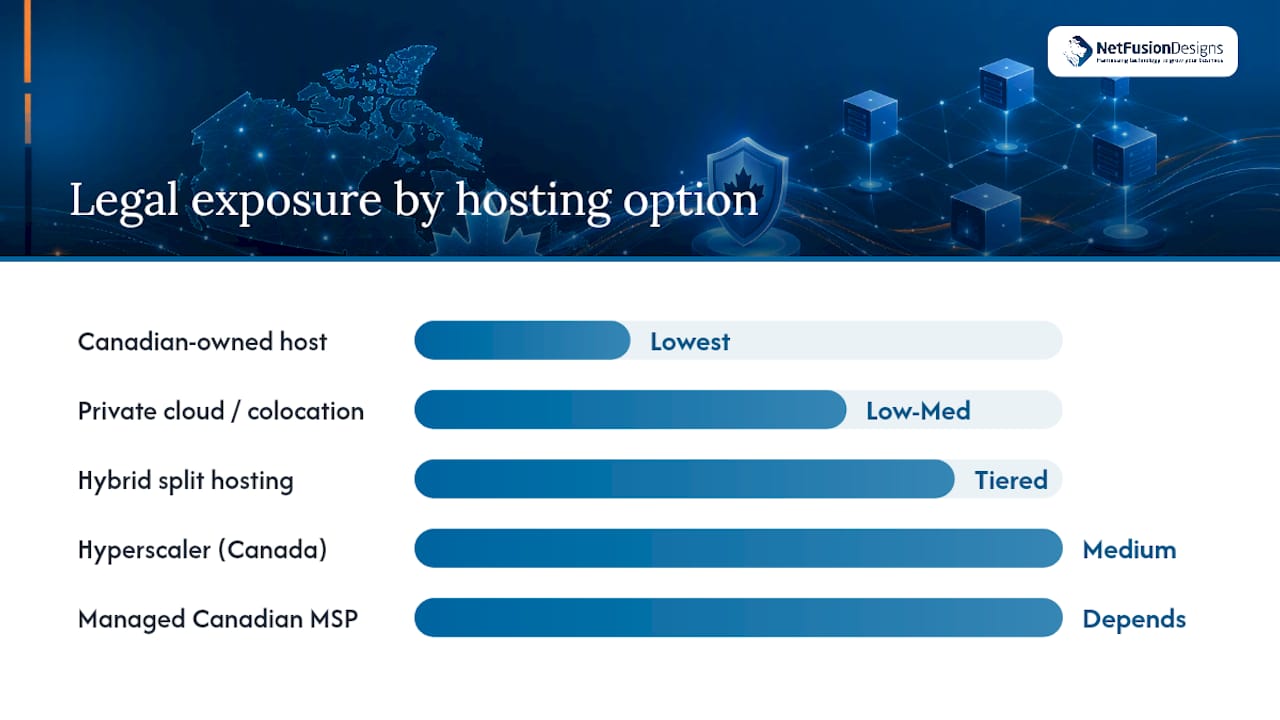
Sovereignty is not binary, and neither are your options. The right choice depends on data sensitivity, your internal IT capability, and your risk tolerance.
| Hosting option | Data sensitivity fit | Legal exposure | Key control | Operational complexity | Certifications / auditability |
|---|---|---|---|---|---|
| Canadian-owned and -incorporated host | All levels, including Protected B | Lowest: governed by Canadian law | Varies by provider; ask explicitly | Low to medium | Ask for SOC 2, ISO 27001, CSA STAR |
| Hyperscaler Canada regions (AWS Canada, Azure Canada, GCP Canada) | Up to Protected B with mitigations | Medium: U.S.-incorporated parent; CLOUD Act applies | Customer-managed keys (CMKs) available | Medium to high | SOC 2, ISO 27001, CSA STAR available |
| Private cloud / colocation in Canada | Confidential and regulated data | Low to medium depending on operator | Full control possible | High | Depends on operator; negotiate audit rights |
| Hybrid (Canadian host for sensitive, hyperscaler for non-sensitive) | Tiered by classification | Tiered accordingly | Split; document both | High | Requires dual audit trail |
| Managed Canadian MSP | All levels; MSP handles classification | Depends on MSP’s own hosting stack | Negotiable; ask for CMKs and key custody docs | Low for client | Ask for SOC 2 Type II evidence |
A few points worth unpacking:
Hyperscalers’ Canadian regions (AWS Canada Central, Azure Canada Central and Canada East, Google Cloud’s Montréal region) offer genuine data residency and strong technical controls. However, because AWS, Microsoft, and Google are U.S.-incorporated, the CLOUD Act applies to data they control. Osler’s legal analysis confirms that full sovereignty generally requires a Canadian-controlled provider, and that technical mitigations like customer-managed keys reduce but do not fully eliminate exposure to foreign legal orders.
For Protected B federal data specifically, the TBS white paper requires additional mitigations beyond simply selecting a Canadian region. Interpret hyperscaler “Canada region” claims carefully: residency is real, sovereignty is partial.
Canadian-owned hosts and managed service providers with Canadian incorporation offer the strongest sovereignty posture, provided you verify their backup locations and subprocessor lists. Backups and ancillary services sometimes leave copies outside Canada even when primary servers are local. Ask vendors explicitly where backups and logs are stored.
For cloud solutions serving regulated sectors like law and accounting, the combination of a Canadian-controlled host and documented contractual controls is typically the minimum defensible posture.
Technical controls are your second line of defence. They reduce risk materially, but they do not replace jurisdictional sovereignty. The Canadian Centre for Cyber Security recommends encryption, key management, logging, and supplier diligence as the core controls for managing cloud security and cross-border risk.
Core controls to implement:
What these controls cannot do:
Encryption protects content, not metadata. Account metadata, access logs, IP addresses, and usage patterns may still be accessible to a provider under a legal order even when data is encrypted with CMKs. The provider’s control plane — the infrastructure that manages your account — remains subject to the provider’s governing law.
Pro Tip: When deploying CMKs, document key custody, backup procedures, and cross-border recovery plans in writing. If your key management service is hosted outside Canada, a legal order could potentially reach the keys themselves. Keep key management within Canadian jurisdiction wherever possible, and test your recovery process before you need it.
The Osler analysis is direct on this point: CMKs reduce risk but do not fully eliminate legal exposure to account metadata and logs. Technical controls and jurisdictional sovereignty work best together, not as substitutes for each other.
Contracts are where sovereignty posture becomes enforceable. A vendor’s marketing claims about “Canadian data centres” mean nothing if the contract does not bind them to specific obligations.
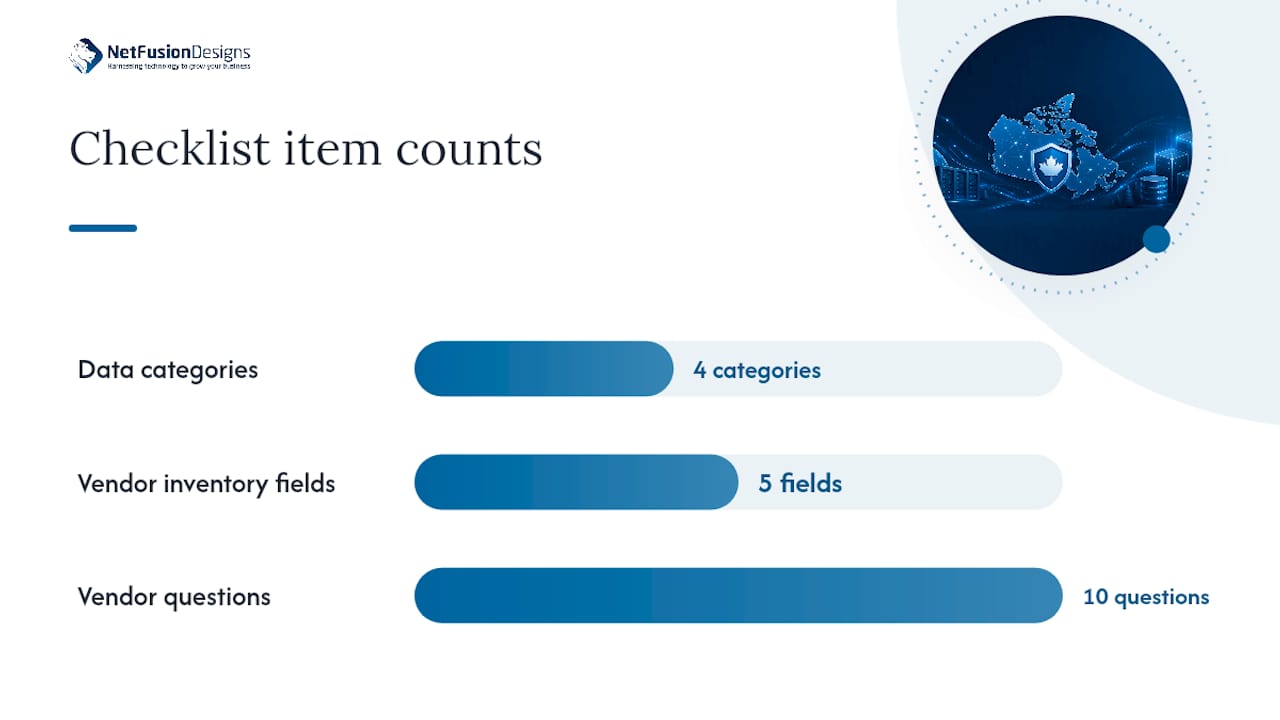
Checklist of clauses to require:
Certifications and attestations to request:
Ask for current SOC 2 Type II reports (not just SOC 2 Type I), ISO 27001 certificates with scope statements, and CSA STAR attestations. Request the data-centre addresses covered by each certification. A certificate that covers the vendor’s head office but not the specific data centre where your data lives is not useful evidence.
Document all vendor responses in a format suitable for PIAs and tender evaluations. For government procurement, the TBS white paper provides the framework for what constitutes acceptable evidence of Canadian jurisdiction.
This is the decision sequence that a procurement or IT lead can work through immediately.
Step 1: Classify your data by sensitivity
Map your data into categories: public, internal, confidential, and regulated. Regulated data includes personal information under PIPEDA, health information under PHIPA, financial data under OSFI scope, and any federal data classified as Protected A or Protected B.
Step 2: Map your current vendors
For each vendor, identify: their jurisdiction of incorporation, parent company, data-centre locations, backup locations, and whether they hold encryption keys. This is your jurisdictional inventory.
Step 3: Prioritise high-risk workloads
Any workload handling regulated or confidential data should be assessed first. Apply a sovereignty-first rule: if the data is sensitive enough to trigger regulatory obligations, the default should be a Canadian-controlled host unless there is a documented reason otherwise.
Step 4: Run PIAs or Transfer Impact Assessments (TIAs)
For any cross-border transfer of personal information, a PIA or TIA is required under Law 25 and recommended under PIPEDA. Document the receiving jurisdiction’s legal framework, the risks, and the mitigations applied.
Step 5: Ask vendors these ten questions
Timeline and cost notes: A jurisdictional inventory for a mid-sized organisation typically takes a few weeks. A full PIA for a regulated workload adds additional weeks depending on complexity. Migration to a Canadian-controlled host, if required, can range from short to extended durations for complex environments. Customer-managed key deployments add cost and operational overhead; budget accordingly. For managed IT services guidance on scoping these projects, a qualified MSP can compress the timeline significantly.
Not every workload requires Canadian-controlled hosting. A risk-managed approach recognises that some data and some contexts make non-Canadian hosting a reasonable choice, provided the right compensating controls are in place.
Scenarios where non-Canadian hosting is generally acceptable:
Required mitigations when hosting outside Canada:
A practical example: a Canadian retailer uses a U.S.-based e-commerce platform for its public storefront. Transaction data is tokenised before it reaches the platform; no raw payment card data or personal health information is stored there. The retailer has a documented TIA, CMKs for any stored customer data, and a subprocessor list on file. That is a defensible posture for a regulator reviewing the decision. The same retailer storing employee health records on the same platform without those controls would not be defensible.
The key documentation question is: can you demonstrate to a privacy commissioner or auditor that you understood the risk, assessed it formally, and applied proportionate controls? Regulators are not expecting perfection. They are expecting evidence of deliberate, documented decision-making.
The gap between knowing what sovereignty requires and actually implementing it is where most Canadian organisations get stuck. The policy framework is clear enough. The operational reality — classifying data across dozens of systems, negotiating contract clauses with large vendors, managing CMKs, and producing audit evidence — is where things stall.
A well-structured MSP engagement starts with discovery: mapping every system that touches personal, regulated, or sensitive data, identifying the jurisdiction of each vendor, and producing a gap analysis against the organisation’s regulatory obligations. That inventory becomes the foundation for every subsequent decision.
From there, the work is practical. Procurement support means reviewing vendor contracts against the clause checklist above, flagging missing provisions, and negotiating additions. Technical implementation covers CMK deployment, IAM hardening, logging configuration, and SIEM integration. Backup localisation — confirming that secondary copies stay within Canadian jurisdiction — is a step that many organisations overlook until an audit surfaces it.
Ongoing compliance reporting matters as much as the initial implementation. Regulators and enterprise clients increasingly ask for current evidence: SOC 2 Type II reports, key custody documentation, subprocessor lists, and incident response records. An MSP that maintains this evidence continuously makes audit preparation a routine task instead of a scramble.
The balance between developer experience and sovereignty controls is real. Modern tooling — containerised workloads, CI/CD pipelines, SaaS integrations — creates constant pressure to use whatever service is fastest and cheapest. A sovereignty-aware MSP helps organisations draw the line at the right place: sovereignty-first for regulated and confidential workloads, risk-managed flexibility for everything else. That distinction, applied consistently, is what turns a compliance obligation into a manageable operating posture.
For organisations in regulated sectors, the cybersecurity threats facing Canadian businesses make the case even more directly: jurisdictional control over your data is also a security control, not only a compliance one.
Canadian businesses that need to get their hosting decisions right — not just compliant on paper, but genuinely defensible to regulators and clients — need more than a checklist. They need someone who has done the work before.
NetFusion Designs Inc is a SOC 2 Type II–certified managed IT provider serving small and mid-sized businesses across Ontario and Canada, with teams in Kitchener-Waterloo, Toronto, Markham, Mississauga, Montréal, and Winnipeg. For data sovereignty specifically, NetFusion Designs Inc delivers jurisdictional discovery and gap analysis, CMK deployment and key custody documentation, procurement and contract review support, PIA assistance, and ongoing compliance reporting. For healthcare organisations navigating PHIPA and PIPEDA obligations, or financial services firms under OSFI scrutiny, that combination of technical and compliance capability in a single Canadian-controlled provider matters.
The next step is a sovereignty assessment: a structured review of your current hosting stack, vendor jurisdictions, and data classifications, with a prioritised remediation plan. Request a scoping call with the NetFusion Designs Inc team to get started.
The following official and authoritative sources provide the regulatory detail behind the guidance in this article:
This article is general information, not a substitute for advice from a qualified lawyer. Consult a qualified legal professional about your own circumstances before acting on anything here.
Data residency means your data is stored on servers in a specific country. Data sovereignty means your data is governed by the laws of the jurisdiction that controls the provider — which follows corporate structure, not server location.
No. PIPEDA does not mandate physical storage in Canada. It requires accountability and comparable protections for cross-border transfers, meaning you must assess and document the protections in place wherever data is processed.
If the data centre is operated by a U.S.-incorporated provider, the CLOUD Act allows U.S. law enforcement to compel that provider to produce data it controls, regardless of where the servers are located. Storing data in Canada with a U.S.-controlled provider does not prevent this.
No. CMKs meaningfully reduce exposure by preventing a provider from decrypting your data without your keys. However, account metadata, access logs, and usage patterns remain accessible to a provider under a legal order, even when content is encrypted with CMKs.
NetFusion Designs Inc provides jurisdictional discovery, CMK deployment, procurement and contract review, PIA support, and ongoing compliance reporting for Canadian SMBs, backed by SOC 2 Type II certification and teams across Ontario and Canada.
%20(1).avif)
%201.avif)