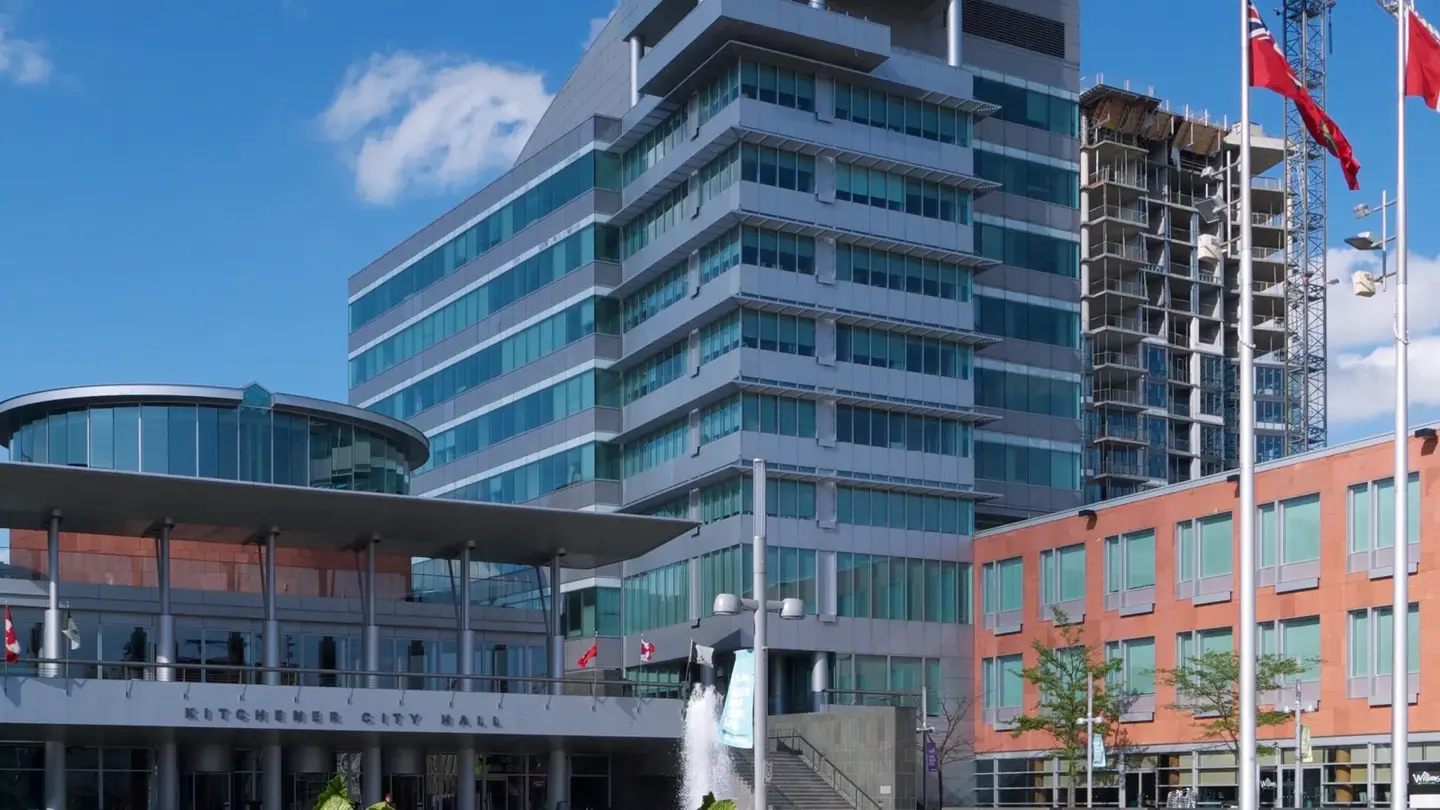
You run a business in Kitchener-Waterloo and you're ready to hand IT to specialists rather than patch it as it breaks. From our office at 22 Frederick Street in downtown Kitchener, NFD delivers full outsourced IT: named engineers, a 24/7 helpdesk, a 15-minute critical response target, and proactive cybersecurity, all on a fixed monthly agreement.
Need help now or looking for a Kitchener MSP to take IT off your plate? Tell us what's happening and we'll come straight back to you.
We respect your privacy. We won’t send you marketing you didn’t ask for.
Trusted by businesses across Kitchener, the KW tri-city, and North America
Your local NFD office
22 Frederick St, Suite 700, Kitchener, ON N2H 6M6
“NetFusion Designs has been our IT guru for several years now and they have proved themselves to be one of the best companies we’ve seen in a long time.”
“They rebuilt our environment which was aging and under-performing; the new environment was super fast and enabled us to scale our business.”
“They take the time to explain the how’s and why’s and do not assume everyone has the same IT brain — which I personally appreciate.”
Our Kitchener clients span the downtown core and the wider region — small and mid-sized businesses, Kitchener-Waterloo manufacturers, and professional services firms who just need IT that works. Some have one person stretched thin; most have nobody in-house. Either way, they want a local team that picks up the phone.
You have a growing team and nobody whose actual job is IT. Someone technical has been holding it together on the side, and that is no longer fair to them or safe for the business. We become your outsourced desk: Microsoft 365, device management, secure sign-on, and a real security baseline.
We deliverflat per-user managed IT, MFA and EDR on every endpoint, and a Kitchener IT support desk that answers in minutes when your whole team runs on laptops. Seemanaged IT services for the fixed-fee model.
You run a plant floor, a warehouse, or a shop where downtime stops shipments. You need networks that stay up, backups that actually restore, and a technician who can be on-site in Kitchener when something on the line goes down.
We deliver a bench of engineers, a virtual CIOwho runs quarterly business reviews, and Kitchener IT support that keeps production and the back office moving.
Accounting, legal, engineering, and financial firms in and around downtown Kitchener, where client data is sensitive and a slow Monday-morning login costs real billable hours. We handle endpoint hardening, clean offboarding, and access reviews that stand up to audits.
We deliveron-site dispatch from our downtown Kitchener base, documented change control, and compliance-ready security that stands up to client questionnaires and audits.
Most Kitchener business owners and ops leads searching for IT support don't yet know which buying model fits. Here is how the three models actually differ, side by side. If you want continuity for a growing team, only one column wins.
For most established Kitchener businesses, a managed retainer is the boring right answer. For a very small team, break-fix or a light retainer works. We won't upsell you into a contract you don't need.
A useful IT support agreement in Kitchener isn't just "call us when it breaks." This is what a competent MSP contract covers for a growing local team, in plain language.
People pick up. Tickets are logged, ranked, and routed by severity. First-touch resolution wherever possible, escalation with named owners when not. 24/7 for managed clients.
When you call, a technician who already knows your Kitchener setup answers — no phone tree, no re-explaining your environment. Critical issues get a 15-minute response target on managed plans, and every ticket is tracked to resolution with a named owner.
Learn more →Engineers roll from 22 Frederick Street in downtown Kitchener across the tri-city, typically a short drive. Same-day for most tickets, next-day guaranteed for standard requests.
Some problems need hands on the hardware. A technician rolls from 22 Frederick Street in downtown Kitchener to your office for failed switches, cabling, new-desk setups, and anything remote tools can't reach — same-day for most tickets.
Learn more →Endpoints, servers, network gear, and Microsoft 365 tenants monitored around the clock. Windows and third-party patch cycles managed on a documented schedule, tested before broad rollout.
Agents watch your endpoints and servers continuously and flag issues before staff notice them, so most problems are resolved before they interrupt work. Patches are tested and staged, not pushed blind, which keeps updates from breaking the tools your team depends on.
Learn more →MFA on every account, EDR on every endpoint, DNS filtering, phishing training, quarterly review. See cyber security & antivirus for the full stack.
Every client starts on the same hardened baseline: MFA enforced, EDR on all endpoints, DNS filtering, and ongoing phishing training. It closes the gaps attackers actually exploit and gives you a documented security posture for insurers and clients who ask.
Learn more →Tenant licensing, mailbox hygiene, SharePoint governance, and Teams rollout done properly. Details on the Microsoft 365 optimization page.
We manage the full Microsoft 365 tenant — licensing right-sized to headcount, mailbox and SharePoint permissions kept clean, and Teams configured for how your team actually works. You get the productivity without the licensing waste or the security holes of a neglected tenant.
Learn more →Immutable backups, off-site copies stored in Canada, and quarterly restore drills. Real recovery targets, not just "we have backups." See cloud backup & DR.
Backups are immutable and stored on Canadian soil, with restores tested on a schedule so recovery is proven, not assumed. If ransomware or hardware failure hits your office, you have real recovery-time targets instead of hoping the last backup worked.
Learn more →Quarterly business reviews, three-year technology roadmap, budget forecasting, and vendor negotiation. Virtual CIO services included with mid-market managed IT.
Beyond day-to-day support, you get a technology strategy: quarterly business reviews, a three-year roadmap, and budget forecasting so IT spend is planned, not reactive. It's the planning layer most small businesses never get from a break-fix provider.
Learn more →Every network diagram, admin account, license, and vendor contact captured in a maintained knowledge base. If we walk away tomorrow, the next provider can pick up where we left off. Most competitors won't tell you this — most don't have it.
Your entire environment — network diagrams, admin credentials, licenses, and vendor contacts — is documented and kept current, not locked in one technician's head. If you ever change providers, the next team can pick up cleanly, and you're never held hostage by undocumented infrastructure.
Learn more →Five stages, one named engineer, no round-trip to a call center.
Kitchener teams file most tickets between 8am and 6pm ET, with a spike right at 9am when everyone tries to log in at once. We staff to that curve. Critical incidents — a whole team locked out, a compromised endpoint — get a 15-minute response any hour of the day.
Numbers are contractual. The most common Sev-1 we see is an SSO or identity outage that locks a whole company out mid-morning — our on-call is paged within a minute and a human is engaged within fifteen.
Time from ticket open to a real engineer working the issue.
Cyber-insurance renewals, client questionnaires, and board risk reviews now ask for evidence, not adjectives. This is the security floor every managed IT client gets, and the audit trail behind it.
NetFusion Designs is independently audited to the SOC 2 Type 2 standard — trust services criteria across security, availability, and confidentiality. Not a checklist we filled out; a report a third party signs.
Multi-factor authentication is mandatory across Microsoft 365, VPN, admin consoles, and privileged internal systems. No exceptions, no long-term bypass tokens, no shared logins.
Endpoint detection and response with a 24/7 SOC watching the alert stream. Not signature-based antivirus — behavioural detection that catches things AV misses, with automated containment.
Immutable backups with Canadian data residency, tested by monthly automated restore and quarterly manual restore drills. If your backup has never been restored, you don't have a backup — you have a hope.
Annual tabletop and one live failover per managed client. Recovery time and recovery point objectives are documented per system, not guessed at during the incident.
Every configuration change to a production system goes through review and is recorded in the ticket. When something breaks at 11 p.m., we know what changed at 3 p.m.
On-site engineers dispatch from 22 Frederick Street in downtown Kitchener, right in the core. The tri-city is our home ground, not a satellite territory a Toronto MSP visits when a truck can be spared.
The Communitech and Tannery-corridor tenants, King Street offices, and the tech companies clustered around the downtown core. On-site engineers can be at the door the same day for anything the remote desk can't clear.
Manufacturers, warehouses, and trades along the expressway and in the city's industrial parks. We know the ground here — shift schedules, plant-floor networks, and after-hours deployment windows.
Uptown Waterloo, Cambridge Preston, Guelph, and the 401 corridor. Our Frederick Street office in Kitchener puts a technician within easy reach of any Waterloo Region address.
Half of our client base has people in Vancouver, Halifax, Toronto, or an EU timezone. Our helpdesk is 24/7, and endpoint policy applies the same at a coffee shop as at HQ.
Engineers dispatched from 22 Frederick Street cover the entire Waterloo Region and beyond.
Switching MSPs sounds painful. Done properly, it isn't. Here is the exact sequence from first call to steady-state operations — usually inside 30 days.
A working conversation, not a sales pitch. What's broken today, what's threatening to break, what's on the roadmap. We come back with a written summary and a rough scope inside three business days.
An engineer walks the environment — usually on-site at your Kitchener office — and inventories endpoints, servers, network, cloud tenants, and licensing. Deliverable: a documented current-state and a prioritised remediation list, useful for board reporting as well as internal planning.
Admin credentials rotated to our vaults, monitoring agents deployed, backups verified, MFA rolled out. Handover from your previous provider is coordinated so nothing lapses between the two of us — no dark days.
Helpdesk numbers published to your team, the SLA clock starts, and your first quarterly business review is booked with the vCIO. From day 31 onward, Waterloo IT support is on autopilot and you are back to shipping product.
Your staff should not have to remember a process in order to report a broken laptop. Four routes in, and every one creates the same ticket, in the same queue, with the same ownership.
On the phone, a person answers, and that person can begin working on the problem rather than taking a message for someone who can. The most common complaint we hear about a previous provider is not slowness — it is having to explain the same problem three times. By email, a ticket is created automatically with a reference, and replying to that acknowledgement adds to the existing ticket rather than opening a second one.
Covered devices carry a small support application: staff click it, describe the problem, and a technician can connect with permission and see what the user is seeing. Ad-hoc sessions for devices that are not covered use the tool on our remote support page. Where you run Teams, staff can raise a request from inside it, and for most office workers that becomes the default route within a fortnight.
One thing we ask. Route requests through the desk rather than to an individual technician’s mobile. Direct messages create work nobody else can see, cover, or escalate.
Every ticket is read and categorised on arrival, not when it reaches the front of a queue. Triage establishes what is affected, how many people are blocked, and whether it is a security matter — because a security matter leaves the standard queue immediately.
Nobody can work, or a critical system is unavailable. Everything else is put down.
One department cannot invoice, dispatch, or serve customers.
A degraded machine, a slow application, a failing peripheral.
A new starter, a mailbox change, a software installation, a permission adjustment.
Response and resolution targets against each band are written into your service agreement and reported monthly. No headline number appears on this page, for the reason given in the FAQs below.
A ticket has one named owner from the point it is triaged. If it needs a specialist, the specialist joins the ticket — the owner does not hand it over and stop caring. Tickets are closed when the person who raised them agrees they are fixed, not when the technician believes they are, and the closure note records what was actually wrong. That is what makes the pattern visible when the same fault turns up on four machines.
Ours is an ITIL certified service desk, which in day-to-day terms means incidents, requests, problems and changes are handled as four different things rather than all being called “a ticket”. That distinction sounds procedural until the third time the same fault appears and somebody has to decide whether to keep fixing it or find out why.
Technicians have your documentation open before they pick up: your environment, your standard build, your applications, and what has broken before. The desk is small enough that the same names recur, which is what allows someone to say “this is the third time on that switch”.
Where an issue exceeds first-line scope it moves to a senior engineer, and for infrastructure matters to the engineer who knows your environment. Escalation is triggered by the nature of the problem and by elapsed time, so a ticket cannot sit quietly with somebody who is stuck and does not want to say so.
Security alerts do not go into the general queue. Our Security Operations Centre runs separately and around the clock, because a compromised account is a containment exercise with a clock on it, not a support request. Our own handling of client data and access is covered by a SOC 2 Type 2 attestation — audited rather than self-declared. And where you have staff in Quebec, or francophone staff here, support is available in French — see bilingual technical support.
Most tickets are resolved remotely, and that is the faster outcome rather than the cheaper one — a technician connecting to a machine straight away beats one arriving in forty minutes.
Failed hardware and replacement swaps. Cabling and patching. A switch or firewall that has stopped responding to anything remote. New site builds and office moves. And the physical equipment that always turns out to be unplugged in a way nobody could see over a screen share.
We are at 22 Frederick St, Suite 700, in the downtown core — roughly ten minutes to uptown Waterloo, twenty to Cambridge, half an hour to Guelph. Short journeys rather than expeditions, which is the practical difference between a provider based here and one dispatching up the 401 from the GTA for an hour in each direction.
Emergencies get same-day attendance. Everything else is scheduled, usually grouping several jobs into one visit so your day is interrupted once rather than four times. Onsite attendance for covered sites is included in a managed agreement — see onsite IT support.
Home and hybrid workers are supported the same way as anyone at a desk. Two local details are worth stating. Staff out on the fringe — Baden, New Hamburg, Elmira, St. Jacobs, Wellesley, Ayr — are often on connections that behave nothing like the office link, and when a call drops or a file sync stalls the laptop is usually not the problem. Diagnosing that correctly the first time saves a wasted afternoon and an unnecessary drive in. And the morning after a storm closes the 401 or Highway 7 and 8, everybody works from home at once — which is the day a business discovers how much concurrent remote capacity it actually has. Better to know in advance than at 8:15 on a Monday.
A lot of Waterloo Region does not start at nine. Manufacturing, food processing, distribution and logistics run shift patterns that begin before six in the morning and change over mid-afternoon. An IT problem at 6:05am on a line that is starting up is not an after-hours inconvenience — it is the most expensive moment of the day to be stuck, and it falls well outside the hours any single internal person can reasonably hold. The desk is staffed around the clock, so a call at two in the morning reaches a person rather than a voicemail box checked at nine.
A business-down event. A suspected compromise or ransomware incident. A failed server. A connectivity loss at a site that is trading or running. One user with a slow laptop at nine on a Saturday evening is not an emergency, and we would rather say so here than have you discover the distinction during one.
Server reboots, firmware, major updates, migrations and cutovers are done outside working hours by design — and where you run shifts, “outside working hours” is a narrower window than most providers assume, so we set it against your actual pattern rather than a default Saturday night. Planned work carries a defined window and a stated fallback position.
Account administration is unglamorous and it is a large fraction of what any helpdesk actually does. It is also the thing most often left half-finished, and the half that gets skipped is always the leaver.
New starters are built from a checklist agreed with you: account, licence, security groups, machine build, applications, phone. Leavers run the same way in reverse on the date you specify — account disabled, sessions revoked, mailbox handled as instructed, licence released, machine collected.
Three times a year, in January, May and September, a large number of employers here turn over a meaningful share of their staff in the same fortnight. Co-op terms end and begin together. For a company running a dozen students that is a dozen builds and a dozen offboardings, twice a year — and it arrives as a wave rather than a trickle of individual tickets.
Handled casually, this is where an environment quietly rots. What we find on taking over is consistent enough to predict: licensed accounts belonging to people who left two intakes ago, a repository somebody still has access to, a personal laptop added to the network during a busy onboarding week and never removed.
So intake is treated as a scheduled operation rather than a queue of P4s. Machines are imaged and accounts provisioned before day one. The offboarding list runs on the last day of term whether or not anybody remembers to raise it. Licences come back, which is a recurring cost rather than a tidiness point. And a student returning for a second term is a restore rather than a rebuild.
Anything that changes the shape of your environment is a project rather than support: a server or firewall replacement, a Microsoft 365 tenant migration, an office move or a new site, a network redesign, rolling out a new line-of-business application. These are scoped and quoted separately, because project work done inside a support queue gets interrupted by support and both suffer. We flag that boundary as soon as we see it, rather than starting and raising the question halfway through.
Most Kitchener businesses under about eighty people have somebody who is not in IT but has become the person others walk over to when something breaks — an operations manager, a finance lead, or whoever was visibly competent with a computer in year one. They did not volunteer, they are interrupted constantly, and none of it appears in their job description. The change after a helpdesk is onboarded is that this person gets their own job back. If that describes somebody at your company, they should be on the first call.
Staff get one place to report a problem and an acknowledgement that confirms it landed. They are asked what they were doing when it broke rather than told to turn it off and on again by somebody who has not looked. Managers get monthly reporting: ticket volume, what the tickets were actually about, and how they were distributed. Recurring categories point at a fixable cause rather than a run of bad luck, and a business paying every month is entitled to see whether the underlying number is going down.
Three quotes from managed IT clients who let us paraphrase what happened. Names redacted at their request — the specifics are real.
“We went from 20 to 90 people in eighteen months and NFD kept the wheels on. They understand what a growing Kitchener company feels like from the inside — nobody had to explain what a co-op cohort onboarding looks like.”
“Response time is the thing. Our head of eng used to burn Fridays on printer questions. Now his Slack DMs are quiet and tickets close in the SLA window. That's the whole pitch.”
“The transition off our previous MSP took two weekends and one all-hands. Runbooks were readable, RMM was clean, and there was no orphaned admin account left behind. Painless is not a word I usually use for IT migrations.”
A quick reference for Kitchener businesses working with technology partners in the region.
Kitchener-Waterloo's technology sector has one distinctive procurement pattern: SaaS founders and post-Series-A companies are asked about SOC 2 by their enterprise customers long before they have the security team to answer. That question typically arrives during a late-stage sales cycle, when the customer's vendor security review lands on the founder's desk with a two-week response window. The MSP is one of the fastest paths to closing that finding.
When your enterprise customer asks about your IT infrastructure, working with a SOC 2 Type II attested MSP means you can hand over the MSP's report and answer a substantial portion of the questionnaire directly. That is faster and cheaper than committing to your own SOC 2 audit before you have to.
For KW SaaS companies preparing for their own SOC 2 audit, a SOC 2 attested MSP is also a shortcut through vendor management controls — one of the categories your own auditor will test. If the MSP is already attested, the vendor management workpaper writes itself.
Access controls, endpoint protection, backup, incident response, change management, and vendor coordination are all inside the audit scope. Those are the same categories the enterprise customer's vendor security team asks about. NFD delivers the report and a mapping to the specific questions on the questionnaire under NDA, typically within one business day of the request.
US enterprise buyers do not distinguish between Canadian and US SOC 2 attestations — the AICPA standard is the same. What they distinguish is Type I versus Type II, and aligned versus attested. NFD's Type II report meets the bar those buyers set.
Early-stage founders often outsource IT to save the internal hire. Post-Series-A companies often outsource to get depth and 24/7 coverage they cannot yet staff. NFD serves both, and the SOC 2 attestation is the same either way. As the company grows, the operating baseline scales without a re-platform.
Waterloo Region hosts more than SaaS. Insurance carriers, insurance-tech firms, wealth management practices, healthcare clinics, and export-focused manufacturers all operate in Kitchener-Waterloo, and each carries its own compliance overlay.
The Personal Information Protection and Electronic Documents Act is the federal baseline for handling personal information across Canada. For most KW businesses, PIPEDA is the operative statute for customer, prospect, and employee data. Its safeguards principle expects security measures appropriate to the sensitivity of the information.
Kitchener and Waterloo's medical practices, physiotherapy clinics, dental groups, and mental health providers are health information custodians under PHIPA. The Ontario Information and Privacy Commissioner publishes guidance that reaches through the custodian to their IT provider.
KW's insurance industry — brokers, MGAs, insurtech platforms, and carriers with regional operations — operates under FSRA in Ontario and, for federally regulated insurers, under OSFI. Both regulators expect documented IT controls, tested incident response, and vendor risk management. The SOC 2 report speaks to all three.
Beyond regulators, KW's SaaS founders face compliance pressure from their customers. Enterprise buyers in the US, UK, and EU send vendor security reviews that ask about IT provider controls. NFD's Type II report answers the vendor review directly.
KW SaaS companies serving Canadian federal-government or provincial-government customers face data-residency requirements. Backups and monitoring data reside in Canadian-region infrastructure by default at NFD, which means the residency question does not require re-platforming after a government sale.
NFD's headquarters at 22 Frederick Street, Suite 700, sits in downtown Kitchener, a few minutes from the Communitech Hub, the Accelerator Centre, and the concentration of SaaS companies in the King-Belmont corridor. That location is not incidental. It is where our engineers work and where our KW clients are.
Downtown Kitchener, uptown Waterloo, the University of Waterloo research parks, and the R+T Park cluster are all within a same-day onsite window from Frederick Street. For a Communitech-based startup that needs an engineer onsite to remediate a security incident before a customer call, the response is measured in minutes, not scheduled days.
Many of our KW clients came to NFD through the Communitech and Accelerator Centre ecosystems. We understand the funding cycles, the growth pressures, and the compliance timeline SaaS companies face as they scale from seed round to Series B and beyond. Our operating baseline is designed to scale with the company rather than require a re-platform at each stage.
The engineers working out of the Frederick Street office are KW-based. They know the vendor landscape locally — the telecoms, the Microsoft partners, the cybersecurity boutiques, the co-working operators — and they navigate it without needing a rolodex.
NFD's KW book covers the categories where a written SLA, a named engineer, and SOC 2 attestation are the difference between winning and losing enterprise business.
Kitchener-Waterloo's SaaS companies — from Communitech-founded startups to Series-B growth-stage firms — are the largest segment of our KW book. The typical engagement includes 24/7 monitoring, endpoint security, cybersecurity stack, backup, and SOC 2 vendor evidence to close enterprise sales cycles.
KW's concentration of insurance carriers, brokers, and insurtech platforms brings a distinctive compliance profile: FSRA and OSFI expectations, US customer contracts, cybersecurity underwriting scrutiny, and a heavy dependence on the reliability of the platform during renewal cycles.
KW accounting firms handle client tax data, financial statements, and audit workpapers on the same busy-season load pattern as their counterparts in Toronto. Independent wealth managers and financial advisory practices carry the same regulatory overlay — CIRO, OSC, cyber-insurance requirements, and institutional client due diligence.
KW's medical practices, physiotherapy chains, dental groups, and mental health clinics operate under PHIPA and are subject to Ontario IPC oversight. NFD's privacy and confidentiality controls, immutable backups, and incident response process align with the safeguards custodians are expected to have in place.
Waterloo Region's manufacturing base includes firms that export to the US and Europe. Export customers routinely send security questionnaires that ask about IT controls. NFD's audit closes those questionnaires without forcing the manufacturer into a SOC 2 audit of its own.
Consultancies, engineering firms, architecture and design practices, and marketing agencies with sizable client rosters hold significant client and personal information. KW non-profits and foundations increasingly face donor-privacy expectations similar to the private sector. NFD serves both segments on the same operating baseline.
Common questions from Kitchener business owners, ops leads, and finance leaders evaluating an MSP. If yours isn't here, ask us directly — we'll answer in writing.
Yes. Ad-hoc and hourly support is a real option and plenty of clients start there — see IT support. What it does not include is the monitoring, patching and preventative work that stops tickets being raised at all. The comparison sits on our managed IT services page.
Yes — 22 Frederick St, Suite 700, in the downtown core. Remote support is unaffected by geography, but onsite attendance across Waterloo Region is dispatched from that office, and we would rather state where we are than imply a presence everywhere.
Critical, business-down issues carry a 15-minute response target. The remaining priority bands are set in your service agreement and reported against each month. We publish that one figure with the priority definition attached, because a number quoted without a scope behind it is not a commitment to anything.
Largely, yes. Your account has a named team who hold the context. Around-the-clock and holiday coverage means it will not be the same individual every time, which is why the documentation matters.
Yes. The desk is staffed around the clock, and where you run shifts we set the escalation path against your pattern rather than against office hours — including who on your side can authorise what at five in the morning, when the usual approver is asleep.
We take it on. Dealing with a line-of-business vendor, an internet provider or a telephone carrier on your behalf is part of the service, and it saves your staff sitting in somebody else's support queue describing a technical problem they did not cause.
Contact the desk immediately and say exactly that. Nobody here is interested in blame, and delay is the only thing that makes it materially worse. The account is contained first and investigated second. Reporting a phishing email that turns out to be harmless is always the right call — we would rather field ten of those than miss one.
Tell us where your Kitchener business is and what's happening. Whether you need same-day IT support, a scoped project, or a full MSP handover, we'll come back with a written recommendation — not a sales sequence.
22 Frederick Street, Suite 700, Kitchener ON N2H 6M6 · +1 (647) 476-5259 · Mon-Fri 8am-6pm, managed clients 24/7.
We reply within one business day. We do not share your data.
%20(1).avif)
%201.avif)





