The ten emerging new IT technologies that matter most right now are: agentic AI, AI security, physical AI, hybrid cloud infrastructure, edge computing, quantum-safe cryptography, digital twins, AI-driven automation, extended reality (XR), and DNA/next-generation data storage. Forrester’s 2026 emerging technology report frames this list around a decisive shift: AI is no longer experimental. It is moving into physical environments, autonomous workflows, and the security stack itself.
Here is why each one belongs on your radar:
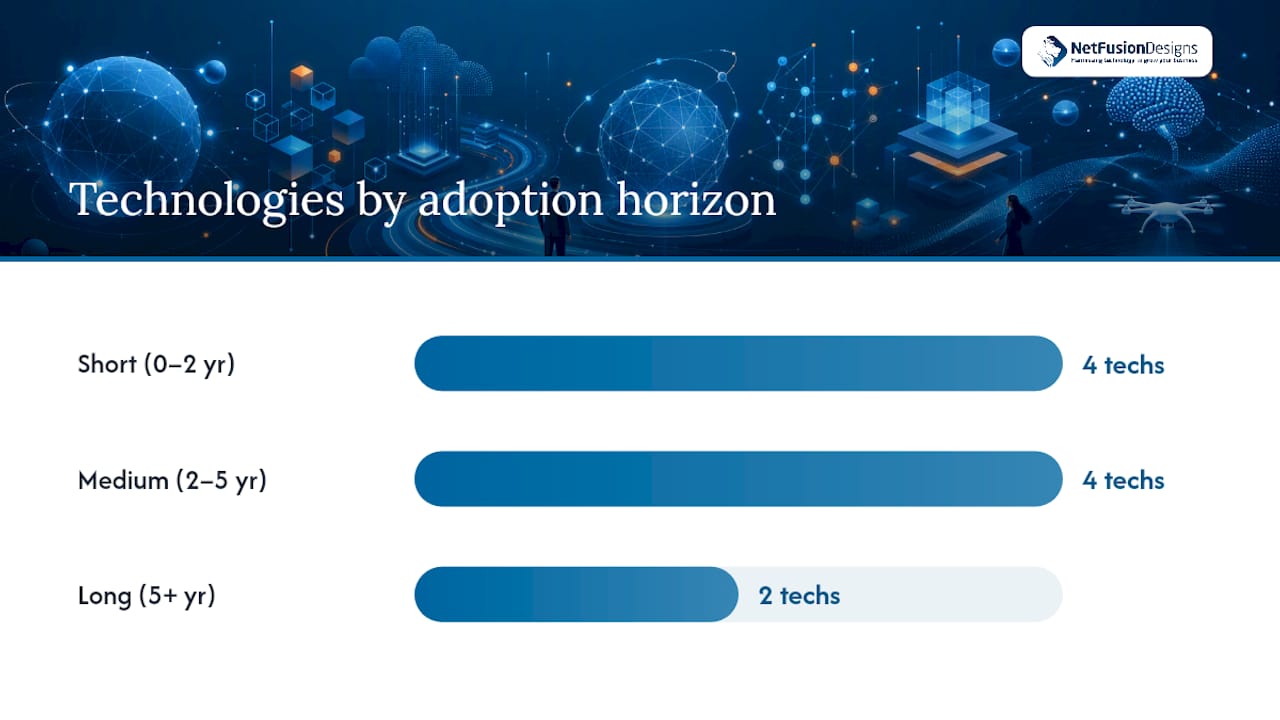
Not every technology on this list deserves your budget today. The most useful lens is adoption horizon: how long before a technology delivers measurable enterprise ROI, and what does “ready” actually mean at each stage?
Short-term (0–2 years) means the technology is past proof-of-concept, has enterprise-grade tooling available, and early adopters are already reporting productivity or cost gains. Your pilots should be running now, not planned.
Medium-term (2–5 years) means the technology is maturing but still requires significant integration work, skills investment, or standards development before it scales reliably. Budget for experimentation and skills-building, not full deployment.
Long-term (5+ years) means the technology is strategically important but not yet production-ready for most enterprises. Watch it, fund small research bets, and build awareness in your architecture team.
| Technology | Horizon | Expected ROI window | Typical enterprise use case |
|---|---|---|---|
| Agentic AI | Short (0–2 yr) | 0–2 years | Automated customer service, procurement workflows |
| AI security | Short (0–2 yr) | 0–2 years | Threat detection, identity attack response |
| AI-driven automation | Short (0–2 yr) | 2–5 years | Finance reconciliation, IT ops, HR onboarding |
| Hybrid cloud infrastructure | Short (0–2 yr) | 2–5 years | Cost-optimised AI inference, data residency compliance |
| Edge computing | Medium (2–5 yr) | 2–5 years | Manufacturing quality control, retail analytics |
| Digital twins | Medium (2–5 yr) | 2–5 years | Predictive maintenance, supply-chain simulation |
| Extended reality (XR) | Medium (2–5 yr) | 5+ years | Remote technician training, product design |
| Physical AI | Medium (2–5 yr) | 5+ years | Warehouse robotics, autonomous inspection |
| Quantum-safe cryptography | Long (5+ yr) | 5–10 years | Data-at-rest protection, PKI infrastructure overhaul |
| DNA/next-gen data storage | Long (5+ yr) | 10+ years | Cold archival storage, genomic data repositories |
Deloitte’s Tech Trends research reinforces the hybrid infrastructure point: organisations moving from cloud-first to a strategic hybrid model — cloud for variable workloads, on-premises for consistent AI inference, and edge for latency-sensitive applications — are controlling costs in ways that pure-cloud strategies cannot match.
The QuickBooks 2026 AI Impact Report finds roughly 7 in 10 businesses now use AI regularly, yet productivity and revenue gains remain uneven. The gap between adopters who see returns and those who do not almost always comes down to whether they matched the technology to the right horizon and use case.
Agentic AI refers to systems that can set sub-goals, call external tools, and complete multi-step tasks with minimal human intervention. Unlike a chatbot that answers a single question, an agent can research a topic, draft a document, send an approval request, and update a CRM record in one uninterrupted run. Maturity is high for narrow, well-defined workflows; lower for open-ended, high-stakes decisions. Enterprise use cases include procurement automation, IT ticket triage, and customer onboarding. Integration note: agents require access to internal APIs and data stores, so data governance and access controls must be in place before deployment.
AI security uses machine learning models to detect anomalies, correlate signals across endpoints and identity systems, and respond to threats faster than any human SOC analyst can. MSSP Alert’s 2026 analysis identifies this as a services turning point: buyers now demand demonstrable risk reduction, pushing providers toward integrated managed detection and response backed by AI-driven automation. Maturity is high for endpoint detection and response (EDR) and identity threat detection and response (ITDR). Procurement signal: look for SOC 2 Type II certification and documented model governance controls in any vendor’s security stack.
Physical AI embeds intelligence into robots, drones, and industrial sensors. The technology moves AI decision-making out of data centres and into the physical world, enabling autonomous inspection, warehouse picking, and precision agriculture. Maturity is medium; most production deployments are in controlled environments like manufacturing floors and logistics warehouses. Integration with existing operational technology (OT) networks is the primary challenge, and it requires careful network segmentation to avoid exposing OT systems to IT-side threats.
Hybrid cloud is not a new concept, but the 2026 version is more deliberate. Organisations are no longer defaulting to “cloud-first.” They are placing workloads strategically: variable or bursty AI training jobs go to public cloud, consistent inference workloads run on-premises to control per-token costs, and latency-sensitive tasks run at the edge. Maturity is high. The integration challenge is orchestration: managing workloads across three environments requires unified observability and policy enforcement tools.
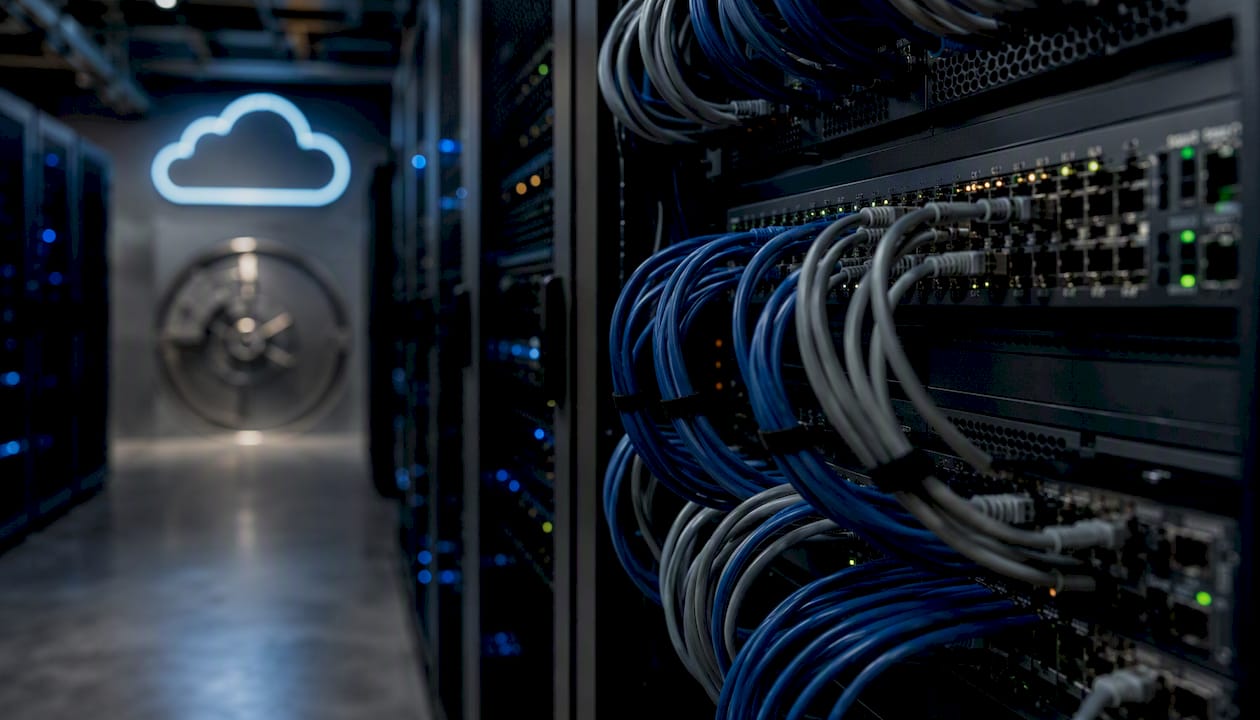
Edge computing processes data at or near the source rather than sending it to a central data centre. For a manufacturer running computer vision quality checks at 60 frames per second, sending every frame to the cloud is both too slow and too expensive. Edge nodes handle the inference locally. Maturity is medium; the hardware ecosystem is maturing quickly, but operational management of distributed edge fleets remains complex. Enterprises in retail, healthcare, and manufacturing are the primary early adopters.
Quantum computers, once they reach sufficient scale, will be able to break the RSA and ECC encryption algorithms that protect most enterprise data today. Quantum-safe (or post-quantum) cryptography replaces those algorithms with ones that resist quantum attacks. The U.S. National Institute of Standards and Technology (NIST) finalised its first post-quantum cryptography standards in 2024, giving enterprises a concrete migration target. Maturity is early for enterprise deployment but the planning window is now: data encrypted today can be harvested and decrypted later once quantum capability arrives, a threat known as “harvest now, decrypt later.”
A digital twin is a real-time virtual model of a physical asset, process, or system, fed by live sensor data. Manufacturers use them to simulate equipment failures before they happen. Supply-chain teams use them to model disruption scenarios. Maturity is medium-to-high in asset-intensive industries; lower in services. The integration requirement is a reliable data pipeline from physical sensors to the modelling environment, which often means upgrading legacy OT instrumentation.
AI-driven automation goes beyond traditional robotic process automation (RPA) by learning from data rather than following hard-coded rules. It can handle unstructured inputs like invoices in varied formats, emails with ambiguous intent, and handwritten forms. Maturity is high for document processing and IT operations; medium for more complex judgment-intensive workflows. Most enterprise deployments start with finance, HR, and IT ops because those functions have high-volume, repetitive tasks with clear success metrics.
XR covers augmented reality (AR), mixed reality (MR), and virtual reality (VR). Enterprise use cases are more practical than consumer ones: remote technician guidance overlaid on physical equipment, immersive safety training, and 3D product design review. Maturity is medium; hardware costs have dropped significantly, but content creation and device management at scale remain friction points. Regulated industries like healthcare and energy are moving fastest because the training ROI is clearest.
Microsoft’s research into DNA-based storage illustrates where long-horizon infrastructure R&D is heading: a single gram of DNA can theoretically store exabytes of data with a shelf life measured in thousands of years. This is not a near-term enterprise procurement decision. It is a signal that the economics of cold archival storage will shift dramatically over the next decade, with implications for organisations managing genomic data, media archives, and long-retention regulatory records.
Adopting these technologies without a governance framework is where organisations get hurt. The risk profile is not uniform across the list, but several threats cut across almost all of them.
AI model risk is the most immediate. Models trained on biased or incomplete data produce outputs that can expose organisations to regulatory liability, especially in hiring, lending, and healthcare. Model cards, audit trails, and human-in-the-loop checkpoints are not optional extras; they are procurement requirements.
Data leakage is a close second. Agentic AI systems that have broad API access can exfiltrate sensitive data if access controls are not scoped tightly. The principle of least privilege applies to AI agents just as it does to human users.
Identity attacks are accelerating. AI-generated phishing, deepfake voice calls, and credential-stuffing attacks are all becoming cheaper to execute. Multi-factor authentication (MFA) and ITDR tools are the baseline response.
Supply-chain risk affects every organisation that relies on third-party AI models, cloud APIs, or edge device firmware. A compromised model or a malicious update pushed to edge nodes can propagate damage faster than traditional malware.
Quantum-related cryptography threats are a longer-fuse risk but one that requires action now. The “harvest now, decrypt later” attack vector means sensitive data encrypted today is already at risk if quantum capability arrives within the next decade.
Statistic callout: The OECD’s emerging technologies policy framework notes that governments and organisations worldwide are actively developing governance structures for emerging technologies precisely because the pace of adoption is outrunning existing regulatory frameworks.
Practical procurement checklist:
The honest answer is that most organisations try to do too much at once and end up with a collection of disconnected pilots that never reach production. A priority matrix cuts through that.
| Technology | Business value | Adoption risk/cost | Recommended action |
|---|---|---|---|
| AI-driven automation | High | Low | Pilot now — high ROI, low integration complexity |
| AI security | High | Low | Deploy now — immediate risk reduction |
| Agentic AI | High | Medium | Structured pilot with guardrails |
| Hybrid cloud infrastructure | High | Medium | Architecture review and phased migration |
| Edge computing | Medium | Medium | Targeted pilot in one operational area |
| Digital twins | Medium | High | Proof-of-concept in asset-intensive function |
| Extended reality (XR) | Medium | Medium | Training use case pilot |
| Physical AI | Medium | High | Monitor; pilot only if OT environment is ready |
| Quantum-safe cryptography | High (long-term) | Low (planning) | Start NIST migration assessment now |
| DNA/next-gen storage | Low (near-term) | Low (monitoring) | Watch; no budget commitment yet |
Vendor and partner evaluation: what procurement should require
This is the question most small and mid-sized businesses get wrong. The instinct is to build in-house to “own” the capability. The reality, as Business Insider’s reporting on SME AI adoption shows, is that surprise costs and skills gaps derail more in-house AI projects than any technical limitation.
Thryv’s 2026 small-business AI adoption report confirms the pattern: AI adoption among small firms is rising quickly, but the skills and training gaps are just as real as the productivity gains. The organisations that capture value fastest are those that pair a managed provider with a clear internal champion, not those that try to staff up a full AI team from scratch.
MIP vs. build-in-house decision checklist:
Choose a Managed Intelligence Provider (MIP) if:
Build in-house if:
AI-led transformation is the defining IT priority of 2026, and the organisations that capture value fastest are those that match each emerging technology to the right adoption horizon, governance framework, and delivery model.
| Point | Details |
|---|---|
| Match technology to horizon | Short-term bets (AI security, automation) should be in pilot now; long-term bets (quantum-safe crypto) need planning, not deployment. |
| Governance before deployment | Require SOC 2 Type II, data residency clauses, and model governance controls from every AI vendor before signing. |
| SME skills gap is real | Most small firms lack the in-house AI/ML talent to build and maintain production systems; a managed provider closes that gap faster. |
| Hybrid infrastructure wins on cost | Strategic placement of workloads across cloud, on-premises, and edge consistently outperforms pure-cloud on AI inference costs. |
| NetFusion Designs Inc as MIP | NetFusion Designs Inc provides SOC 2 Type II–certified managed AI enablement, 24/7 NOC, and pilot-to-production support for SMEs across Ontario and Canada. |
Most articles about emerging technology trends focus on what the technologies can do. The harder question is what they will cost you if you get the adoption sequence wrong.
Here is what gets overlooked: the organisations that struggle most with new IT technologies are not the ones that move too slowly. They are the ones that move at the wrong layer. They deploy an AI automation tool before they have clean data. They adopt edge computing before they have OT network segmentation. They sign a three-year AI platform contract before they have a governance policy. The technology works fine. The context around it does not.
The shift Deloitte describes — CIOs moving from technical support roles to AI evangelists who must guarantee security and trust across data, models, and infrastructure — is real, but it understates the pressure on smaller organisations. A mid-sized business in Ontario does not have a CISO, a data governance team, and an AI ethics board. It has an IT manager, a tight budget, and a board that read something about AI in a trade publication.
That is not a criticism. It is the actual operating reality for the majority of Canadian SMEs. And it is precisely why the MIP model matters more than any individual technology on this list. The technology is not the hard part. Deploying it safely, governing it continuously, and scaling it without creating new security debt — that is where most organisations need help.
The OECD’s governance work on emerging technologies makes the same point at a policy level: adoption is outrunning governance everywhere, not just in small businesses. The difference is that large enterprises have the resources to catch up. SMEs need a partner who has already built the governance infrastructure and can extend it to them.
Keeping pace with the latest IT innovations is one thing. Deploying them without creating new security debt or compliance gaps is another challenge entirely. NetFusion Designs Inc is built for exactly that gap: a SOC 2 Type II–certified Managed Intelligence Provider that takes SMEs from technology curiosity to production deployment, without the hidden costs that derail in-house projects.
Here is what that looks like in practice:
NetFusion Designs Inc serves businesses across Ontario and Canada, with teams in Kitchener-Waterloo, Toronto, Markham, Mississauga, Montréal, and Winnipeg. If you are ready to move from planning to a structured pilot, talk to the NetFusion Designs Inc team about where to start.
These are the primary sources behind this guide. Each one is worth bookmarking if you are tracking emerging technology trends for enterprise planning.
Forrester — The Top 10 Emerging Technologies In 2026: Forrester’s annual shortlist categorises technologies by short, medium, and long-term impact horizons. The 2026 edition marks the shift from AI experimentation to agentic and physical AI as the dominant near-term priorities.
Deloitte — Tech Trends: Deloitte’s practitioner-level research covers hybrid infrastructure strategy, the human-agent operating model, and the evolving role of the CIO as an AI trust guarantor. Useful for enterprise architecture and leadership planning.
MSSP Alert — Why 2026 Is a Turning Point for MSP Cybersecurity: Industry analysis of how managed security providers are shifting toward integrated, AI-driven detection and response models. Relevant for procurement decisions and managed security evaluation.
QuickBooks/Intuit — 2026 AI Impact Report: Canadian-market data on AI adoption rates, productivity impacts, and governance barriers across businesses of all sizes. The Canadian edition is particularly relevant for Ontario-based decision-makers.
Thryv — AI for Small Business: 2026 AI Adoption Report: Small-business-focused adoption data covering skills gaps, training needs, and the pace of AI uptake among firms with fewer than 50 employees.
Microsoft News — Hello data: DNA storage: Microsoft’s own reporting on its DNA storage research programme. A useful reference for long-horizon infrastructure planning and the future of cold archival storage.
OECD — Emerging technologies: The OECD’s policy-oriented framework for monitoring and governing emerging technologies. Relevant for compliance and regulatory planning, particularly for organisations operating in regulated sectors.
Business Insider — AI transforms small businesses, but challenges persist: Real-world SME case studies showing where AI delivers results and where surprise costs and skills gaps create adoption friction. Useful for building a realistic business case.
Forrester’s 2026 emerging technology report identifies agentic AI, AI security, and physical AI as the near-term priorities, with hybrid cloud infrastructure, edge computing, and digital twins following in the medium term. Quantum-safe cryptography and DNA storage are longer-horizon bets that require planning now.
Emerging technologies in IT are those that are past early research but not yet widely deployed at enterprise scale, meaning they carry higher adoption risk but also higher competitive upside for early movers. The OECD defines emerging technologies as those whose development and governance structures are still actively forming, which is why monitoring and policy frameworks matter as much as the technology itself.
SMEs with fewer than 50 IT staff, no dedicated AI engineer, or compliance requirements they cannot meet quickly are almost always better served by a Managed Intelligence Provider. Thryv’s 2026 small-business AI report shows that skills and training gaps are the most common barrier to SME AI adoption, and a managed provider closes that gap without the hiring timeline.
“Harvest now, decrypt later” refers to adversaries collecting encrypted data today with the intention of decrypting it once quantum computing reaches sufficient scale. It means sensitive data you encrypt with current RSA or ECC algorithms is already at risk over a long enough time horizon, which is why NIST’s post-quantum cryptography standards are a planning priority now, not a future concern.
NetFusion Designs Inc is a SOC 2 Type II–certified Managed Intelligence Provider that supports SMEs across Ontario and Canada through structured AI pilots, managed cybersecurity, 24/7 NOC coverage, and AI workforce training. The managed model means clients get enterprise-grade governance and security controls without building that infrastructure from scratch.
%20(1).avif)
%201.avif)