Run a portfolio inventory with live dependency mapping first, score every application on business value against technical health, then assign each one a modernization path using the 7 Rs framework before touching code. Modernize in waves, funding harder refactors with quick wins from retirements and rehosts. Most well-run programs see measurable risk reduction and cost recovery within two to three waves, not one big rewrite.
TL;DR:
- Most modernization programs achieve risk reduction and cost recovery within two to three waves, not after a single rewrite.
- Proper discovery and dependency mapping, including live telemetry and AI tools, are critical to avoid dependency breaches and costly errors.
- Using the 7 Rs framework ensures applications are classified accurately, preventing unnecessary rebuilds or risky rehosts.
- Structuring data migration with techniques like Change Data Capture and staged cutovers minimizes disruption and maintains data consistency.
- Effective governance, stakeholder communication, and a cross-functional team support success and help prevent organizational resistance.
The right approach is portfolio-first, not project-first. Too many IT leaders pick a single flashy application, throw a rebuild team at it, and call that “modernization.” That’s backward. A defensible legacy app modernization approach starts by scoring your entire application estate, then deciding, app by app, whether it should be retired, rehosted, refactored, or replaced.
This is where the 7 Rs decision framework earns its reputation as the industry standard. It gives you seven distinct verdicts instead of one default answer, and it forces the conversation your organization has probably been avoiding: some of these applications shouldn’t be modernized at all.
Retire applications with no active users or duplicated functionality. You’d be surprised how many production systems fall into this bucket once someone actually checks the logs.
Retain applications that are stable, low risk, and cheap to run as-is. Not everything needs attention just because it’s old.
Rehost (lift-and-shift) moves an app to new infrastructure with minimal code change, usually for a quick infrastructure cost win.
Replatform shifts the runtime (say, moving a database to a managed cloud service) while keeping the application logic largely intact.
Refactor/Rearchitect restructures the code itself, often to move from a monolith toward services aligned with composable, API-first design.
Repurchase swaps the custom application for a commercial product (SaaS or COTS) that does the same job.
Rebuild rewrites the application from the ground up on modern architecture, reserved for cases where the business logic itself has fundamentally changed.
A scoring matrix turns this from opinion into method. A payroll system with high business value and reasonable technical health scores a Refactor. A dead internal reporting tool with low value and high technical debt scores a Retire. A 7 Rs analysis run properly on 40 to 60 applications typically sorts them into all seven buckets within a week or two.
Pro Tip: The most common mistake is defaulting to Rehost for everything because it’s the fastest to execute. Rehosting a poorly architected monolith just moves your technical debt to a more expensive cloud bill.
You can’t score what you haven’t measured, and you can’t safely modernize what you haven’t mapped. This sequence protects you from the single most expensive mistake in legacy system upgrade strategies: breaking a dependency nobody documented.
1. Build the inventory. For every application, capture owner, runtime environment, integration points, monthly run cost, compliance weight, and business criticality. Treat this like an audit, not a survey. Systems with unknown owners are a red flag on their own.
2. Map dependencies live, not statically. A dependency diagram drawn eighteen months ago is fiction by now. The operational standard in 2026 is closer to a live digital twin, pulling runtime telemetry, network flow data, and configuration state to keep the map current automatically.
3. Pull telemetry from the right sources. Network flow logs, application performance monitoring, database query logs, and API gateway traffic all reveal dependencies that documentation misses entirely.
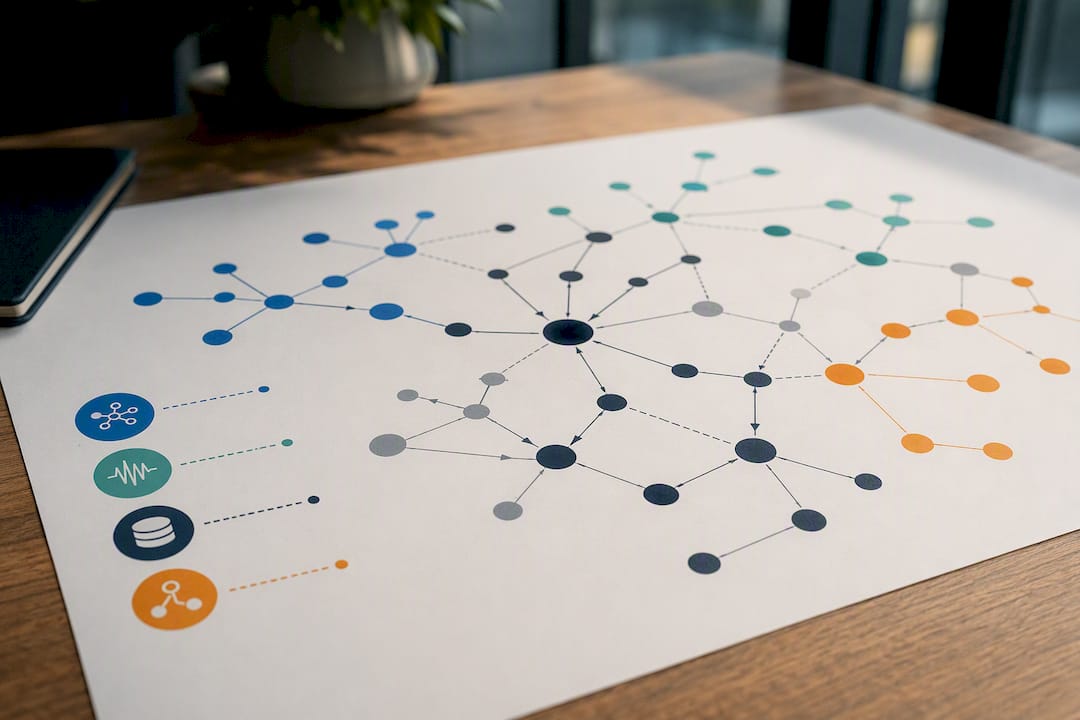
4. Let AI agents accelerate the grunt work. Discovery used to take weeks of manual tracing through code and interviews. AI-assisted mapping and characterization tooling now materially shortens that phase, letting teams reach a defensible R decision faster.
5. Select pilots that fund the program. Choose one or two applications with clear business value, contained blast radius, and a realistic timeline. A successful pilot generates the internal credibility (and often the cost savings) that pays for the harder refactors later.
Dependency mapping is also where governance conversations get real. If your billing system talks to fourteen downstream services and three of them are undocumented, that application is not a Rehost candidate no matter how tempting the timeline looks. This is the step most rushed modernization programs skip, and it’s the step that determines whether your later waves succeed or blow up in production.
An enterprise consulting engagement built around portfolio health checks typically front-loads this discovery work precisely because skipping it is where budgets get destroyed.
Four execution patterns cover most real-world legacy application transformation techniques, and each fits a different risk profile.
The mechanics that make these safe are consistent across all four: an API gateway or facade to control traffic routing, feature flags to control exposure, idempotent writes so retries don’t duplicate transactions, and staged rollout percentages (5%, then 25%, then 100%) rather than an all-or-nothing switch.
Pro Tip: Idempotent writes are the detail teams forget until a network blip causes a duplicate payment. Build for retries from day one, not after the first incident.
A practical example: an insurance claims platform on Replatform used CDC to stream policy data into a new managed database while the legacy mainframe kept processing claims, cutting over only after three weeks of matched output. That’s the strangler fig philosophy applied to data instead of code, and it’s a technique worth borrowing regardless of which R you’ve assigned.
A wave is a bounded batch of applications moving through discovery, build, parallel run, and cutover together, usually four to eight weeks depending on complexity. Waves exist so that governance has a checkpoint instead of an open-ended program with no accountability.
Reporting should lean on DORA metrics: deployment frequency, change-failure rate, lead time for changes, and mean time to recovery. Add cost per transaction as a business-facing signal executives actually understand. Continuous modernization with regular wave reviews, rather than a single annual roadmap review, keeps the program honest and catches drift before it compounds.
Governance cadence matters more than governance depth. A 30 minute biweekly wave review with the CIO sponsor, platform owner, and SRE lead catches more problems than a quarterly steering committee ever will.
Data consistency failures are the most expensive and most avoidable risk in the entire program. Dual-write patterns without idempotency checks create silent duplicate or lost transactions, and they rarely surface until a customer complains. Build reconciliation windows into every CDC pipeline and require idempotent write keys on every dual-write integration before it ships.
Pro Tip: If your vendor contract or internal SOW doesn’t name an exit criterion, assume the project has no defined finish line. That’s how modernization budgets quietly triple.
NetFusion Designs Inc is SOC 2 Type II certified, which matters here because modernization work touches production data and compliance posture directly, not just code. A managed migration approach that treats security controls as part of the plan, not an afterthought, changes how much risk a decommission actually carries.
One reference point is the Youth Employment Services server modernization, where an aging on-premises server environment was assessed, mapped, and migrated in stages rather than swapped out in one cutover window, reducing operational disruption for a nonprofit that couldn’t afford downtime.
That kind of engagement tends to follow a reusable five-step checklist worth borrowing regardless of who runs your program:
Modernization programs fail organizationally more often than they fail technically. A finance team that finds out its reporting tool is being retired three weeks before cutover will fight the whole program, regardless of how sound the architecture is.
Build a stakeholder map alongside your application inventory. For every application in scope, identify the business owner, the end users, and anyone downstream who depends on its output. Brief them before the wave starts, not after the pilot succeeds.
A short, recurring communication cadence works better than a single kickoff announcement. Monthly updates that name which applications are moving, when, and what changes for end users keep trust intact. Silence between updates is what breeds resistance, not the change itself.
Executive sponsorship needs to be visible, not just funded. A CIO who shows up to wave reviews signals that modernization is a business priority, which makes it far easier for product owners to reprioritize their own teams’ time toward migration work instead of quietly deprioritizing it.
Give business stakeholders a way to raise concerns before cutover, not after. A simple intake form or office hours slot during each wave catches objections while there’s still time to adjust the plan, rather than during an escalation after something breaks.
The strongest modernization teams pull from four roles: a platform owner who understands the target architecture, a product owner who represents business priorities, an SRE who owns operational risk, and a data engineer who owns migration integrity. Skipping any one of these creates a predictable failure pattern.
Without an SRE embedded from the start, rollback plans get written as an afterthought and tested for the first time during an actual incident. Without a data engineer, reconciliation problems surface in production instead of during parallel run.
Keep the core team small, five to eight people per wave, and rotate in application-specific specialists as needed rather than building one enormous standing team. A large permanent modernization team tends to develop its own momentum disconnected from what the business actually needs next.
Weekly stand-ups work for build execution, but wave-level decisions (go/no-go on cutover, exit criteria sign-off) deserve a separate, less frequent forum with the CIO sponsor present. Mixing daily tactical updates with strategic go/no-go decisions slows both down.
Reward decommissioning as much as launching. Teams that get recognition only for shipping new systems have no incentive to finish the unglamorous work of shutting down the old one, which is exactly how permanent hybrid states happen.
The wave isn’t finished when the legacy system goes dark. Post-cutover monitoring for the first stability window, typically one to two weeks, should track the same SLOs used in the exit criteria: latency, error rate, and transaction accuracy against the retired baseline.
Set alert thresholds tighter than normal for the first month after cutover. A newly modernized system behaving marginally differently under load is a signal worth catching early, not a footnote for next quarter’s review.
Beyond the immediate stability window, treat modernized applications as living systems, not finished projects. Schedule a health check every two quarters using the same business value and technical health scoring you used during discovery. Architectures that looked composable and API-first at launch can accumulate their own debt within eighteen months if nobody’s watching.
Feed DORA metrics from the modernized system back into your governance dashboard alongside the legacy baseline you captured during discovery. A visible before-and-after comparison, deployment frequency up, change-failure rate down, is the clearest evidence a modernization wave actually worked, and it’s the evidence that earns budget for the next wave.
Tooling choices should follow the pattern, not precede it. A CDC pipeline needs different tooling than a strangler fig facade, and picking a platform before deciding your R per application usually means buying capability you don’t need.
For dependency mapping, prioritize tools that pull live telemetry (network flow, APM, API gateway logs) over static architecture diagramming software. For Rehost and Replatform moves, cloud migration tooling that supports staged, percentage-based cutover reduces risk versus a single switchover event, a comparison worth reading in more depth in NetFusion Designs’ cloud migration strategy guide.
For Refactor and Rearchitect work involving content or data migration, purpose-built migration plugins matter more than generic ETL tools. Strapi’s migration plugin ecosystem is a useful reference point for teams moving structured content between systems without writing custom migration scripts from scratch.
For AI-accelerated discovery and mapping, agent-based tooling that traces code dependencies and API calls automatically has cut weeks off manual discovery phases. Readiness for that kind of tooling is as much an organizational question as a technical one, which is where AI workforce training tends to matter more than the tool license itself.
Cost estimation methods differ sharply by R, and applying one costing model across the whole portfolio is a common budgeting failure. Rehost costs scale mainly with infrastructure and migration labour, and are the most predictable to estimate. Refactor and Rebuild costs scale with code complexity and, more expensively, with data migration and reconciliation effort that’s easy to underestimate on a spreadsheet.
Skipping that contingency is the single most common reason modernization budgets blow past their original estimate.
Fund later, harder waves with savings from earlier, easier ones. Retirements and Rehosts typically generate infrastructure savings within the first one or two waves, and that money is what should pay for the Refactor and Rebuild work scheduled two or three waves later. Programs that try to fund every wave from a single upfront budget line tend to stall the moment the first Refactor runs over.
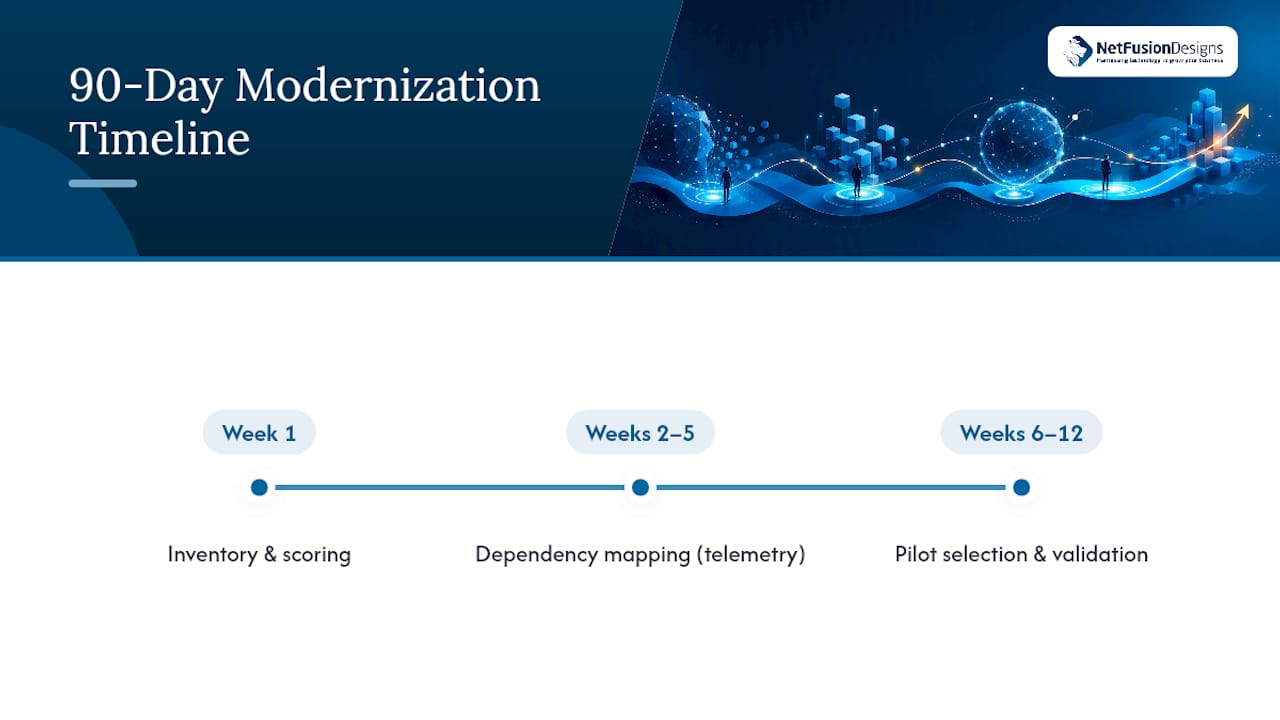
Week one is inventory: score every application on business value and technical health before anyone commits to an R. Weeks two through five are live dependency mapping, using telemetry rather than outdated diagrams. Weeks six through twelve are pilot selection and execution on one or two low-risk, high-value applications, run through a full parallel-run validation before cutover.
Mobilize a CIO sponsor for visible backing, a product owner who represents the business side, a platform owner who owns the target architecture, and an SRE who owns rollback readiness. Meet biweekly on wave progress and monthly with wider stakeholders. That rhythm, more than any single technology choice, is what separates programs that compound results from ones that stall after the first pilot.
— Geeshan
If your team doesn’t have the bandwidth to run portfolio scoring, live dependency mapping, and wave governance on top of daily operations, that’s precisely where a managed partner earns its cost. NetFusion Designs Inc runs managed IT services built around exactly this kind of structured migration work, backed by a SOC 2 Type II certified team and a single point of accountability instead of juggling three vendors across security, cloud, and development.
A discovery engagement typically starts with a portfolio health check and dependency mapping exercise, the exact groundwork this article recommends before assigning a single R. From there, a pilot wave proves the pattern on one or two applications before scaling into a full managed migration program. For teams also exploring AI-accelerated discovery or automation across the broader IT estate, NetFusion Designs Inc’s Managed Intelligence Provider offering extends that same discipline into AI enablement rather than treating it as a separate project.
Book a discovery call to walk through your application portfolio and get a straight answer on where to start.
Start with a portfolio inventory and live dependency mapping, then score each application on business value against technical health to assign one of the 7 Rs. Execute in waves using patterns like strangler fig or parallel run, with defined exit criteria before each cutover.
These are structured engagements, whether run internally or through a managed partner, that cover portfolio health checks, dependency mapping, pilot migrations, and full wave execution. NetFusion Designs Inc offers this through its managed IT services, pairing migration work with ongoing security and monitoring rather than a one-off project handoff.
A common example is an insurance or financial platform on a mainframe moving to a managed cloud database using Change Data Capture, running old and new systems in parallel until output matches, then decommissioning the mainframe. The Youth Employment Services server modernization is a real-world instance of staged migration replacing a risky single cutover.
Legacy modernization means updating an ageing application’s architecture, platform, or code so it can meet current business, security, and integration needs, without necessarily discarding it entirely. It’s a portfolio decision covering seven distinct paths, from retiring an app outright to fully rebuilding it, not a single fixed action.
Cost varies enormously by which R applies. NetFusion Designs Inc’s current pricing for managed migration engagements is available directly through a discovery conversation.
%20(1).avif)
%201.avif)