Industrial network security is the practice of protecting operational technology (OT) systems, including industrial control systems (ICS), SCADA platforms, and programmable logic controllers (PLCs), to maintain process safety and continuous uptime. The role of industrial network security explained in plain terms is this: keeping machines running safely matters more than keeping data secret. Unlike conventional IT security, OT environments prioritise availability and safety above confidentiality. Foundational standards like IEC 62443, NIST SP 800-82, and the Purdue Enterprise Reference Architecture give IT managers a structured way to think about and implement cybersecurity in industrial networks. Understanding these frameworks is the first step toward protecting your plant floor from threats that can cause real physical harm.
The CIA triad governs conventional IT security: confidentiality first, then integrity, then availability. OT environments invert this entirely. Availability and safety sit at the top. Integrity comes second. Confidentiality, while still relevant, is the lowest priority.
The reason is physical consequence. A 100 ms network outage can disrupt high-speed industrial processes. That is not a data loss event. That is a production stoppage, a safety hazard, or both. A hospital IT system going offline for a minute is recoverable. A PLC losing network connectivity mid-cycle on a chemical line is not.
This priority shift changes every security decision you make. Patching schedules, monitoring tools, and access controls all look different when uptime is a safety requirement, not just a business preference.
Pro Tip: When evaluating any new security tool for your OT environment, ask the vendor directly: “Has this tool caused a PLC crash or production delay in a live industrial deployment?” If they cannot answer clearly, treat that as a red flag.
Two frameworks define how most industrial organisations structure their network security: the Purdue Enterprise Reference Architecture and IEC 62443. They are complementary, not competing.
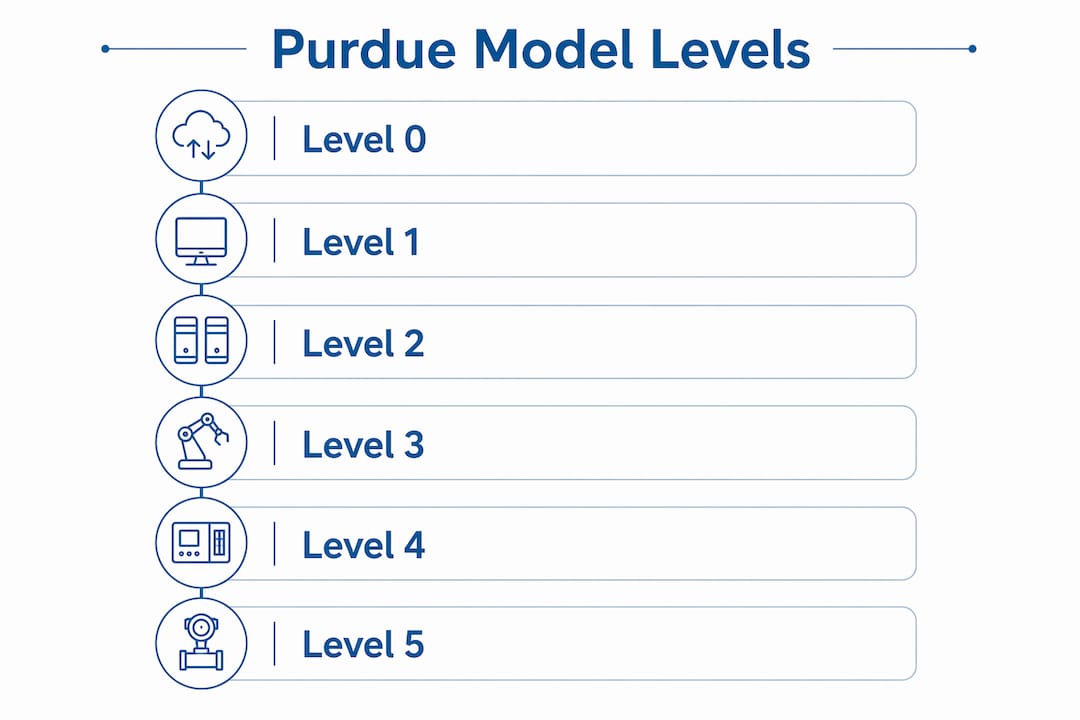
The Purdue model organises industrial networks into six levels, from Level 0 (physical process devices like sensors and actuators) up to Level 5 (enterprise IT and cloud systems). Levels 0 through 3 are OT. Levels 4 and 5 are IT. Level 3.5 is the industrial DMZ, a controlled buffer zone that brokers all traffic between enterprise IT and critical OT systems. Nothing should pass directly from Level 4 to Level 3 without inspection at Level 3.5. This boundary is where most IT-OT security failures occur.
IEC 62443 takes a different but compatible approach. It groups assets with shared security requirements into zones, then defines conduits as the only permitted communication paths between zones. Security levels SL1 through SL4 indicate the strength of protection required, matched against the capability of likely attackers. SL1 addresses casual threats. SL4 addresses nation-state-level attacks.
The critical detail most teams miss: static VLAN segmentation alone does not meet IEC 62443 conduit requirements. Each conduit must explicitly document allowed protocols, communication directions, and authentication methods. A VLAN without those controls is a boundary in name only.
| Framework | Core concept | Primary strength |
|---|---|---|
| Purdue Model | Hierarchical level separation (0–5) | Clear IT-OT boundary definition |
| IEC 62443 | Zones and conduits with security levels | Granular segmentation and access control |
| NIST SP 800-82 | OT-specific cybersecurity overlays | Incident response and configuration guidance |
Pro Tip: Use the Purdue model to draw your network map and assign assets to levels. Then apply IEC 62443 zones and conduits to enforce what can talk to what within and across those levels. The two frameworks work best together.
Practical industrial network security rests on four pillars: visibility, segmentation, access control, and monitoring. Each one addresses a specific failure mode common in manufacturing environments.
Effective OT security requires seeing every device, assessing real operational risk, and enforcing segmentation boundaries. You cannot protect what you cannot see. Industrial networks often contain legacy PLCs, remote terminal units, and embedded controllers that were never inventoried. Start with a complete asset register before applying any other control.

Segmentation contains lateral movement. If an attacker compromises one zone, proper conduit enforcement stops them from reaching adjacent zones. Legacy OT protocols like Modbus and DNP3 lack built-in authentication and encryption. They were designed for closed networks. Compensating controls, including application-aware firewalls and protocol-specific gateways at DMZ choke points, are required to protect them.
NIST SP 800-82’s 2023 revision includes OT-specific overlays for identity and access management, configuration management, and communications protection. Role-based access, multi-factor authentication for remote sessions, and strict vendor access controls are all applicable in OT environments, though implementation must account for operator workflow and device constraints.
Active vulnerability scanning can crash PLCs and cause production downtime. OT security programmes favour passive monitoring techniques that capture network traffic without sending probes. Tools designed for IT environments are often unsafe in OT contexts. Use purpose-built OT monitoring platforms that understand industrial protocols natively.
IT-OT convergence is the single biggest source of new risk in industrial environments. As manufacturers connect plant floor systems to enterprise networks, ERP platforms, and cloud analytics tools, the controlled boundary at Level 3.5 often becomes an uncontrolled pass-through. That is where zero trust principles become critical.
Zero trust applied at the IT-OT boundary means no session is trusted by default. Every connection requires identity verification, per-session authorisation, and outbound-only data flows where possible. Data historians, for example, should pull data from OT systems rather than OT systems pushing data into IT networks. That directional control alone eliminates a significant class of attack vectors.
The best practices for managing IT-OT convergence risks follow a clear order:
| Risk factor | IT environment | OT environment |
|---|---|---|
| Patch cycle | Weeks to months | Years or never |
| Downtime tolerance | Hours | Milliseconds |
| Primary threat impact | Data breach | Physical process disruption |
| Scanning approach | Active | Passive only |
The manufacturing IT partner you choose must understand both sides of this table. An IT-only perspective will create controls that look correct on paper but cause operational problems on the plant floor.
Industrial network security protects OT environments by prioritising availability and safety first, using architectural frameworks like the Purdue Model and IEC 62443 to enforce segmentation, and applying passive monitoring and zero trust controls at the IT-OT boundary.
| Point | Details |
|---|---|
| Availability comes first | OT security prioritises uptime and safety over data confidentiality, unlike conventional IT. |
| Use both Purdue and IEC 62443 | The Purdue model maps your network levels; IEC 62443 enforces what can communicate across them. |
| VLANs alone are not enough | IEC 62443 conduits require documented protocols, directions, and authentication, not just network separation. |
| Passive monitoring is mandatory | Active scanning tools can crash PLCs; use purpose-built OT monitoring platforms instead. |
| Zero trust at Level 3.5 | Per-session identity verification and outbound-only data flows are the minimum for IT-OT boundary control. |
Working with manufacturing clients across Ontario, I have seen the same mistake repeated: IT teams apply their standard security playbook to OT environments and create new problems in the process. They deploy active scanners that crash controllers. They push patches that break process logic. They segment networks with VLANs and assume the job is done.
The uncomfortable truth is that OT security requires a fundamentally different mindset, not just different tools. The Purdue model and IEC 62443 are not bureaucratic frameworks. They exist because people learned these lessons the hard way, through production outages and safety incidents. Static segmentation without documented conduits is security theatre. It looks defensible until an attacker walks straight through it.
What actually works is layered defence that respects operational constraints. Passive visibility tools that understand Modbus and DNP3. Conduit enforcement that is documented, authenticated, and monitored. Zero trust controls at the IT-OT boundary that treat every vendor session as untrusted by default. And an architecture-first approach that accepts you cannot patch your way to safety on a 15-year-old PLC.
The organisations that get this right treat security and operational continuity as the same goal, not competing ones. That shift in perspective is more valuable than any single tool or framework.
— Geeshan
Industrial network security is not a one-time project. It requires ongoing monitoring, boundary enforcement, and expert response when something goes wrong.

NetFusion Designs Inc delivers managed cybersecurity services built for manufacturing and industrial environments across Ontario and Canada. Our team understands the IT-OT boundary, the Purdue model, and the operational constraints that make OT security different from standard IT work. When a security incident threatens plant uptime, our emergency IT support team responds fast to contain the damage and restore operations. Whether you need ongoing managed security or urgent incident response, NetFusion Designs Inc has the expertise to protect your plant floor without disrupting your processes.
The primary goal is maintaining operational process safety and continuous availability. OT networks require deterministic timing, and even brief disruptions can cause physical and financial harm.
The Purdue model defines hierarchical network levels separating OT from IT. IEC 62443 defines security zones and conduits that enforce which assets can communicate and how. The two frameworks work together, not as alternatives.
Active scanning sends network probes that can overwhelm or crash industrial controllers. Active scans have caused PLC crashes and production downtime, which is why OT security programmes use passive monitoring instead.
The industrial DMZ is Level 3.5 in the Purdue model. It acts as a controlled buffer between enterprise IT and critical OT systems, preventing direct routing from IT networks to plant floor devices.
Zero trust at the IT-OT boundary means every session requires identity verification and per-session authorisation. Outbound-only data flows and strict access controls prevent IT-side credentials from granting uncontrolled access to OT systems.
%20(1).avif)
%201.avif)