A local managed IT provider gives your business faster on-site response, technology aligned to your specific goals, predictable monthly costs, and compliance support grounded in regional regulations. These are not marginal improvements. For most Canadian SMBs, they translate directly into less downtime, fewer surprise invoices, and a clearer technology path forward.
The principal advantages you can expect:
The North American managed services market is expanding as SMBs shift spending from capital equipment to packaged cloud, security, and compliance services. NetFusion Designs Inc, a SOC 2 Type II–certified provider with offices in Kitchener-Waterloo, Toronto, Markham, Mississauga, Montréal, and Winnipeg, is one example of how a local managed IT provider can deliver enterprise-grade tooling with the responsiveness of a neighbourhood partner.
The clearest benefit of a local managed IT provider is that your technology plan reflects your business, not a vendor’s default configuration. National providers supply scale and standardised processes; local MSPs supply relationship-driven, customised planning — and for an SMB with specific workflows, that difference matters.
A local MSP builds a technology roadmap tied to your growth plans, budget cycles, and operational constraints. A professional services firm running time-sensitive client billing needs different infrastructure priorities than a small manufacturer managing inventory and production scheduling. A local provider who has visited your site, met your team, and reviewed your current stack can make those distinctions. A national provider working from a standardised intake form usually cannot.
The fractional virtual CIO (vCIO) model is where this customisation becomes most tangible. Rather than hiring a full-time CIO at a six-figure salary, you get strategic planning, vendor coordination, and budget forecasting from a senior technologist who knows your environment. That means fewer unnecessary products, better vendor negotiations, and technology decisions that actually align with where your business is heading.
Signals that a local MSP is genuinely customising your service:
Geographic proximity is a practical advantage, not a marketing claim. Local MSPs typically achieve faster first-response and on-site arrival times than national providers because they operate with smaller client rosters and local technician pools. When a server goes down or a network switch fails, the difference between a two-hour on-site arrival and a next-business-day dispatch is measurable in lost revenue and staff productivity.
On-site capability matters most for hardware failures, physical network issues, and security containment. Remote monitoring can detect a ransomware event, but containing it often requires someone physically on-site to isolate affected machines, preserve evidence, and restore from backup. A local technician who has visited your office before can move faster because they already know your layout, your hardware, and your escalation contacts.
Response time matters most when you can least afford to wait. A local MSP with a committed on-site SLA gives you a defined recovery window rather than a vague “we’ll get someone there as soon as possible.”
Pro Tip: When reviewing proposals, ask each provider to put their on-site response commitment in writing as a named SLA metric — specifically the maximum time from ticket escalation to technician arrival. A provider unwilling to commit to a number in writing is telling you something important.
Local technicians also accumulate institutional knowledge that shortens diagnostic time. A technician who has visited your site three times already knows that your accounting workstations run an older application that conflicts with certain Windows updates, or that your server room runs warm in summer. That context speeds every future call.
Managed services shift spending from capital spikes to predictable monthly fees, and for most SMBs that change alone justifies the contract. Emergency repairs, unplanned hardware replacements, and reactive IT labour are expensive and impossible to budget for. A monthly managed fee covers monitoring, helpdesk, patching, and often on-site visits, converting those variables into a fixed line item.
The 12–24 month total cost of ownership (TCO) comparison is where the case becomes clearest. Consider the calculation approach: take your current annual spend on break-fix labour, emergency hardware, lost productivity from downtime, and any IT staff time diverted from core work. Compare that against a flat monthly managed fee that covers all of those categories. Local MSPs often include on-site visits in base pricing, which changes the TCO comparison with national firms who bill travel and on-site time separately.
When reviewing pricing structures, ask about:
For very small businesses with minimal IT footprint, a flat managed plan may cost more than a trusted break-fix technician. The managed model pays off when your environment is complex enough that proactive monitoring and patching prevent more problems than reactive support would fix.
A local managed IT provider combines hands-on familiarity with your environment and modern managed security tooling. Many local MSPs partner with 24/7 security operations centre (SOC) providers to fill gaps in round-the-clock monitoring while retaining local on-site presence for containment and recovery. The result is enterprise-grade detection backed by someone who can physically respond when an alert escalates.
Cloud modernisation, cyber-insurance pressures, and provincial privacy rules are all driving SMB adoption of managed security services. Ontario’s privacy framework, sector-specific requirements for healthcare and financial services, and PCI DSS obligations for businesses processing card payments all require ongoing attention. A local provider who works regularly with Ontario-based businesses understands these requirements in practice, not just in theory.
For regulated SMBs, the compliance value is specific:
Trust signals to request from any prospective provider:
Local MSPs support growth without forcing you into enterprise-priced bundles you do not need yet. Phased cloud migration, hybrid infrastructure models, and consumption-based licensing let you scale up or down as your business changes, rather than committing to a fixed configuration that fits today but not next year.
A staged cloud migration is the most common example. Rather than a disruptive full cutover, a local provider moves workloads in phases: email and productivity first (typically Microsoft 365), then file storage, then line-of-business applications. Each phase is tested and stabilised before the next begins. That approach reduces risk and keeps staff productive throughout the transition.
Practical negotiation points to include in any managed services agreement:
When national scale genuinely matters — say, a business expanding into multiple provinces simultaneously — a larger provider may have advantages in standardised multi-site deployment. For most Ontario-based SMBs growing steadily, a local MSP with strong vendor relationships and a flexible contract structure handles that growth without the overhead of a national contract.
The difference between a good local MSP and a disappointing one usually shows up in the contract details and the first few discovery conversations, not in the marketing materials.
Evaluation checklist:
Interview questions worth asking:
Red flags to watch for:
Sample SLA metrics to request:
NetFusion Designs Inc is a SOC 2 Type II–certified managed IT provider with local teams in Kitchener-Waterloo, Toronto, Markham, Mississauga, Montréal, and Winnipeg. The delivery model combines local technicians who can arrive on-site with enterprise-grade tooling and a 24/7 NOC, which is the combination that makes the earlier advantages real rather than theoretical.
NetFusion Designs Inc maps directly to the benefits this article covers: on-site support dispatched from local offices, a 24/7 NOC for round-the-clock monitoring, SOC 2 Type II certification for security and compliance credibility, fractional virtual CIO services for strategic planning, and Microsoft 365 optimisation for cloud productivity. Each service ties to a measurable business outcome rather than a feature list.
Core services and their connection to the benefits covered above:
NFD’s regional footprint means a technician familiar with your office can be on-site the same day for hardware failures or security containment. The 24/7 NOC handles after-hours monitoring so incidents are caught before they become outages. And the SOC 2 Type II certification gives clients and their auditors documented evidence that NFD’s own security controls meet an independently verified standard.
A local managed IT provider delivers faster on-site response, technology tailored to your business, predictable monthly costs, and compliance support grounded in your regional regulatory environment.
| Point | Details |
|---|---|
| Faster on-site response | Local technicians arrive the same day; national providers often dispatch next business day or later. |
| Tailored technology roadmap | A local MSP builds your plan around your workflows and growth goals, not a standardised template. |
| Predictable OPEX | Monthly managed fees replace capital spikes and emergency repair bills, improving 12–24 month TCO. |
| Regional compliance knowledge | Local providers understand Ontario privacy rules, HIPAA-readiness, and PCI DSS requirements in practice. |
| NetFusion Designs Inc | SOC 2 Type II–certified, with local teams across Ontario and Canada, 24/7 NOC, and fractional vCIO services. |
Most articles about managed IT focus on features: monitoring, patching, helpdesk tiers. Those matter, but they are table stakes. What actually separates a good local MSP from a frustrating one is accountability. When something goes wrong at 11 PM, you want to know exactly who is picking up the phone and exactly how long before someone is at your door.
The local advantage is not just proximity. It is the accumulation of context. A technician who has visited your office five times already knows your server room, your quirky legacy application, and the name of your office manager. That institutional knowledge shortens every future call and prevents the kind of diagnostic dead-ends that cost hours of billable time.
There is also a strategic dimension that gets underestimated. A fractional vCIO from a local provider who understands the Ontario market, your industry’s regulatory pressures, and your competitive environment can give you technology advice that a national helpdesk simply cannot. That is not a soft benefit. It is the difference between a technology plan that supports your business and one that just keeps the lights on.
The businesses that get the most from a local managed IT partnership treat it as a strategic relationship, not a vendor contract. That means regular roadmap sessions, honest conversations about budget, and a provider who pushes back when you are about to spend money on something you do not need.
If you are comparing managed IT options for your Ontario or Canadian business, NetFusion Designs Inc offers something most national providers cannot: local technicians who arrive the same day, a 24/7 NOC that catches issues before they become outages, and a SOC 2 Type II–certified security posture that holds up under audit.
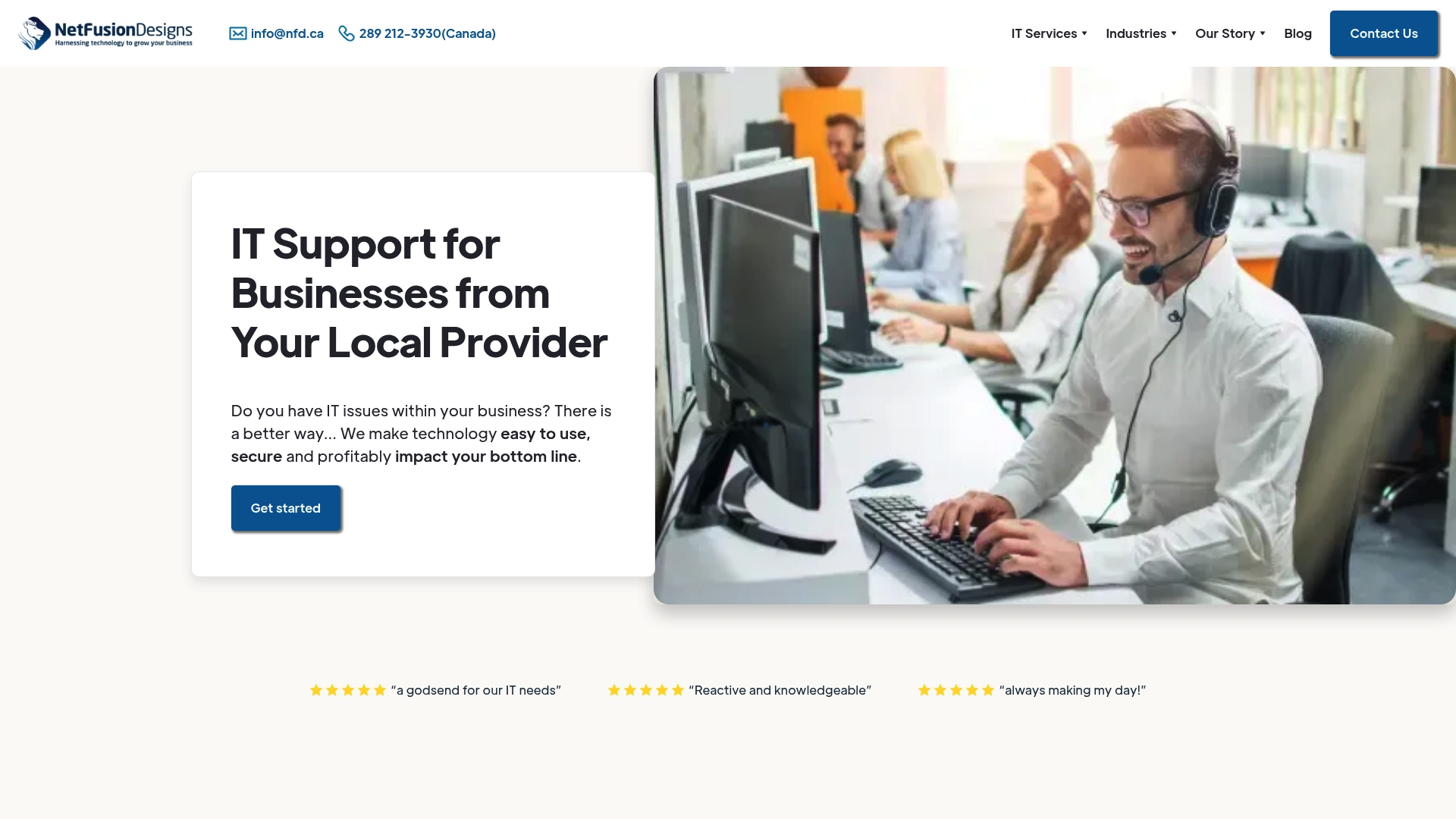
The service range covers what most SMBs actually need: managed IT in Kitchener-Waterloo and across Ontario, emergency on-site response, managed cybersecurity, Microsoft 365 optimisation, virtual CIO planning, and backup and disaster recovery. Pricing is transparent, contracts are flexible, and the team assigned to your account stays consistent.
The right next step is a 30–60 minute discovery call where you walk through your current environment, your biggest IT pain points, and what a realistic SLA looks like for your business. Request a sample SLA and a reference from a business in your sector before you sign anything.
Faster on-site response, technology tailored to your business goals, predictable monthly costs, and compliance support grounded in your regional regulatory environment are the core advantages of a local managed IT provider over a national alternative.
For most SMBs, managed IT delivers broader coverage at a lower cost than a full-time hire, including 24/7 monitoring, security tooling, and strategic planning that a single in-house technician cannot provide alone.
Ask for written SLA commitments covering first response and on-site arrival times, SOC 2 Type II certification, local client references, and a clear escalation path for after-hours incidents.
A local provider with regional experience understands Ontario privacy rules, HIPAA-readiness requirements, and PCI DSS obligations in practice, and can map your data flows and controls to prepare for audits. NetFusion Designs Inc holds SOC 2 Type II certification and supports HIPAA-readiness and PCI awareness for regulated SMBs.
Managed services convert unpredictable capital expenses and emergency repair costs into a fixed monthly fee, improving budget visibility over a 12–24 month period and often reducing total cost of ownership when on-site visits and proactive monitoring are included in the base price.
%20(1).avif)
%201.avif)