Operational technology (OT) security is defined as the practice of protecting the hardware and software that monitor and control physical industrial processes, from factory assembly lines to water treatment systems. Unlike traditional IT security, OT security prioritises availability, integrity, and then confidentiality — in that exact order — because a shutdown of a power grid or a manufacturing line causes immediate physical harm. Critical infrastructure organisations reported over 4,800 cyberattack complaints in 2024, with ransomware rising 9% year over year. That number tells you the threat is not theoretical. Standards like IEC 62443 and NIST SP 800-82 exist specifically to address these risks, yet many organisations still apply IT security thinking to OT environments and create new problems in the process.
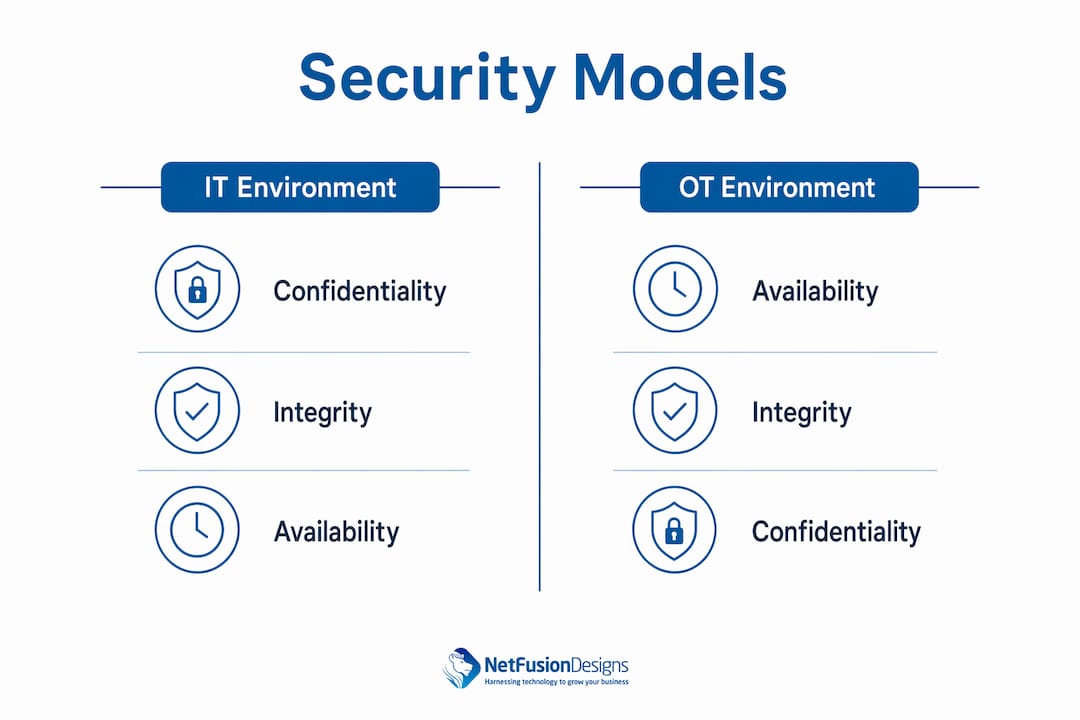
OT security and IT security share the same goal — keeping systems safe — but they operate under fundamentally different rules. IT security follows the CIA triad: confidentiality first, integrity second, availability third. OT security inverts this model. Availability and safety come first because a stopped production line or a failed safety system has immediate, physical consequences.
A data breach in an IT environment is serious. A failure in an OT environment can injure workers, damage equipment, or contaminate a water supply. This is why OT security frameworks like IEC 62443 treat uptime and safety as non-negotiable. Confidentiality matters, but it ranks below keeping the lights on and the machinery running safely.
OT hardware and controllers often remain in service for 15–30 years, compared to the 3–5 year refresh cycle typical of IT equipment. That gap creates a serious patching problem. A programmable logic controller (PLC) installed in 2005 may run an operating system that no longer receives security updates. You cannot simply patch it the way you would a Windows workstation. The vendor may no longer support it, and the production schedule may never allow a maintenance window long enough to test a patch safely.

Pro Tip: Before applying any security tool to an OT asset, check whether the vendor has tested it against your specific controller model and firmware version. Assumptions made in IT environments do not transfer.
Applying standard IT security tools to OT environments can cause system crashes and disrupt real-time control loops. Active vulnerability scanners send network traffic that legacy PLCs and distributed control systems (DCS) were never designed to handle. The result is unplanned downtime that can cost tens of thousands of dollars per hour. This is not a theoretical risk. It is one of the most common mistakes organisations make when they first bring IT security thinking into an OT environment.
| Security dimension | IT environment | OT environment |
|---|---|---|
| Priority model | Confidentiality, Integrity, Availability | Availability, Integrity, Confidentiality |
| System lifespan | 3–5 years | 15–30 years |
| Patching approach | Regular automated updates | Risk-assessed, infrequent, manual |
| Downtime tolerance | Hours to days | Near zero |
| Failure consequence | Data loss, financial impact | Physical harm, equipment damage |
OT environments face a distinct set of risks that standard IT security programmes are not built to address. Understanding these risks is the first step toward managing them.
The convergence of IT and OT is the single biggest driver of new OT risk. When a historian server that collects OT data also connects to the corporate email network, the OT environment inherits every IT vulnerability. Cloud and AI integrations amplify this further. Each new connection is a potential attack path, and most OT environments were not designed with that reality in mind.
Effective OT security does not start with buying a new tool. It starts with understanding what you have and how your network is structured.
Build a complete asset inventory. You cannot protect what you cannot see. Document every device, firmware version, communication protocol, and network connection in your OT environment. This baseline is the foundation of every other security decision.
Apply the Purdue Model for network segmentation. The Purdue Model divides OT networks into defined zones, from field devices at the lowest level to enterprise systems at the top. Clean segmentation following the Purdue Model and the removal of hidden backdoors like open VPN connections dramatically improves network hygiene. Watch for “bleeding,” where IT traffic crosses into OT zones through poorly managed connections.
Use passive monitoring, not active scanning. Passive monitoring listens to network traffic without sending packets that could disrupt control systems. Most OT security failures occur because IT tools disrupt OT processes. Passive approaches give you visibility without the risk. For a deeper look at non-intrusive assessment methods, purpose-built OT assessment services are available.
Apply compensating controls to unpatchable assets. For devices that cannot be patched, use micro-segmentation to isolate them, enforce application whitelisting to block unauthorised processes, and establish behavioural baselines to detect anomalies.
Implement identity management and zero trust principles. Every OT asset needs identity management as part of basic cybersecurity hygiene. Zero trust principles — verify every connection, grant minimum necessary access — are becoming foundational in modern OT environments.
Align IT and OT governance. Governance gaps between OT engineers and IT security teams are one of the most common sources of security failures. OT engineers measure success in uptime and safety. IT security teams measure it in threat detection and patch compliance. Bridging that gap requires shared metrics and regular cross-functional communication.
Pro Tip: When presenting OT security investments to leadership, frame the risk in operational terms: potential hours of downtime, cost per hour, and regulatory exposure. That language resonates with both plant managers and CFOs.
The discipline of OT security is shifting from reactive patching to continuous risk assessment and attack surface hardening. This is a meaningful change. Organisations that once patched on a fixed schedule are now building programmes around ongoing visibility and risk reduction.
Several trends are shaping this shift:
The organisations that are ahead of this curve treat OT security as an ongoing programme, not a project. They assess continuously, harden incrementally, and build the governance structures that keep IT and OT teams working toward the same goals. For a detailed look at industrial network security strategies, the principles of attack surface reduction apply directly to OT environments.
OT security requires a fundamentally different approach from IT security because the consequences of failure are physical, immediate, and potentially irreversible.
| Point | Details |
|---|---|
| OT security inverts IT priorities | Availability and safety come before confidentiality in every OT security decision. |
| Long asset lifespans demand compensating controls | Devices running 15–30 years cannot be patched traditionally; use segmentation and whitelisting instead. |
| Active scanning breaks OT systems | Passive monitoring is the only safe way to gain visibility without risking downtime. |
| Governance alignment is non-negotiable | IT and OT teams must share metrics and communicate regularly to close security gaps. |
| Continuous assessment replaces reactive patching | Modern OT security programmes focus on ongoing visibility and hardening, not scheduled patch cycles. |
I have seen this pattern more times than I can count. An IT security team, well-intentioned and technically capable, rolls out a vulnerability scanner across the network. Nobody tells them the OT segment is in scope. Three hours later, a production line is down and nobody knows why. The scanner did exactly what it was designed to do. The problem was the assumption that OT and IT environments behave the same way.
The governance gap is real, and it is not a technology problem. It is a communication problem. OT engineers speak the language of uptime, safety, and process reliability. IT security professionals speak the language of CVEs, patch cycles, and threat intelligence. Neither group is wrong. They are optimising for different outcomes, and without a shared framework, they will keep working at cross purposes.
What I have found actually works is starting with the network diagram, not the threat model. Get both teams in the same room with a whiteboard. Map every connection between IT and OT zones. Find the bleeding points. That exercise alone surfaces more risk than most formal assessments. From there, you build the governance structure around what both teams agree matters: uptime, safety, and a defensible security posture.
The organisations that get this right do not treat OT security as an IT project with a different scope. They treat it as a discipline that requires its own tools, its own metrics, and its own governance. The technology is the easy part. The alignment is the work.
— Geeshan
OT security incidents do not wait for business hours. When a control system goes offline or ransomware hits a production network, the cost of every hour without a response is measurable.

NetFusion Designs Inc provides emergency IT support for organisations facing active OT security incidents, as well as proactive cybersecurity and vulnerability assessments designed to identify risk before an attacker does. As a SOC 2 Type 2 attested provider with a 24/7 NOC, NetFusion Designs Inc brings enterprise-grade security capabilities to small and mid-sized businesses across Ontario and Canada. Whether you need a managed IT programme that covers your OT environment or a focused assessment of your industrial network, the team at NetFusion Designs Inc is ready to help.
OT security is the practice of protecting the systems that control physical processes, such as manufacturing equipment, power grids, and water treatment facilities, from cyberattacks. It prioritises keeping those systems running safely over protecting data confidentiality.
IT security follows the CIA triad, placing confidentiality first. OT security uses the AIC model, placing availability and safety first because a system failure in an OT environment can cause physical harm, not just data loss.
Active scanning and automated patching tools can crash legacy OT devices like PLCs and DCS controllers, causing unplanned downtime. Passive monitoring tools are used instead because they observe network traffic without sending disruptive packets.
Ransomware, flat network architecture, legacy operating systems without patch support, and unmanaged vendor remote access connections are the most common threats facing OT environments today.
IEC 62443 and NIST SP 800-82 are the primary frameworks for OT and industrial control system security. Both are increasingly referenced in insurance requirements and government procurement contracts across Canada.
%20(1).avif)
%201.avif)