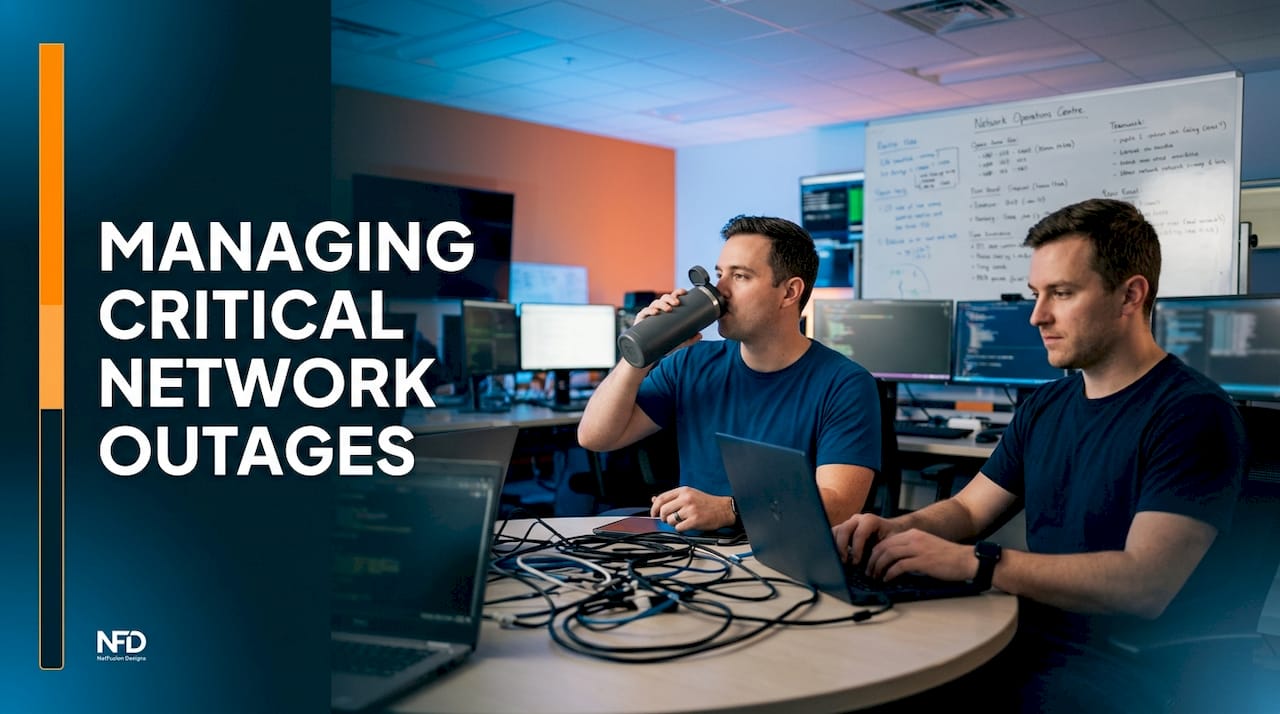
A Network Operations Centre (NOC) is a centralised hub where IT engineers monitor, manage, and respond to infrastructure events 24 hours a day to maintain business continuity. The role of a NOC in business continuity goes well beyond watching dashboards. NOCs reduce the time it takes to detect and resolve incidents, enforce structured escalation workflows, and prevent small anomalies from becoming full outages. For business leaders and IT managers, understanding how a NOC functions within a broader continuity programme is the difference between planned recovery and unplanned chaos.
Two metrics define NOC performance in a continuity context: MTTD (mean time to detect) and MTTR (mean time to resolve). MTTD measures how long it takes to identify an incident from the moment it begins. MTTR measures how long it takes to restore normal service after detection. Both metrics directly determine how long your business is exposed to an outage.
Opsio benchmarks define MTTD and MTTR by service tier, which means a Tier 1 network outage carries a different acceptable threshold than a Tier 3 application slowdown. Tracking these separately gives IT managers a clear picture of where response gaps actually exist. Without that granularity, you are averaging away the incidents that matter most.
NOCs improve both metrics through pre-built runbook logic. A runbook maps a specific alert type to a defined escalation path, so engineers do not waste time deciding what to do next. Pre-built runbook logic reduces MTTD and MTTA (mean time to acknowledge) significantly during active outages. That speed matters because every minute of undetected failure compounds the recovery effort.
| Incident tier | Typical MTTD target | Typical MTTR target |
|---|---|---|
| Tier 1 (critical outage) | Under 5 minutes | Under 1 hour |
| Tier 2 (degraded service) | Under 15 minutes | Under 4 hours |
| Tier 3 (minor issue) | Under 60 minutes | Under 24 hours |
Pro Tip: Start your incident clock at the moment the event began, not when a user reported it. Accurate MTTD measurement from incident onset gives you reliable data for continuity decisions. User-reported start times consistently understate detection delays.
NOC impact on business continuity is strongest before an incident escalates. NOC systems detect problems minutes to hours before users notice, using real-time alerting and threshold monitoring. That window is where cascading failures are stopped.
Reactive incident response is only one part of what a NOC delivers. The proactive functions are what separate a well-run NOC from a glorified help desk. Continuous monitoring prevents complex outages by catching early signals and escalating to the right specialists before the situation widens.
Proactive NOC functions that directly support business resilience include:
Good NOC continuity programmes measure service dependencies and prioritise incidents by business impact to prevent cascading failures. That prioritisation is what keeps a storage alert from being treated the same as a core network failure.
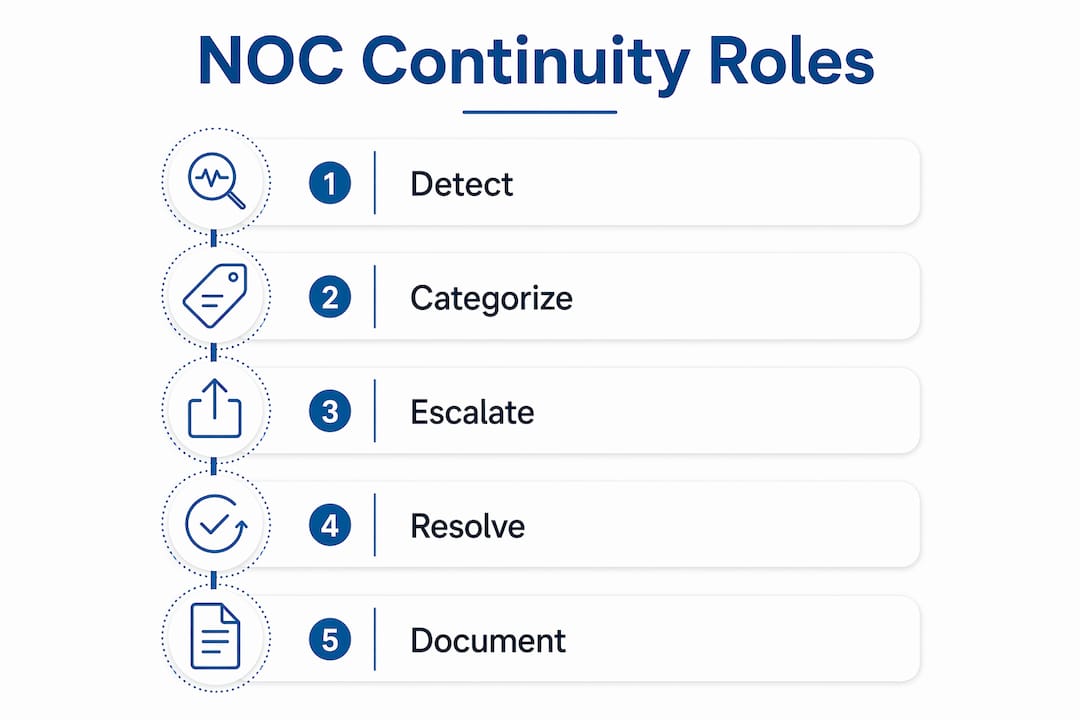
The importance of NOC in operations becomes clearest when you map NOC activities to ITIL incident management stages. ITIL incident management includes detection, logging, categorisation, prioritisation, investigation, resolution, and closure. A NOC operationalises every one of these stages through monitoring tools and escalation workflows.
A NOC engineer does not wait for a user to call. Monitoring platforms generate alerts automatically, and the NOC logs each event with a timestamp, affected system, and initial severity rating. That log becomes the foundation for every decision that follows.
Alert validation is where NOC triage adds real value. NOC triage includes symptom analysis and relevant log delivery to speed up specialist intervention. Engineers confirm whether an alert is a genuine incident or a false positive before escalating. False positives that reach senior engineers waste time and erode trust in the monitoring system.
Once an incident is contained, the NOC documents the resolution steps and closes the ticket with a root cause note. That documentation feeds into post-incident reviews and informs runbook updates. Without closure discipline, the same incident recurs.
High-assurance environments take this further. The DHS NOSC contract integrates 24/7 NOC monitoring and incident management for network, cloud, and cyber events, demonstrating that operational continuity at scale requires unified observability, response, and escalation under one programme. That model applies equally to mid-sized Canadian businesses operating critical infrastructure.
Pro Tip: Continuity fails when monitoring is disconnected from incident and service continuity management. Treat your NOC as an integrated part of your ITSM programme, not a separate tool.
NOC efficiency translates directly into financial outcomes. NOC efficiency reduces revenue loss and customer complaints by keeping uptime high and response times low. The cost of downtime is not just lost transactions. It includes staff idle time, recovery labour, customer trust damage, and potential regulatory exposure.
Customer satisfaction tracks closely with uptime and response speed. When a NOC resolves a network issue before users notice, the business avoids the support calls, escalations, and reputation damage that follow a visible outage. That invisible work is the NOC’s most undervalued contribution.
Monitoring data also drives continuous improvement. Trend reports from a NOC reveal which systems degrade most frequently, which time windows carry the highest incident volume, and where infrastructure investment will have the greatest continuity impact. That data turns reactive IT spending into planned investment.
| NOC operational benefit | Downtime risk without NOC |
|---|---|
| 24/7 alert detection | Outages go undetected overnight or on weekends |
| Structured escalation paths | Incidents sit in queues without clear ownership |
| Runbook-driven response | Engineers improvise under pressure, extending MTTR |
| Performance trend reporting | Degradation patterns go unnoticed until failure |
| Patch and backup verification | Silent failures leave systems unprotected |
Pro Tip: Align your NOC metrics with business objectives, not just technical targets. Present MTTR improvements to leadership as reduced revenue exposure, not as a faster ticket closure rate. That framing gets continuity programmes the budget they need.
For organisations that rely on cloud backup and disaster recovery, a NOC that monitors backup job completion and flags failures in real time is the difference between a tested recovery plan and a false sense of security.
A NOC is the operational backbone of business continuity, reducing detection and resolution times through structured workflows, proactive monitoring, and ITIL-aligned incident management.
| Point | Details |
|---|---|
| MTTD and MTTR are the core metrics | Track both by service tier to identify where continuity gaps actually exist. |
| Proactive monitoring prevents cascading failures | NOCs detect anomalies before users notice, stopping small issues from widening. |
| ITIL integration structures the response | NOCs operationalise every stage of incident management from detection to closure. |
| Runbooks reduce improvisation under pressure | Pre-built escalation logic cuts acknowledgement and containment times significantly. |
| NOC data drives investment decisions | Trend reports reveal where infrastructure spending will have the greatest continuity impact. |
Business leaders consistently underestimate what continuity actually requires. The conversation almost always starts with backups. Backups matter, but a backup you cannot restore in time is not a continuity plan. The real gap I see is between monitoring and response. Organisations have tools generating alerts, but no structured process to act on them.
The teams that handle outages best are the ones that invested in runbook development before the crisis. When an engineer has a documented escalation path in front of them at 2 a.m., they move fast and make fewer mistakes. When they are improvising, MTTR climbs and the blast radius grows.
I have also seen how much damage a poorly validated alert system causes. When engineers stop trusting their alerts because of constant false positives, they start ignoring them. That is how a real incident goes undetected for hours. Alert validation and triage discipline are not optional extras. They are the foundation of a credible NOC programme.
The organisations that get the most from their NOC are the ones that treat it as part of their ITSM programme, not a separate monitoring tool. When NOC data feeds into change management, capacity planning, and post-incident reviews, continuity improves continuously rather than only after a major failure.
— Geeshan
NetFusion Designs Inc operates a 24/7 NOC that monitors client infrastructure around the clock, detects incidents before they reach users, and follows structured escalation workflows to minimise downtime. For small and mid-sized businesses across Ontario and Canada, that means enterprise-grade monitoring without the cost of building an internal operations centre.

If your organisation has experienced unplanned outages, slow incident response, or gaps in after-hours coverage, emergency IT support from NetFusion Designs Inc delivers rapid response when it matters most. For ongoing continuity management, the managed IT services offer includes continuous monitoring, patch management, backup verification, and incident management integrated into a single programme. Your infrastructure stays up. Your team stays focused.
A NOC monitors IT infrastructure 24/7, detects incidents early, and follows structured escalation workflows to minimise downtime. Its core function in business continuity is reducing MTTD and MTTR so disruptions are contained before they affect operations.
A help desk responds to user-reported problems after they occur. A NOC proactively monitors systems and detects issues before users notice, making it a prevention and early-response function rather than a reactive support function.
MTTD, MTTR, and MTTA (mean time to acknowledge) are the primary metrics. Tracking these by service tier and incident severity gives IT managers an accurate view of where continuity gaps exist and where to invest.
A NOC monitors backup job completion, verifies recovery point objectives are met, and detects infrastructure failures that trigger disaster recovery procedures. Without NOC oversight, backup failures often go unnoticed until a recovery is attempted.
Yes. Unplanned downtime carries the same financial and reputational cost regardless of company size. A managed NOC through an MSP gives smaller organisations 24/7 monitoring and structured incident response without the overhead of an internal operations team.
%20(1).avif)
%201.avif)