IT infrastructure is defined as the complete set of hardware, software, networks, and services that enable every business process to function. Without it, there is no email, no data storage, no customer transaction, and no operational continuity. The role of IT infrastructure in business has shifted from a back-office cost centre to a primary driver of competitive advantage. Platforms like Microsoft 365, AWS, Azure, and VMware now sit at the core of how Canadian businesses operate, scale, and protect their data. Understanding what your infrastructure does, and what it costs you when it fails, is the starting point for every sound technology decision.
IT infrastructure is the digital nervous system of an organisation, and treating it as anything less is a strategic mistake. Every workflow, customer interaction, and data transaction runs through it. When it works well, it is invisible. When it fails, the entire business feels it immediately.
The core components fall into three categories. Hardware includes servers, workstations, and networking equipment from vendors like Cisco. Software covers operating systems, productivity suites like Microsoft 365, and virtualisation platforms like VMware. Services include cloud platforms such as AWS and Azure, managed security, and identity management tools.

The importance of IT infrastructure goes beyond keeping the lights on. It determines how fast your teams can respond to market changes, how securely you store customer data, and how quickly you can bring a new product or service to market. Business leaders who treat infrastructure as a utility miss the strategic value it creates every day.
A resilient technology backbone reduces friction, speeds deployments, and protects business continuity by moving organisations toward automation and observable processes. That is not a technical achievement. It is a business outcome with a direct impact on revenue and staff productivity.
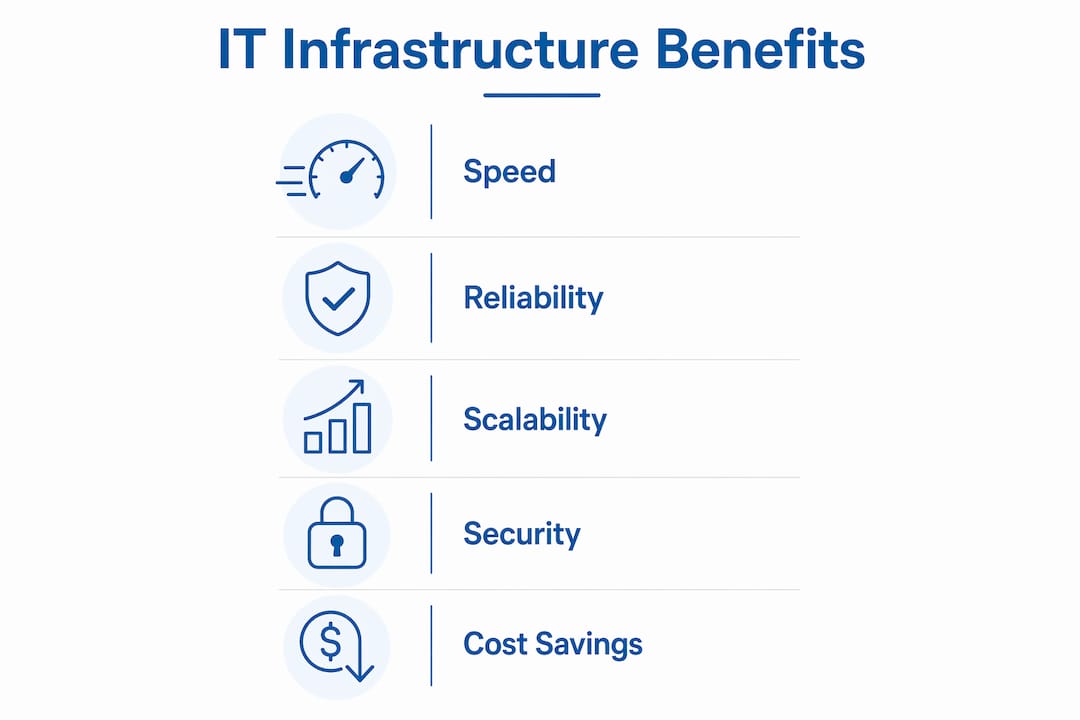
The most direct IT infrastructure benefits for operational efficiency include:
Pro Tip: Prioritise infrastructure investments that directly map to a specific business process bottleneck. If your sales team waits 20 minutes for reports to generate, that is an infrastructure problem with a measurable cost. Fix that first.
How IT supports business efficiency is not just about speed. It is about removing the friction that quietly drains productivity across every department, every day.
Connecting IT investments to business growth requires a shared language between technology leaders and executives. The BCG framework for segmenting IT investment into three categories, operate, expand, and innovate, gives CIOs a clear way to show where money goes and what it returns.
“Operate” spending covers the infrastructure that keeps existing processes functional. Servers, network equipment, security tools, and helpdesk services all fall here. This spending is non-negotiable, but it should be measured by uptime, incident response time, and cost per user, not just by whether the lights stay on.
“Expand” investments scale proven capabilities into new markets, geographies, or customer segments. Cloud elasticity on platforms like Azure and AWS allows businesses to scale resources for performance and compliance without buying new hardware. This flexibility directly accelerates time-to-market and supports new business models.
“Innovate” spending funds new capabilities that do not yet exist in the business. AI tools, automation platforms, and new application development fall here. This is where infrastructure decisions create the widest gap between market leaders and those who fall behind.
Aligning IT decisions with long-term growth targets requires KPIs that executives actually care about: revenue protected by system availability, cost avoidance from prevented outages, and the percentage of strategic initiatives delivered on time. When IT leaders report in these terms, the conversation changes from budget defence to investment planning.
Pro Tip: Build a one-page IT value report for your leadership team each quarter. List three business outcomes your infrastructure enabled, not three technical metrics. Revenue protected, projects delivered on time, and security incidents prevented are the numbers that move budget conversations.
Proactive infrastructure management encompasses planning, deployment, monitoring, and optimisation to protect revenue and reputation. Businesses that treat infrastructure management as a reactive function pay for it in downtime, data breaches, and regulatory fines.
The contrast between traditional and modern infrastructure management is significant.
| Practice area | Traditional approach | Modern approach |
|---|---|---|
| Monitoring | Reactive, ticket-driven | Continuous, AI-assisted alerting |
| Security | Perimeter firewall only | Security by design, zero-trust architecture |
| Identity management | Shared passwords, basic access | Okta, Azure AD, MFA enforced across all apps |
| Disaster recovery | Annual backup test | Automated recovery with defined RTO and RPO targets |
| Compliance | Manual audits | Continuous compliance monitoring and reporting |
| Incident response | Ad hoc, undocumented | Documented playbooks, tested quarterly |
Modern IT management extends beyond uptime to include AI-powered automation, continuous compliance, and proactive incident response. Tools like Palo Alto Networks handle threat detection at the network level, while Okta manages identity and access across cloud and on-premises environments.
Business resilience separates market leaders from those who fall behind. It depends on treating IT infrastructure management as a strategic function, not a back-office task. The businesses that recover fastest from a ransomware attack or a cloud outage are the ones that planned for it before it happened.
Pro Tip: Run a tabletop exercise with your leadership team once a year. Simulate a ransomware attack or a critical system outage and walk through your response. You will find gaps in your plan that no audit would catch.
The impact of IT on business is accelerating, and the infrastructure decisions you make now will shape your competitive position for the next five years. Several trends are redefining what good infrastructure looks like.
Digital transformation delivers benefits only when embedded in coherent configurations involving innovation, investment, and sustainability. Isolated technology adoption does not drive growth without aligned systems. That finding matters because many organisations are buying AI tools without changing the processes those tools are supposed to improve.
Key trends shaping business IT systems in 2026 include:
The role of technology in business is not to replace human judgement. It is to give people better information, faster access, and fewer obstacles so they can make better decisions.
IT infrastructure is a strategic business asset, and its management directly determines operational efficiency, risk exposure, and capacity for growth.
| Point | Details |
|---|---|
| Infrastructure enables every process | Hardware, software, networks, and cloud platforms like AWS and Azure underpin every business operation. |
| Align investments to business outcomes | Use the operate, expand, innovate framework to connect IT spending to revenue, growth, and innovation goals. |
| Modern management reduces risk | Continuous monitoring, zero-trust security, and tools like Okta and Palo Alto protect revenue and reputation. |
| People and process drive most of the value | The BCG 10-20-70 rule shows that 70% of technology value comes from operating model changes, not technology alone. |
| Measure what executives care about | Report on revenue protected, time-to-market, and strategic initiatives delivered, not just uptime percentages. |
The most common mistake I see business leaders make is treating IT infrastructure as a procurement decision rather than a strategic one. They approve a budget for servers or a Microsoft 365 licence and consider the job done. The infrastructure is in place. The strategy is not.
What I have found, working with businesses across Ontario, is that the gap between good infrastructure and great business outcomes is almost always a people and process problem. The technology is often fine. The workflows built on top of it are not. Teams are duplicating work because two systems do not talk to each other. Approvals are delayed because no one defined who has access to what. Data sits in silos because no one mapped the flow from source to decision.
The virtual CIO function exists precisely because most small and mid-sized businesses do not have someone whose job is to connect infrastructure decisions to business goals. That connection is where the real value lives. When you have it, every infrastructure investment has a clear purpose. When you do not, you are buying technology and hoping it helps.
My honest advice: stop measuring your IT team by ticket closure rates. Start measuring them by the business outcomes their infrastructure enables. That shift in measurement changes everything, from how projects get prioritised to how budgets get approved.
— Geeshan
NetFusion Designs Inc works with small and mid-sized businesses across Ontario, including Mississauga, Toronto, Kitchener-Waterloo, and Markham, to build and manage IT infrastructure that supports real business goals. If your infrastructure is holding your team back, or if you are not sure what it is actually doing for your business, that is the conversation to start.

Our managed IT services in Mississauga cover security monitoring, Microsoft 365 optimisation, cloud management, and 24/7 helpdesk support. We also provide emergency IT support for businesses that need fast response when systems go down. As a SOC 2 Type 2 attested provider, NetFusion Designs Inc brings enterprise-grade discipline to businesses that need it without the enterprise-grade overhead. The goal is simple: your infrastructure should work for your business, not the other way around.
IT infrastructure includes hardware such as servers and workstations, software such as operating systems and Microsoft 365, networks, cloud platforms like AWS and Azure, and managed services including security and helpdesk support.
Proactive IT infrastructure management protects revenue and reputation by reducing downtime, preventing data breaches, and maintaining regulatory compliance through continuous monitoring and security controls.
Modern infrastructure uses tools like Okta for identity management, Palo Alto Networks for threat detection, and zero-trust architecture to protect data at every access point, not just at the network perimeter.
IT leaders should report on revenue protected by system availability, time-to-market for new initiatives, cost avoidance from prevented outages, and the percentage of strategic projects delivered on schedule.
Cloud platforms like Azure and AWS allow Canadian businesses to scale resources up or down based on demand, reduce capital expenditure on hardware, and place workloads in Canadian data centres to meet data residency requirements.
%20(1).avif)
%201.avif)