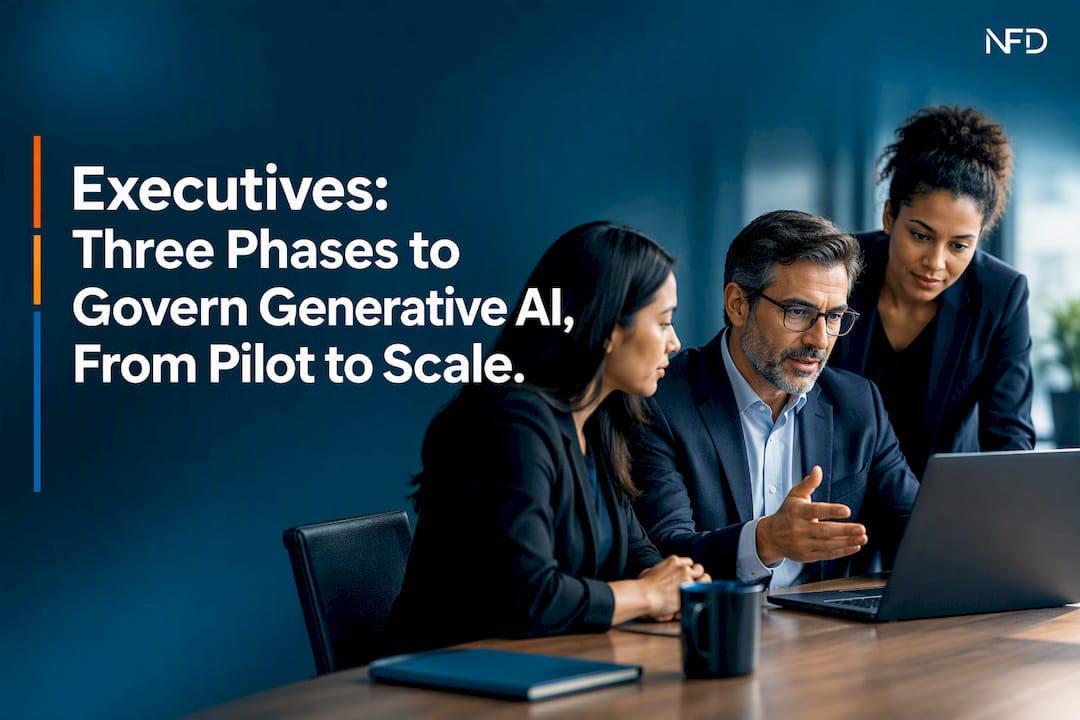
Generative AI data governance is the set of policies and enforceable controls that keep training and inference data lawful, traceable, and safe. The immediate priority for any organization deploying generative AI is straightforward: embed automated lineage and consent checks directly into your pipelines and secure an executive mandate to fund them. Anchor that work to recognized frameworks like ISO/IEC 42001, Canadian privacy guidance from the Office of the Privacy Commissioner, and Gartner’s AI TRiSM model, and you have a defensible starting point.
TL;DR:
- Upfront lineage and consent tracking are essential, as post-training traceability is nearly impossible once a model absorbs data patterns.
- Governance must be integrated into the entire AI lifecycle with policies, roles, and technical controls at each point, not added after deployment.
- Responsibility should be clearly assigned to executives, product owners, and privacy leads, with policies enforced automatically through infrastructure.
- Achieving maturity requires progressing through experiment, launch, and scale phases, with automation and reusable pipelines critical for ongoing compliance.
- Monitoring tools like lineage logs, model versioning, and incident registries are vital for demonstrating compliance and managing AI risks openly.
Traditional data governance manages records sitting in databases and warehouses. You know where a customer’s address lives, who touched it, and when to delete it. Generative AI breaks that model. A model trained on millions of documents doesn’t store a record, it absorbs patterns from it, and once training finishes, tracing a specific output back to a specific input becomes genuinely difficult.

This is why lineage has to start before training, not after. You need to know what data went into a model, under what licence, with what consent, and how it was transformed before the training job ever runs. Retrofitting that traceability after deployment is far harder than gating it upfront, according to Gartner’s analysis of why GenAI projects fail.
Two frameworks give this work structure:
Five principles recur across every credible generative AI compliance framework: accountability, transparency, safety, fairness, and privacy. The gap between organizations that manage AI risk well and those that don’t usually comes down to whether these principles are written into enforceable policy or left as slogans on a slide deck.
Map them to concrete anchors:
Each principle needs a governance artefact behind it: a written policy, an assigned role, a completed privacy assessment, and a line item in executive reporting. Without those artefacts, the principle is aspirational, not operational.
Governance has to travel with the data, not sit beside it. That means building controls at four distinct points in the pipeline rather than bolting on a review at the end.
Pro Tip: Don’t treat consent metadata as a compliance afterthought. Build it as a required field at the point of ingestion, so a training job without valid consent tags simply can’t run, rather than relying on someone remembering to check later.
Governance fails when responsibility is vague. It works when specific people own specific decisions and those decisions are enforced automatically rather than by memo.
The mechanism that makes this real is policy-as-code: encoding your approval rules directly into pipeline infrastructure so a training job lacking a consent flag or lineage record is blocked automatically, not flagged for someone to notice weeks later. Governance metrics belong on the same corporate scorecard as revenue and uptime, backed by actual budget rather than goodwill.
Generative AI governance maturity moves through three recognizable phases, and skipping a phase is the most common way projects stall or get shut down by legal review.
A realistic timeline runs three to six months from a first pilot to a governed production launch for a mid-sized organization, longer if legal review surfaces gaps in vendor contracts. Rushing this timeline is exactly the pattern Gartner points to when it predicts that 80% of data and analytics governance initiatives will fail by 2027 without a real driver forcing the change.
Auditability isn’t optional once regulators or clients start asking questions. You need telemetry that reconstructs what happened, not just a policy document that says what should happen.
Track a handful of KPIs consistently: consent coverage across your training datasets, the number of training jobs blocked by policy-as-code gates, and mean time to remediate a flagged issue. Gartner’s cross-border risk research warns that misuse of generative AI is a growing source of data breaches, which makes documented, retrievable evidence, not just good intentions, the difference between a manageable incident and a regulatory finding.
We operate as a managed IT and AI enablement provider, applying governance controls directly in client infrastructure. We build them directly into client infrastructure. One recurring pattern: clients running an IT service management tool with a generative AI assistant layered on top, where ticket data, employee information, and customer details all flow through the same prompts. Governing that means classifying which fields can reach the model, filtering prompts before submission, and logging every interaction for later review, the same discipline covered in our Power Apps governance work for business applications.
Clients can request three practical artefacts:
Treating generative AI governance as strategic infrastructure, not a checkbox, is what separates organizations that scale AI reliably from those stuck relitigating the same risk debate every quarter. The gap isn’t technical maturity. It’s whether leadership funded automation and lineage tooling before the first production incident forced their hand.
— Geeshan
Standing up generative AI data governance without a partner who already handles SOC 2 controls, monitoring, and security operations means building three capabilities at once, on a compressed timeline, with a team that has other work to do. We position ourselves as a Managed Intelligence Provider, providing integrated managed IT, security operations, and AI enablement without coordinating separate vendors.

For most clients, the first engagement is a governance assessment through our Managed Intelligence Provider service, mapping your current AI use cases against ISO/IEC 42001 and Canadian privacy expectations before you scale further. From there, our managed cybersecurity and SOC services protect the training data and infrastructure underneath. If you’re weighing where to start, request a governance assessment through our Managed IT Services page and we’ll scope the gaps in your current pipeline before you write another policy document nobody enforces.
This article is general information, not a substitute for advice from a qualified lawyer. Consult a qualified legal professional about your own circumstances before acting on anything here.
There’s no single official “30% rule” recognized by a standards body or regulator for generative AI governance. If you’ve seen the figure applied to AI adoption or content generation elsewhere, treat it as an informal guideline rather than a governance requirement, and rely instead on frameworks like ISO/IEC 42001 for actual compliance obligations.
Organizations use generative AI itself to draft policy documentation, summarize audit logs, and flag anomalies in lineage records, but every one of those uses still needs the same consent and access controls as any other AI application. The ISED voluntary code recommends human oversight for exactly this reason.
Rather than naming specific vendors, focus on capability categories: automated lineage tracking, policy-as-code enforcement engines, content-aware storage for vector databases, and consent management platforms that tag data at ingestion. NetFusion Designs Inc helps clients evaluate and implement these capabilities through its Managed Intelligence Provider service rather than reselling a single tool.
Common formulations vary, but most frameworks converge on accountability, transparency, safety and robustness, and fairness, with privacy often treated as a fifth pillar specific to data-intensive systems like generative AI. ISO/IEC 42001 and the ISED voluntary code both reflect this structure in how they define required controls.
Yes, PIPEDA governs personal information used in generative AI systems the same way it governs any other business data, and the Office of the Privacy Commissioner’s guidance specifically warns against inputting personal information into public generative AI tools. Review our PIPEDA compliance checklist for the specific obligations that apply before training or fine-tuning on customer data.
%20(1).avif)
%201.avif)