Security Information and Event Management (SIEM) is defined as a platform that collects, normalises, and correlates security event data from across an enterprise’s entire infrastructure to enable real-time threat detection and compliance reporting. The role of SIEM in enterprise cybersecurity is not optional for organisations operating at scale. Regulatory frameworks like PCI DSS mandate centralised log storage and event monitoring, and SIEM is the primary technology that satisfies those requirements. For IT and security professionals, understanding how SIEM functions, where it fits alongside tools like SOAR and XDR, and where it falls short is the difference between a security programme that works and one that only looks like it does.
SIEM enhances threat detection by aggregating log and event data from firewalls, endpoints, identity providers, cloud workloads, and applications into a single normalised data stream. Without that normalisation step, a brute-force attack that spans three different systems looks like three unrelated events. SIEM correlation rules connect those events into a single alert.

Behavioural analytics take this further. Modern SIEM platforms establish baselines for user and system behaviour, then flag deviations. A service account that suddenly queries a database it has never touched is a weak signal on its own. Paired with a failed authentication event from an unusual IP address, it becomes a high-confidence indicator of compromise.
The connection between detection and response depends on how well SIEM integrates with SOC workflows. Analysts use SIEM as the starting point for triage: they review the correlated alert, pull supporting log evidence, and determine scope. The problem is that 45% of security alerts go unreviewed due to human resource shortages. That statistic means nearly half of what your SIEM detects never gets acted on.
The core challenge is alert volume, not detection capability. Continuous detection engineering and regular tuning of correlation rules are what separate a SIEM that generates noise from one that generates signal. Teams that treat SIEM as a set-and-forget tool will drown in false positives within months.
Key practices that keep SIEM detection effective:
Pro Tip: Treat your SIEM rule library like production code. Version it, review it quarterly, and retire anything that has not fired a true positive in six months.
SIEM is the system of record for enterprise security events, and that function is irreplaceable for forensic reconstruction and compliance. When a regulator or auditor asks for evidence of who accessed what system and when, SIEM log archives are the answer. No other platform consolidates that evidence across environments with the same depth.
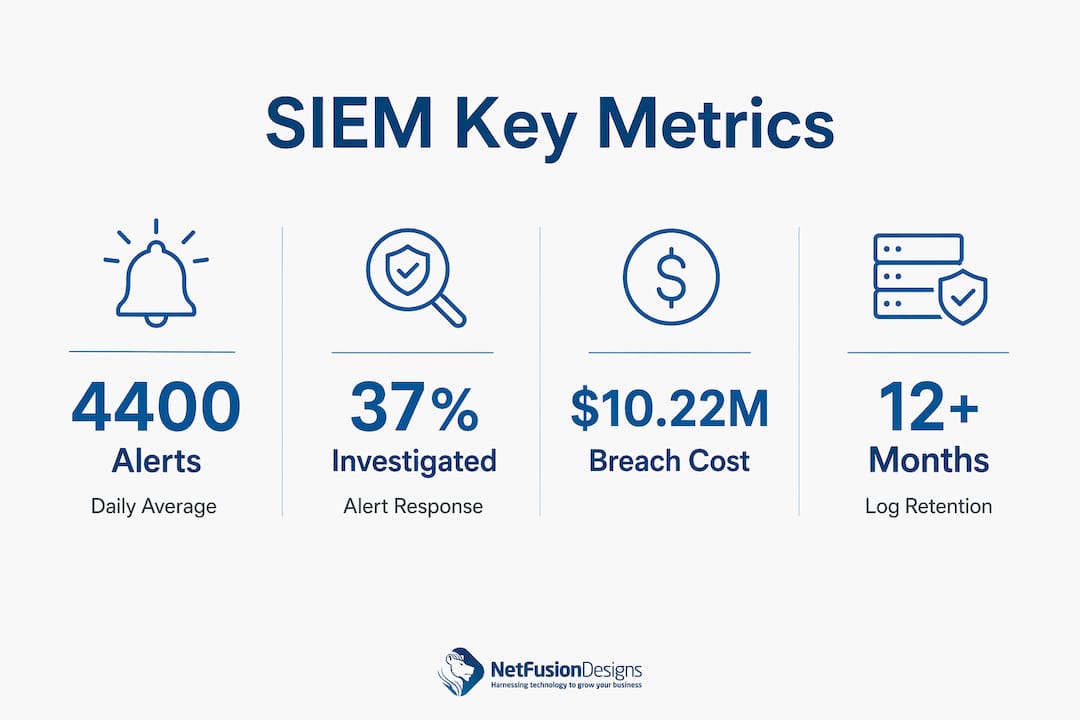
Regulatory frameworks are explicit about this. PCI DSS requires organisations to retain audit logs for at least 12 months, with the most recent three months immediately available for analysis. SIEM satisfies that requirement while also providing the reporting dashboards that auditors expect to see. Organisations that lack a SIEM often scramble to produce evidence manually, which is both expensive and unreliable.
40% of organisations use SIEM primarily for compliance reporting, and another 40% use it for basic detection. That split reflects how central compliance is to the SIEM business case. Only 20% use it for advanced threat hunting, which means most enterprises are leaving significant detection capability on the table.
How SIEM supports audit readiness in practice:
Pro Tip: Model your expected daily log volume before you sign a SIEM contract. Data ingestion costs can inflate subscription fees dramatically if low-value logs are not filtered at the source.
Deploying a SIEM is straightforward. Keeping it effective is not. The average enterprise SOC receives 4,400 alerts daily, and analysts investigate only 37% of them. That gap is not a technology failure. It is a capacity failure, and SIEM amplifies it by surfacing more events than any team can manually review.
Analyst burnout is a direct consequence. 71% of SOC analysts report burnout as a significant factor in their work, and alert fatigue is a primary driver. When analysts stop trusting their SIEM because it fires too many false positives, they begin ignoring alerts selectively. That selective ignoring is where breaches happen.
Cost is the other operational pressure. SIEM licensing models based on data ingestion volume create a perverse incentive: the more you monitor, the more you pay. Organisations that connect every log source without filtering first often face budget overruns within the first year of deployment. Early volume modelling, before procurement, is not optional.
Strategies that address these challenges directly:
The average US data breach cost $10.22 million in 2025. That figure makes even a significant SIEM investment look cost-justified when measured against the alternative.
SIEM, XDR, and SOAR each solve a different problem, and understanding the distinction prevents organisations from making redundant investments. SIEM is the data aggregation and correlation layer. XDR (Extended Detection and Response) focuses on detection and response across endpoint, network, and cloud telemetry with tighter native integration. SOAR automates the response workflows that SIEM and XDR surface.
The three technologies are complementary, not competitive. SIEM provides the long-term data retention and compliance reporting that XDR does not. XDR provides faster, more contextual detection across specific telemetry sources. SOAR turns the alerts from both into automated playbooks that reduce analyst workload.
AI and machine learning are reshaping what SIEM platforms can do natively. Enterprise SIEM selection in 2026 now prioritises AI-driven detection, alert noise reduction, and pricing transparency as top evaluation criteria. That shift reflects how much the market expects AI triage to be built into the platform rather than bolted on. Threat intelligence integrations, including AI-driven detection capabilities, are now a baseline expectation for enterprise-grade platforms.
| Technology | Primary function | Compliance value | Response automation |
|---|---|---|---|
| SIEM | Log aggregation, correlation, long-term retention | High | Low (without SOAR) |
| XDR | Cross-telemetry detection and investigation | Moderate | Moderate |
| SOAR | Workflow automation and playbook execution | Low | High |
Cloud-native SIEM deployments are replacing on-premises architectures for most new implementations. The shift reduces infrastructure overhead and makes elastic scaling practical, which directly addresses the data ingestion cost problem. For enterprises still running legacy on-premises SIEM, migration planning is now a near-term priority rather than a long-term consideration.
SIEM is the foundational detection and compliance layer in enterprise security, and its effectiveness depends entirely on continuous tuning, skilled analysts, and integration with response automation.
| Point | Details |
|---|---|
| SIEM is a system of record | It centralises log retention and forensic evidence across all environments for compliance and investigation. |
| Alert fatigue is the primary operational risk | 45% of alerts go unreviewed; tuning and SOAR integration are the most direct mitigations. |
| Compliance drives most SIEM adoption | 40% of organisations use SIEM primarily for compliance reporting, making it a regulatory necessity. |
| Cost control requires early planning | Model data ingestion volumes before procurement to avoid budget overruns from unfiltered log sources. |
| SIEM needs SOAR to close the loop | Detection without automated response leaves alerts unacted on, which is where breaches occur. |
The most common mistake I see enterprises make with SIEM is treating it as a finished product rather than an ongoing programme. Teams spend months on deployment, go live, and then assume the work is done. Six months later, the alert queue is unmanageable, analysts are ignoring half of what fires, and leadership wonders why they spent the budget.
SIEM is a visibility foundation, not a security outcome. The outcome comes from what you do with the visibility. That means pairing your SIEM with skilled analysts, defined incident response playbooks, and a SOAR integration that converts alerts into actions. Without those three elements, you have an expensive logging system.
The organisations that get the most from their SIEM are the ones that treat detection engineering as a continuous discipline. They map rules to MITRE ATT&CK, retire stale detections, and measure outcomes in MTTD and MTTR. They also know when their internal capacity has reached its limit and bring in managed services to fill the gap. That combination of technology, process, and people is what makes SIEM genuinely effective. Technology alone never will be.
— Geeshan
NetFusion Designs Inc is a SOC 2 Type 2-certified managed IT and security provider with teams across Ontario and Canada, including Kitchener-Waterloo, Toronto, Mississauga, and Markham. We support enterprises that need enterprise-grade security tools deployed and managed without building a full internal SOC from scratch.

Our 24/7 managed SOC service includes SIEM monitoring, alert triage, and incident response support backed by experienced analysts and defined playbooks. For organisations evaluating SIEM deployment or looking to get more from an existing platform, our cybersecurity services cover the full lifecycle from architecture to ongoing management. Contact NetFusion Designs Inc to discuss how we can support your security operations programme.
SIEM (Security Information and Event Management) is a platform that collects, normalises, and correlates security event data from across an enterprise’s infrastructure to support real-time threat detection, compliance reporting, and forensic investigation.
SIEM stores tamper-evident logs from all connected systems and generates pre-built compliance reports for frameworks like PCI DSS, SOC 2, and HIPAA, satisfying audit evidence requirements without manual log collection.
Alert fatigue is the primary challenge. The average enterprise SOC receives 4,400 alerts daily and investigates only 37% of them, making continuous tuning and SOAR integration critical to maintaining effective coverage.
SIEM aggregates and retains log data for detection and compliance. XDR focuses on cross-telemetry detection with faster native response. SOAR automates the response workflows that SIEM and XDR surface. The three technologies work best together.
SIEM detects and alerts but does not automate response on its own. Integration with a SOAR platform and defined playbooks is required to convert SIEM alerts into automated containment actions.
%20(1).avif)
%201.avif)