Build when the software touches the core of your competitive advantage. Buy, or buy and extend, when it doesn’t. That’s the whole rule, and most build/buy failures happen because a team skips this test and starts with “what can we build” instead of “does this need to be ours.”
The decision rule beneath that verdict is simple: weigh control against cost against urgency, in that order, for whatever system is on the table. A payroll tool rarely needs custom control. A pricing engine that encodes how you actually win deals usually does. Here’s what tends to tip the scale toward building rather than buying:
The strongest build/buy decisions come from comparing five-year total cost of ownership and control needs before writing a line of code or signing a licence.
| Point | Details |
|---|---|
| Build for differentiation only | Reserve custom development for capabilities that directly drive competitive advantage, not internal convenience. |
| Compare five-year TCO, not year one | Include maintenance, staffing, and vendor price increases before comparing build and buy costs. |
| Budget 15 to 20% annually for upkeep | Ongoing maintenance typically runs 15 to 20 percent of the initial build cost per year. |
| Default to buy-and-extend when unsure | A hybrid approach fits most real-world decisions better than a pure build or pure buy. |
| Bring in a partner for capacity gaps | NetFusion Designs Inc supports discovery, SOC 2-aligned security, and application development for teams without full in-house bench strength. |
Run this in a single meeting, before anyone touches a requirements document. It won’t give you a perfect answer, but it will surface disagreement early, which is cheaper than surfacing it in month four of a build.
Score each question honestly, even the uncomfortable ones about internal capacity. A decision framework built around exactly this trade-off treats reversibility as a sixth, implicit factor: when requirements are still fuzzy, the correct answer is often “wait,” not “build” or “buy.”
Pro Tip: If two or more of the five answers point toward “unclear,” don’t decide yet. Run a two-week no-code or low-code pilot to pressure-test the actual requirement before committing engineering headcount to it.
Sticker price is the least useful number in this decision. The real comparison is total cost of ownership over roughly five years, and most teams undercount it on both sides.
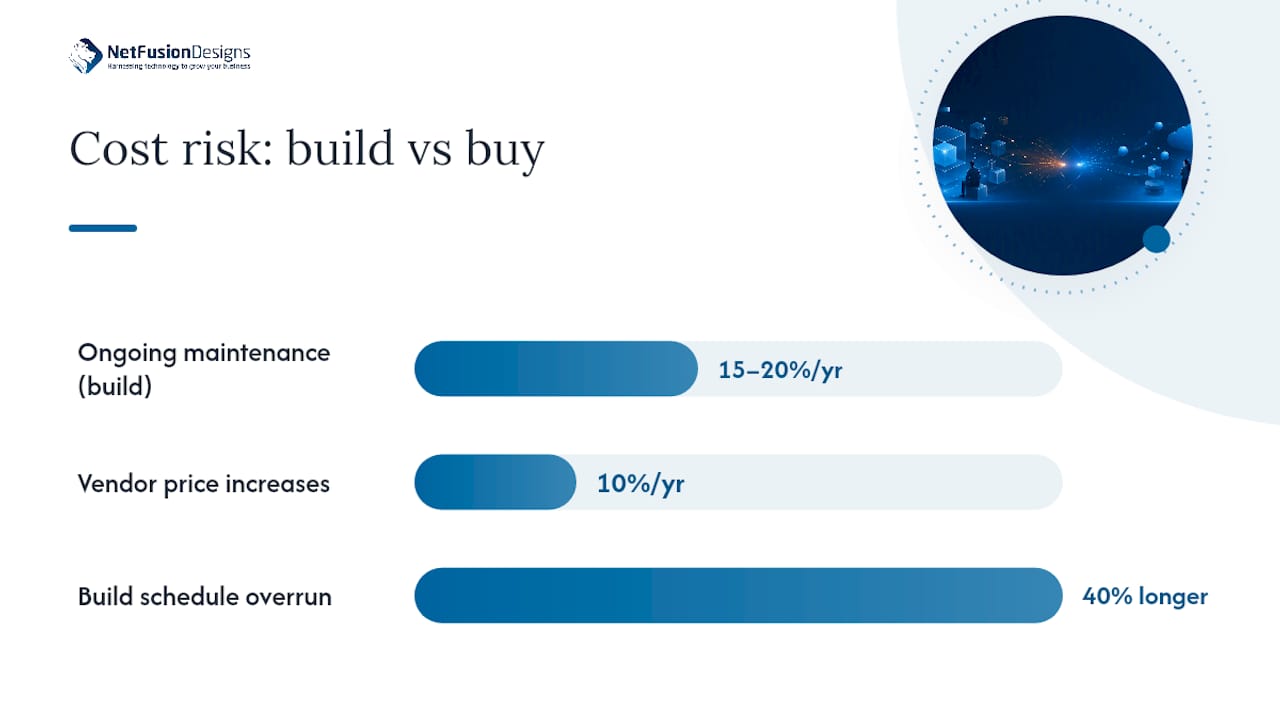
For a build, include: initial development, ongoing maintenance and patching, hosting and infrastructure, internal support time, integration work with existing systems, and the opportunity cost of engineers not working on something else. For a buy, include: licensing or subscription fees, implementation and configuration, vendor price increases over time, integration and middleware costs, and the staff time spent working around whatever the vendor doesn’t do natively.
A workable estimation method, using ratios instead of guessed dollar figures:
Pro Tip: Run the five-year comparison on a single page, side by side. If leadership can’t agree on the numbers in that view, the disagreement is about assumptions, not math, and that’s worth surfacing before you sign anything.
Building is justified when the software is the product, not the plumbing. Watch for these signals, and be honest about which ones actually apply versus which ones just feel flattering to your team.
A specialty insurer with a claims-adjudication logic nobody else uses is a build case. A company that just wants better dashboards on top of standard sales data usually isn’t, even if the current dashboards are ugly.
Pro Tip: Most successful builds are hybrids: a custom core wrapped around commodity infrastructure. Build the differentiator, buy or extend the layers underneath it, and resist the urge to build things like authentication or file storage that a platform already handles well.
Buying wins when the capability is commodity, time to value matters more than perfect fit, or your engineering bench is thin. Building HR software from scratch when a proven platform already handles it well rarely produces a return worth the risk.
Watch for these buy signals:
Between pure buy and pure build sits a spectrum worth knowing by name:
Vendor lock-in is the real risk here. Mitigate it with a data export clause and a documented exit plan written into the contract before you sign, not after you need it.
Build decisions rarely fail because the code doesn’t work. They fail because of what happens after launch, and most of it is predictable.
A structured risk analysis of custom projects groups these under process, people, and product, and the mitigation maps cleanly: pay for real discovery upfront, write staffing continuity into the plan, and hold the build to recognized security standards like SOC 2 from day one rather than retrofitting compliance later.
Pro Tip: Assign one accountable owner and one measurable stop condition before writing a line of code. “We’ll know it’s failing if X” is worth more than any status report you’ll get in month three.
Treat this as a six to ten week gate, not a single meeting. Rushing it is exactly how sunk-cost projects get started.
Before approval, business, security, and engineering stakeholders should each answer: does this justify five years of ownership? Does it meet our compliance baseline? Can we staff it after launch? A 12-point scoring rubric built around exactly these questions turns a subjective debate into something closer to a scorecard, which is worth borrowing whether you use all twelve points or just five.
Not every organization has the bench to run this whole process internally, and pretending otherwise is how projects stall at the discovery stage. A partner earns its place when it brings structured discovery, security practices aligned to standards like SOC 2, flexible pricing that mixes fixed discovery with time-and-materials build, and a plan for maintenance that doesn’t evaporate the day the project ships.
Consider a partner when:
NetFusion Designs Inc runs application development with this discipline built in, alongside enterprise consulting support for the governance and procurement side of the decision.
Most build/buy content treats this as a binary, and that framing alone causes bad decisions. The real answer, most of the time, is buy-and-extend, and the industry’s own data backs that up: pure build and pure buy are both minority outcomes once you look at how enterprises actually behave. Teams that frame the decision as “build or buy” end up defending whichever side they picked first, instead of asking the better question, which is how much of this needs to be ours.
The other overrated variable is speed. AI-assisted development has genuinely compressed prototyping time, and that’s real. But it hasn’t touched the five years of maintenance, security patching, and staffing that follow a launch, and too many 2026-era pitches quietly imply otherwise. If you take one thing from this framework, take this: the build decision isn’t about how fast you can ship version one. It’s about whether you can credibly own version one for the next five years. Most organizations can’t answer that question honestly in the room where the decision gets made, which is exactly why it needs to be asked out loud, on paper, before anyone commits budget.
If you’ve worked through the checklist above and landed on “build” or “buy-and-extend,” the next problem is execution, not theory. NetFusion Designs Inc runs the discovery-to-delivery process this article describes: fixed-cost discovery to pin down real requirements, SOC 2 Type II-aligned security practices baked in from day one, and ongoing maintenance handled by the same team that built the system, so it never becomes an orphaned project six months after launch.
That last part is what most build failures actually come down to: nobody owns the system once the launch excitement fades. NetFusion Designs Inc’s application development team stays accountable for the system after go-live, with managed IT support available to keep it running alongside everything else in your environment. If your team is leaning toward AI-assisted features as part of the build, AI enablement built around your business is worth a look before you scope that piece separately.
Book a discovery conversation to score your specific project against the five-question checklist above, with a real engineering team in the room instead of a slide deck.
Custom software fits your exact workflow and data model instead of forcing your business to adapt to someone else’s assumptions, and it gives you full control over integrations, security posture, and future changes.
Cost depends entirely on scope, but a realistic estimate includes upfront development plus an ongoing maintenance budget of roughly 15 to 20 percent of the initial build cost per year, not just the launch invoice.
Start with a fixed-cost discovery phase to nail down real requirements, build or configure a narrow prototype to test the core assumption, then move to full development only after a go/no-go review with defined acceptance criteria. Partners like NetFusion Designs Inc structure this exact sequence to reduce sunk-cost risk before full build spend begins.
No. Age has little bearing on the skills that matter here, decision judgment, technical literacy, and the ability to run a structured evaluation process, all of which are built through experience and study rather than tied to when someone starts.
Choose buy-and-extend when a vendor platform covers most of your needs but a smaller piece of your workflow is genuinely unique. This hybrid path fits most enterprise decisions better than either pure option.
%20(1).avif)
%201.avif)