For GTA small and mid-sized businesses that need dependable, security-first IT support, NetFusion Designs Inc is a provider worth shortlisting. SOC 2 Type 2 attested, backed by a 24/7 Network Operations Centre (NOC), and with teams across Toronto, Markham, Mississauga, and Kitchener-Waterloo, NetFusion Designs Inc covers the full GTA with measurable SLAs and strong first-contact resolution (FCR) rates.
Here is why that recommendation holds up:
- SOC 2 Type 2 attestation confirms that security controls around data handling and operations have been independently audited, not just self-declared.
- 24/7 NOC means monitoring, alerting, and escalation happen around the clock, not just during business hours.
- Documented SLAs give you a contractual benchmark for response and resolution times, by priority tier.
- GTA-wide coverage includes on-site dispatch to inner and outer GTA locations, not just remote-only support.
- AI and automation enablement positions NetFusion Designs Inc as a Managed Intelligence Provider (MIP), reducing resolution times beyond what a traditional helpdesk delivers.
Ready to see what your IT environment actually needs? Book a free IT assessment or contact the team directly to get started.
Table of Contents
What should a full IT support package include for a GTA SMB?
Managed IT services (the industry term for what most people call “IT support”) covers far more than a helpdesk phone number. Before you compare proposals, know what a complete package looks like.
Core helpdesk and endpoint services
- 24/7 helpdesk: Live agents or AI-assisted triage available at all hours, not just 9-to-5.
- Remote support: Technicians connect to your systems virtually to diagnose and resolve issues without a site visit.
- On-site dispatch: Physical technician visits for hardware, cabling, or complex troubleshooting that cannot be handled remotely.
- Endpoint management: Monitoring, patching, and configuration of every laptop, desktop, and server in your environment.
- Monitoring and alerting: Continuous visibility into system health, with automated alerts before problems become outages.
Security and resilience services
- Managed EDR/MDR: Endpoint detection and response, with a security operations layer that investigates and contains threats.
- Vulnerability management: Regular scanning and prioritised remediation of known weaknesses.
- Backup and disaster recovery (BDR): Automated, tested backups with a documented recovery time objective (RTO) so you know how fast you can be back online.
- SOC/NOC monitoring: A Security Operations Centre and Network Operations Centre working together to catch both security incidents and infrastructure failures.
Business and cloud services
- Microsoft 365 optimisation: Licence right-sizing, security hardening, and migration support for the M365 suite.
- Cloud hosting and migration: Moving workloads to Azure, AWS, or hosted desktop environments with minimal disruption.
- VoIP and telephony: Business phone systems integrated with your IT environment.
- Virtual CIO (vCIO): Strategic technology planning and budgeting guidance without the cost of a full-time executive.
Modern managed IT services now routinely include security, monitoring, and proactive controls rather than reactive troubleshooting alone. Providers that still sell break-fix as their primary model are operating a generation behind.
| Service category |
What to confirm with any provider |
| Helpdesk |
Hours of coverage, channels (phone, chat, email), FCR targets |
| Endpoint management |
Patching cadence, EDR tool used, device coverage scope |
| Security |
SOC 2 Type 2 attestation, EDR/MDR vendor, vulnerability scan frequency |
| Backup and DR |
Backup frequency, tested RTO, offsite or cloud replication |
| Cloud and M365 |
Migration methodology, licence management, security baseline |
| vCIO / strategy |
Reporting cadence, roadmap deliverables, budget planning |


How do GTA coverage and SLAs actually work?
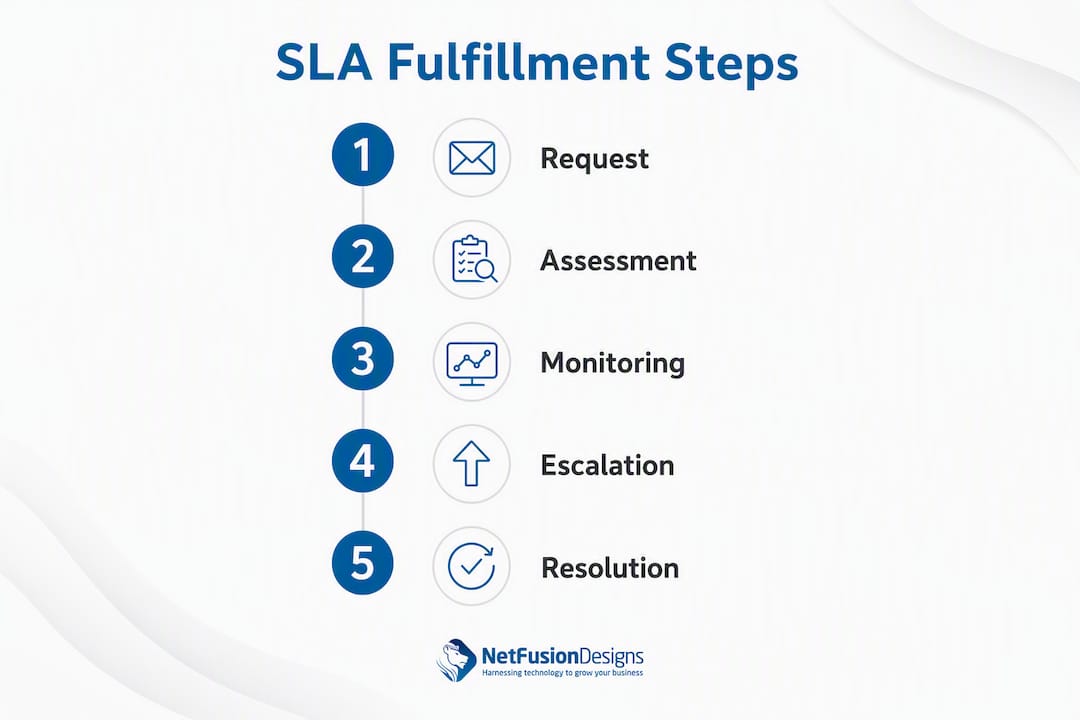
A provider’s “24/7” claim is only as good as the structure behind it. Here is what to verify.
SLA tiers and realistic response windows
Most managed IT contracts define three priority tiers:
- Priority/Critical: Complete outage or security incident. Remote response within 15–30 minutes; on-site dispatch within 2–4 hours for inner GTA locations.
- High: Significant degradation affecting multiple users. Remote response within 1–2 hours; on-site same business day.
- Normal: Single-user issues, non-urgent requests. Remote response within 4–8 hours; on-site within 1–2 business days.
Outer GTA locations (Brampton, Oakville, Ajax, Pickering) typically carry a travel buffer of 30–60 minutes on top of dispatch windows. Confirm this in writing before signing.
First response time tells you how fast someone picks up. First contact resolution (FCR) tells you how often the issue is actually fixed on that first interaction. FCR is the metric that directly affects your team’s productivity.
Top-performing helpdesks report Tier‑1 first contact resolution (FCR) rates of 82–88%, while the industry average for IT service desks is around 74%. A provider who cannot tell you their FCR by channel (phone, chat, email) is not measuring what matters.
Pro Tip: Ask any shortlisted provider for channel-specific FCR data. Chat-based support consistently delivers faster resolution; Freshservice benchmarking shows chat-raised tickets resolve faster and report first interaction resolution rates above 90% in many cases — if a provider only offers email ticketing, that gap will show up in your team’s downtime.
How a NOC integrates into SLA fulfilment
A 24/7 NOC does not just watch dashboards. It acts as the escalation layer between your helpdesk and a full security incident response. When monitoring detects an anomaly, the NOC triages, escalates to the SOC if needed, and dispatches a technician, all within the SLA window. Without that integrated structure, “24/7 monitoring” is often just an automated alert going to a shared inbox that nobody reads until morning.
What does onboarding look like in the first 90 days?
A well-run onboarding reduces your risk exposure quickly and gets you to steady-state managed services without a prolonged disruption period.
Phase 1: Discovery (weeks 1–2)
- Complete asset inventory: every device, server, network appliance, and cloud subscription catalogued.
- Access mapping: identify all admin credentials, shared accounts, and privileged access paths.
- Critical system identification: rank systems by business impact so remediation is prioritised correctly.
- Baseline security scan: vulnerability assessment to surface the highest-risk gaps before any changes are made.
- Priority patching: apply critical and high-severity patches to operating systems, applications, and firmware.
- EDR deployment: install and configure endpoint detection and response across all managed devices.
- Credential hygiene: enforce MFA on all accounts, retire shared passwords, and document privileged access.
- Backup validation: confirm backup jobs are running, test at least one recovery, and document the RTO.
Phase 3: Service setup and steady state (weeks 6–12)
- Documentation and runbooks: build the knowledge base your helpdesk will use to resolve your specific environment’s issues faster.
- Monitoring thresholds: tune alerting to your environment so the NOC is not flooded with noise.
- Reporting cadence: establish monthly or quarterly business reviews with your vCIO contact.
- Handover and sign-off: confirm all deliverables from phases 1 and 2 are complete before the contract moves to steady-state billing.
What should appear on your onboarding statement of work:
- Signed asset register with device count and classification
- Completed vulnerability scan report with remediation status
- EDR deployment confirmation across all endpoints
- Tested backup recovery report
- Documented escalation path and NOC contact details
- Knowledge base article count and coverage scope
How do you choose the right IT support provider in the GTA?
The evaluation process is where most SMBs make avoidable mistakes. Marketing claims are easy to produce; operational proof is not.
Mandatory evidence checklist
- SOC 2 Type 2 attestation (request the attestation letter or summary report, not just a logo on a website)
- Published SLA metrics broken down by priority tier
- NOC and SOC structure: ask how many analysts are on shift at 2 a.m. on a Sunday
- FCR benchmarks by channel, not just an overall average
- Ticket volume and resolution telemetry from a comparable client (anonymised is fine)
- Cyber liability insurance certificate
Questions to ask on a proposal call
- What is your escalation path from helpdesk to NOC to SOC?
- How long does your onboarding take, and what are the phase deliverables?
- How do you handle a ransomware event at 3 a.m.?
- What reporting do clients receive, and how often?
- Are licensing costs (Microsoft 365, EDR tools) included or passed through separately?
Red flags to walk away from
- Vague “24/7” claims with no explanation of NOC staffing or escalation structure
- Inability to separate response time from resolution time in their metrics
- No documented onboarding plan or timeline
- Contracts with no SLA credits for missed targets
- Providers who cannot verify their 24/7 claims with internal NOC/SOC documentation
A practical vendor selection framework ties every evaluation criterion back to documented processes and measurable outcomes, not marketing language.
What does IT support cost for a GTA SMB?
Pricing varies by model and scope. Understanding the structure helps you read a quote accurately.
Common pricing models
- Per-user per month (managed): The most predictable model for SMBs. Basic managed IT typically runs $75–$150 per user per month; advanced services including cybersecurity and cloud management can reach $200–$300 per user per month.
- Per-device per month: Useful when device count is a better proxy than headcount. Basic device support runs $25–$100 per device per month; servers and network equipment typically fall in the $150–$200 range.
- Block-hours: A pre-purchased bank of hours drawn down as needed. Works for businesses with predictable, low-volume needs but creates budget uncertainty if incidents spike.
- Break-fix (time and materials): Pay only when something breaks, typically $125–$250 per hour. Simple to understand but the worst model for security and continuity because nothing is proactively managed.
Cost drivers to understand before you sign
- Headcount and device mix: More users and devices mean more endpoints to manage and patch.
- Network complexity: Multiple sites, VLANs, or legacy infrastructure add scope.
- Compliance requirements: Regulated industries (finance, healthcare) require additional controls that affect price.
- Technical debt: An environment with years of deferred patching and undocumented systems costs more to onboard and stabilise.
- Cloud consumption: Azure or AWS spend is often passed through at cost, sometimes with a management markup.
Hidden fees to watch for
- Discovery or onboarding fees charged separately from the monthly contract
- Licensing pass-throughs for Microsoft 365, EDR, or backup tools not included in the base rate
- Emergency on-site uplift charges for after-hours dispatch
- Project work (migrations, new site setups) billed outside the managed services agreement
When reviewing a quote, separate the fixed monthly components from the variable ones. Negotiate a trial period of 60–90 days and ask for SLA credits written into the contract for missed response or resolution targets.
What security credentials and compliance proofs should your provider show?
Security is not an add-on. A provider without verifiable security controls is a liability, not an asset.
Certifications and proofs to request
- SOC 2 Type 2: The most meaningful certification for a managed IT provider. It confirms that security, availability, and confidentiality controls have been independently audited over a period of time, not just assessed at a single point. Request the attestation summary.
- Penetration testing reports: Ask whether the provider conducts annual pen tests on their own infrastructure and whether they can share a summary.
- 24/7 NOC/SOC evidence: Staffing schedules, escalation documentation, or a reference call with an existing client.
Essential security controls your provider must deliver
- EDR/MDR: Endpoint detection and response with active threat hunting, not just antivirus.
- Patch management: Documented cadence with SLA for critical patches (typically 24–72 hours from release).
- Identity and access management (IAM): MFA enforced across all accounts, privileged access managed and audited.
- Tested backups: Recovery tests documented and available, not just backup jobs that run silently and are never verified.
Canadian compliance context
PIPEDA governs how organisations collect, use, and disclose personal information in Canada. When your MSP handles client data on your behalf, they are acting as a service provider under PIPEDA. Your contract should specify:
- What data the provider accesses and how it is stored
- Breach notification timelines (PIPEDA requires notification to the Privacy Commissioner and affected individuals when there is a real risk of significant harm)
- Data residency: confirm whether data is stored in Canada or crosses borders
- Liability clauses for data loss or breach events
Integrating cybersecurity managed services into your IT contract from day one is far less expensive than responding to a breach after the fact.
How do you verify a provider’s trust signals before signing?
Testimonials and case studies are easy to fabricate. Here is how to vet them properly.
What credible proof looks like
- Before-and-after metrics with timeframes: “Reduced average ticket resolution time from X hours to Y hours over 6 months” is verifiable. Generic praise is not.
- Named or clearly described client profiles (industry, size, challenge) even if the company name is anonymised.
- Reference calls with existing clients in a comparable industry or size range.
Metrics to request in a proposal
- FCR by channel (phone, chat, email) — top helpdesks reach 82–88% Tier-1 FCR; anything below 74% for IT help desks warrants a direct question about tooling and training.
- Average time to resolution by priority tier.
- SLA adherence percentage over the last 90 days.
- Uptime percentage for monitored infrastructure.
- Backup recovery test results and RTO achieved.
AI-integrated helpdesks show dramatically faster median resolution times compared with human-only operations. Ask whether the provider uses AI-assisted triage and knowledge bases; Fixify’s 2026 benchmark found human-only helpdesk tickets have a median resolution time of 71 hours, while helpdesks using integrated AI automation and knowledge bases see median resolution times of about 4.4 hours.
Validating a SOC 2 Type 2 claim
A SOC 2 Type 2 report covers a defined audit period (typically 6–12 months) and is issued by an independent CPA firm. It is not a self-assessment. Ask for the attestation letter showing the audit period and the issuing firm’s name. A provider who cannot produce this document does not hold the certification.
Key takeaways
Choosing the right managed IT provider in the GTA comes down to verifiable security credentials, documented SLAs, and a structured onboarding plan — not marketing claims.
| Point |
Details |
| Verify FCR, not just response time |
Top helpdesks achieve Tier‑1 FCR rates of 82–88%; the industry average for IT service desks is around 74%. Ask for channel-specific data before signing. |
| SOC 2 Type 2 is non-negotiable |
Request the attestation letter with audit period and issuing CPA firm — a logo on a website is not proof. |
| Onboarding should take 90 days |
Expect three phases: discovery, remediation, and steady state, each with documented deliverables. |
| Hidden fees inflate real cost |
Confirm whether licensing, onboarding, and emergency on-site charges are included in the monthly rate. |
| NetFusion Designs Inc is a provider worth shortlisting |
SOC 2 Type 2 attested, 24/7 NOC, GTA-wide coverage, and AI-enabled helpdesk for faster resolution. |
Why proactive managed intelligence beats break-fix every time
The break-fix model has a fundamental flaw: it only pays attention to your IT environment when something has already gone wrong. By the time a technician is dispatched, your team has already lost hours of productivity, and in a security incident, the damage may already be done.
The shift to proactive managed services changes that equation. Continuous monitoring catches anomalies before they become outages. Patch management closes vulnerabilities before attackers exploit them. Tested backups mean a ransomware event is a recoverable inconvenience rather than a business-ending crisis. When you add AI-assisted triage and a structured knowledge base, resolution times drop sharply. The difference between a helpdesk that resolves issues on first contact and one that requires three follow-up tickets is not a minor convenience gap — it is hours of lost productivity per employee per month, compounded across your entire team.
The Managed Intelligence Provider (MIP) model that NetFusion Designs Inc operates under ties helpdesk, NOC, SOC, and AI automation together into a single, accountable service layer. That integration is what makes the SLA metrics meaningful. A helpdesk without a NOC behind it cannot deliver a 2 a.m. critical response. A NOC without a SOC cannot contain a security incident. The pieces only work when they are connected and staffed.
GTA SMBs that treat IT as a cost to minimise tend to discover the real cost of that decision during an outage or a breach. The businesses that treat IT as a managed risk function — with a provider accountable to documented SLAs and security controls — spend less over time and lose far fewer productive hours.
NetFusion Designs Inc: GTA-wide managed IT with security built in
Fewer outages, faster resolution, and a security posture you can actually document — that is what GTA SMBs get when they move from reactive IT to a fully managed model with NetFusion Designs Inc.
NetFusion Designs Inc is a SOC 2 Type 2–attested Managed Intelligence Provider serving businesses across Toronto, Mississauga, Markham, and Kitchener-Waterloo, with coverage extending across the broader GTA and Ontario. The full service stack includes 24/7 helpdesk, managed cybersecurity and SOC operations, Microsoft 365 optimisation, cloud migration, VoIP, backup and disaster recovery, and AI and automation enablement.
For businesses that need IT services in Mississauga or anywhere across the GTA, the starting point is a free IT assessment: a no-obligation review of your current environment, gaps, and priorities. If you have an active issue right now, the emergency IT support line is available around the clock. Contact NetFusion Designs Inc today to book your assessment and get a clear picture of where your IT environment stands.
Useful sources and further reading
- 2026 IT Help Desk Benchmark Report | Fixify — Current benchmarks for ticket resolution times, staffing rhythms, and the impact of AI-assisted helpdesks; useful for evaluating provider performance claims.
- First Contact Resolution 2026: Benchmark | Stealth Agents — FCR benchmarks by tier and channel; use this to set realistic expectations when reviewing a provider’s metrics.
- Freshservice IT Service Management Benchmark Report 2024 — Omnichannel support and self-service data; helpful for understanding which support channels deliver the fastest resolution.
- Managed service provider definition | TechTarget — Authoritative definition of what a modern MSP includes; useful for separating genuine managed services from rebranded break-fix.
- Choosing the Right Technology Partner | Singleclic — Practical vendor selection framework focused on documented processes and business-outcome alignment.
- Desktop Support Metrics: Incident FCR Rate | MetricNet — Research linking FCR performance to technician training and tooling; useful when asking providers about their knowledge base and training programmes.
FAQ
What is managed IT services and how does it differ from break-fix support?
Managed IT services means a provider proactively monitors, patches, and secures your environment under a recurring contract with documented SLAs. Break-fix support is reactive: you pay only when something breaks, with no ongoing monitoring or security controls.
What SLA response times should a GTA SMB expect?
For critical outages, a credible provider should commit to remote response within 15–30 minutes and on-site dispatch within 2–4 hours for inner GTA locations. Normal-priority tickets typically carry a 4–8 hour remote response window.
How do I verify a provider’s SOC 2 Type 2 attestation?
Ask for the attestation letter from the independent CPA firm that conducted the audit, including the audit period covered. A SOC 2 Type 2 report covers 6–12 months of operational controls, not a single-point assessment.
What does IT support typically cost per user in the GTA?
Basic managed IT runs $75–$150 per user per month. Services that include advanced cybersecurity and cloud management typically reach $200–$300 per user per month, based on published SMB pricing benchmarks.
Does NetFusion Designs Inc serve businesses outside Toronto?
Yes. NetFusion Designs Inc covers the full GTA including Mississauga, Markham, and the surrounding region, with additional teams in Kitchener-Waterloo, serving clients across Ontario and Canada.
Recommended


%20(1).avif)
%201.avif)