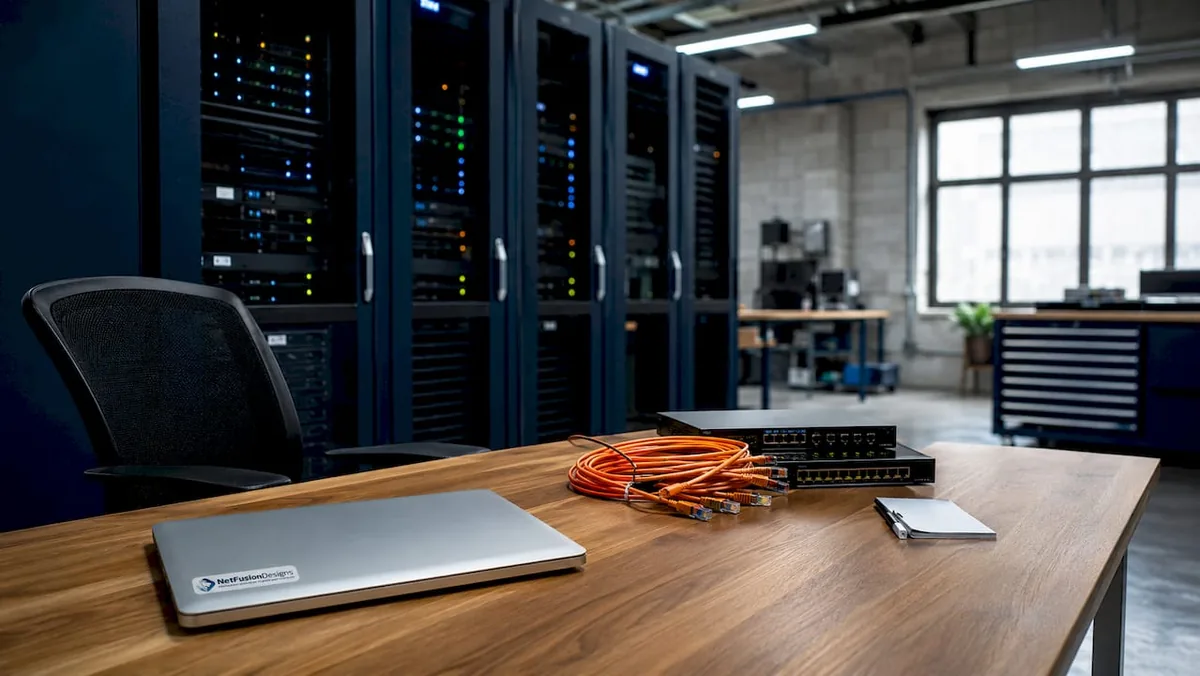
Manufacturing IT support is the specialised management of IT systems, networks, and security controls that directly sustain production operations, data integrity, and network reliability on the factory floor. Unlike general business IT, it must account for operational technology (OT) environments where a server outage does not just slow down email. It stops production lines. Manufacturing was the most targeted sector for cyberattacks for the fifth consecutive year in 2025, accounting for 27.7% of all cybersecurity incidents globally. That figure alone tells you this is not a back-office concern. Standards like IEC 62443 and the Purdue Model exist precisely because the stakes in manufacturing are measured in production hours, not help desk tickets.
Effective manufacturing IT support rests on four pillars: network infrastructure, IT/OT integration, cybersecurity, and continuous monitoring. Each one depends on the others. Weakness in any single pillar creates risk across all four.
Industrial Ethernet backbones, network segmentation, and wireless strategies form the physical foundation of factory IT networks. Wi-Fi 6E and private 5G are now the standard for high-density manufacturing environments where dozens of sensors, robots, and edge devices share bandwidth. Poor physical cabling and missing segmentation at the greenfield stage cost five to ten times more to fix during retrofit than to design correctly from the start. Getting the architecture right before the first machine is installed is the single highest-return decision a manufacturer can make.
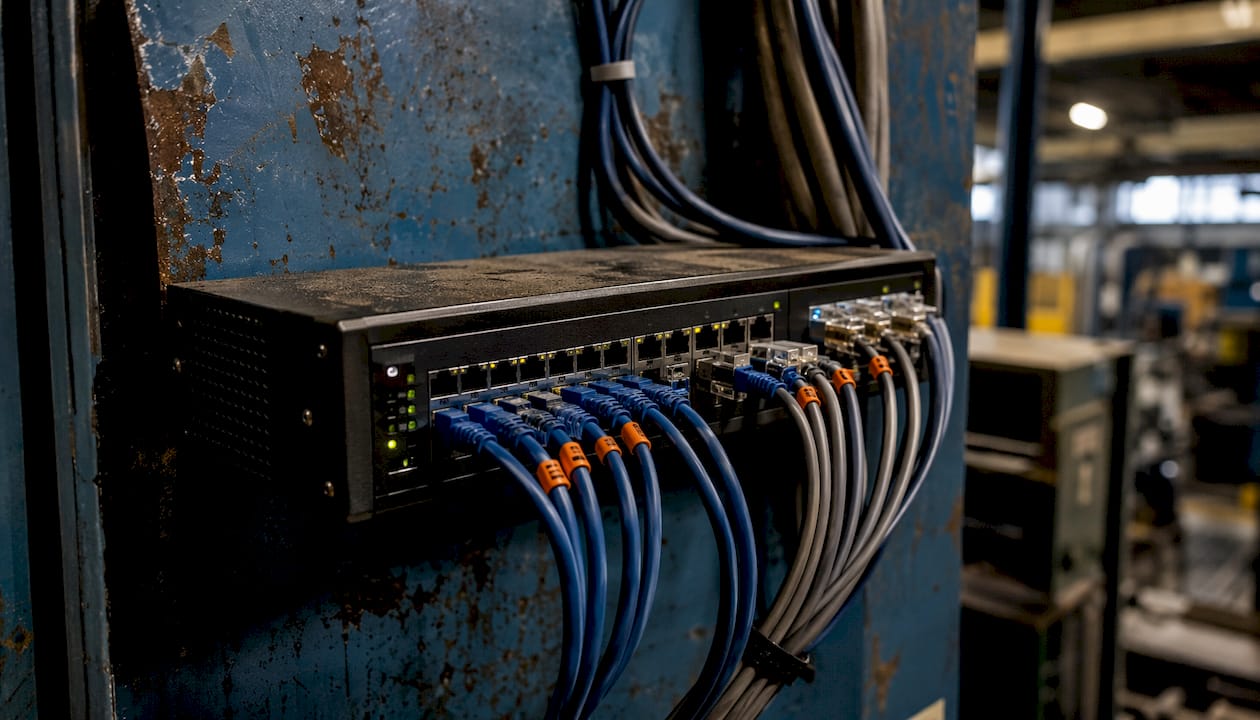
The Purdue Model organises manufacturing networks into distinct zones, separating enterprise IT from control systems and field devices. Network segmentation based on this model prevents threats from moving laterally from a compromised email server down to a programmable logic controller (PLC) on the production line. Without this separation, a single phishing email can reach the machinery that runs your plant. IT/OT convergence is not optional in 2026. It is the architecture that makes everything else work safely.
Manufacturing IT support requires patch management, multi-factor authentication (MFA), and a multi-layered defence posture aligned with IEC 62443. These are not aspirational goals. They are the minimum baseline for any facility connected to the internet. Incident response planning and tested backup strategies complete the picture, because detection alone is not enough when production continuity is at stake.

Pro Tip: Segment your OT backup systems from your enterprise IT backups. A ransomware attack that encrypts your business systems should never be able to reach your production recovery data. Separate cloud backup strategies for OT and IT environments are a non-negotiable control.
The table below compares standard IT support functions with those specific to manufacturing environments.
| Function | Standard IT support | Manufacturing IT support |
|---|---|---|
| Network management | LAN, Wi-Fi, VPN | Industrial Ethernet, private 5G, OT segmentation |
| Security monitoring | Endpoint and email | ICS-aware tools covering OT protocols |
| Incident response | IT systems recovery | OT/ICS-specific recovery with production continuity |
| Patch management | OS and software updates | OT firmware with change-freeze windows |
| Compliance | SOC 2, ISO 27001 | IEC 62443, NIST CSF for OT |
Manufacturing carries a disproportionate share of the global cyber risk burden. 62% of all observed industrial ransomware victims in Q1 2026 were in the manufacturing sector, with nearly 500 incidents reported in North America alone. That concentration is not accidental. It reflects how attractive manufacturing targets are: high operational pressure, legacy OT systems, and historically weak IT/OT boundaries.
“Production disruptions caused by ransomware in manufacturing often stem not from ICS malware but from attacks on virtualization and enterprise IT systems that support OT workloads.” — Dragos Manufacturing OT Cybersecurity Analysis
This finding reframes the threat entirely. Attackers do not need to compromise a PLC directly. They attack the Windows servers and virtual machines that run the software your OT systems depend on. That is why IT/OT segmentation gaps are so dangerous. Nearly 50% of manufacturing assessments reveal shared IT and OT domains with no proper segmentation, a rate three times higher than in the oil and gas sector. Every shared domain is a direct pathway for a threat actor.
The detection problem compounds the exposure. In 56% of manufacturing network penetration tests, defenders failed to detect adversaries using native admin tools like PowerShell, RDP, and WMI. Standard IT security tools do not understand ICS protocols, so malicious activity hidden inside normal automation tasks goes unnoticed. The attacker moves freely while the monitoring dashboard shows green.
Unique risk factors in manufacturing cybersecurity include:
Manufacturing cyber breaches frequently cause full OT site shutdowns, requiring IT support teams to prioritise OT-tailored rapid recovery plans rather than standard IT restoration procedures. The recovery timeline for a production environment is measured differently than for an office network. Every hour offline has a direct dollar cost tied to output.
Resilience in manufacturing IT comes from deliberate architecture and tested processes, not from buying a single product. The following steps reflect what works in practice.
Implement network segmentation based on the Purdue Model. Divide your network into clearly defined zones: enterprise, supervisory, control, and field device layers. Each zone should have explicit rules governing what traffic can cross its boundary.
Develop an integrated IT/OT incident response plan. Integrating IT and OT security teams and creating overlapping response processes prevents gaps in defence and accelerates threat detection. A plan that only covers enterprise IT will fail when the attack hits OT systems.
Deploy ICS-aware monitoring tools. Standard endpoint detection tools do not understand Modbus, PROFINET, or EtherNet/IP. Use monitoring platforms built for OT visibility so that anomalies in industrial protocols trigger alerts, not silence.
Secure all remote and vendor access with MFA and strict access policies. Vendor remote sessions are a leading entry vector. Every third-party connection should require MFA, be time-limited, and be logged in full.
Conduct regular vulnerability assessments and ransomware readiness drills. A penetration and vulnerability assessment specific to your OT environment will surface risks that standard IT scans miss entirely. Drills should simulate production shutdown scenarios, not just data breach scenarios.
Maintain tested, air-gapped backups for OT configurations. PLC programs, HMI configurations, and historian data should be backed up separately from enterprise data, with restoration tested at least quarterly.
Pro Tip: Schedule ransomware tabletop exercises that include your operations manager, not just your IT team. The decisions made in the first two hours of an attack, such as whether to shut down a line or keep it running, are operational decisions. Your IT team cannot make them alone.
Optimised IT support for production environments does more than prevent outages. It actively enables the technologies that improve throughput, reduce waste, and lower maintenance costs. Edge computing, IoT sensors, and cloud integration all depend on a reliable, well-managed IT foundation to deliver their promised benefits.
Wireless infrastructure is a clear example. Wi-Fi 6E reduces latency and increases device density on the factory floor, enabling real-time data collection from hundreds of sensors simultaneously. Private 5G goes further, providing dedicated bandwidth for autonomous guided vehicles (AGVs) and time-sensitive control applications. Neither technology delivers value without the network management and security controls that manufacturing IT support provides. Digital transformation partners, including those offering custom AI tools for manufacturing SMEs, consistently identify reliable IT infrastructure as the prerequisite for any meaningful automation project.
The table below summarises the operational benefits that well-managed IT infrastructure enables in manufacturing.
| Technology | IT support requirement | Operational benefit |
|---|---|---|
| IoT sensors and edge computing | Low-latency OT network, ICS monitoring | Real-time production visibility and predictive maintenance |
| AI analytics platforms | Secure cloud integration, data pipelines | Reduced unplanned downtime through pattern detection |
| Private 5G / Wi-Fi 6E | Wireless infrastructure management | High-density device connectivity on the factory floor |
| Cloud-based historian systems | Hybrid cloud architecture, backup management | Centralised production data with disaster recovery |
| Automated guided vehicles | Network segmentation, real-time monitoring | Increased throughput with reduced manual handling |
Predictive maintenance is where the return on IT investment becomes most visible. When sensors feed clean, continuous data to an analytics platform, maintenance teams shift from reacting to failures to preventing them. That shift reduces unplanned downtime, which is consistently the largest controllable cost in manufacturing operations.
Effective manufacturing IT support requires purpose-built network architecture, ICS-aware security tools, and integrated IT/OT incident response plans to protect production continuity and reduce downtime.
| Point | Details |
|---|---|
| IT/OT segmentation is non-negotiable | Nearly 50% of manufacturing sites lack proper IT/OT separation, creating direct threat pathways to production systems. |
| Ransomware targets enterprise IT, not just OT | Attacks on virtualization and IT systems that support OT workloads cause production shutdowns without touching a single PLC. |
| ICS-aware monitoring closes detection gaps | Standard IT tools miss OT threats; 56% of penetration tests show defenders failing to detect native admin tool abuse. |
| Incident response must cover OT specifically | 24% of manufacturing sites have no OT/ICS incident response plan, the highest preparedness gap in any industrial sector. |
| IT investment enables operational gains | Edge computing, AI analytics, and private 5G all require reliable IT support to deliver measurable efficiency improvements. |
The manufacturers who struggle most with IT support share one trait: they treat IT as a cost centre that runs in the background until something breaks. I have seen greenfield facilities spend millions on automation equipment and then argue over the budget for proper network segmentation. The retrofit bill, when the flat network eventually gets compromised, is always larger than the segmentation project would have been.
The other pattern I keep seeing is the assumption that OT security is someone else’s problem. The operations team assumes IT handles it. The IT team assumes the OT vendor handles it. Nobody owns it. That gap is exactly what threat actors exploit, and the ransomware incidents hitting KW manufacturers are a direct result of it.
What actually works is treating IT and OT as a single, integrated system with shared accountability. That means joint incident response drills, shared visibility tools, and a clear escalation path that both teams understand before an incident occurs. The technology is available. The discipline to maintain it consistently is what separates facilities that recover quickly from those that lose weeks of production.
The threat landscape is also moving faster than most manufacturers realise. Ransomware groups now specifically target the virtualization layers that OT systems depend on, because they know that is where the operational pain is. Staying ahead of that requires continuous monitoring and a support partner who understands both sides of the IT/OT boundary.
— Geeshan
Manufacturing environments need IT support that understands production schedules, OT constraints, and the real cost of downtime. NetFusion Designs Inc is a SOC 2 Type 2-certified managed IT provider with direct experience supporting manufacturers across Ontario and Canada.

NetFusion Designs Inc delivers 24/7 monitoring, ICS-aware security, MFA enforcement, and tested incident response planning built for facilities where every hour offline has a measurable cost. Whether you need managed IT services tailored to your production environment or emergency IT support when an incident is already underway, NetFusion Designs Inc has the team and the tools to respond. Manufacturers across Mississauga, Kitchener-Waterloo, and the broader Ontario region can explore local managed IT options designed specifically for their operational needs.
Manufacturing IT support is the specialised management of IT systems, OT networks, and cybersecurity controls in production environments. It differs from standard IT support by covering industrial protocols, ICS-aware monitoring, and OT-specific incident response.
Manufacturing accounted for 27.7% of all cybersecurity incidents in 2025 and 62% of industrial ransomware victims in Q1 2026. Legacy OT systems, flat network architectures, and high operational pressure make the sector disproportionately vulnerable.
The Purdue Model is a network architecture framework that separates enterprise IT from OT control systems and field devices in manufacturing environments. It prevents threats from moving laterally from a compromised business system to production machinery.
Nearly 50% of manufacturing assessments reveal shared IT and OT domains with no proper segmentation. That creates direct pathways for ransomware and other threats to reach production systems from a compromised enterprise network.
An effective plan must cover OT-specific recovery procedures, not just enterprise IT restoration. It should include joint IT and OT team roles, tested backup restoration for PLC and HMI configurations, and clear criteria for deciding when to shut down production lines during an active incident.
%20(1).avif)
%201.avif)