Cybersecurity managed services integration is the process of connecting an external Managed Security Service Provider (MSSP) to your business’s existing IT environment so that monitoring, detection, and response run continuously without requiring an in-house security team. GTA small and mid-sized businesses face a serious and growing threat: SMBs are targeted roughly four times more often than large organisations. That gap exists because attackers know smaller businesses carry valuable data but typically lack enterprise-grade defences. When you integrate cybersecurity managed services in the GTA, you close that gap without building a costly internal security operations centre from scratch.
Preparation determines whether your integration succeeds or stalls. Before you engage any provider, your business needs a clear picture of its current IT environment, its internal team’s capabilities, and the compliance obligations it must meet.
Your network, endpoints, and cloud environments must be documented before an MSSP can monitor them effectively. That means a current asset inventory covering servers, workstations, mobile devices, and any cloud workloads running in Microsoft Azure or similar platforms. Without this inventory, your provider cannot set accurate detection baselines, and alerts will be noisy and unreliable from day one.

Multi-factor authentication (MFA) should already be active on all critical accounts. Encryption must protect data at rest and in transit. These are not MSSP responsibilities. They are your baseline, and providers will expect them in place before onboarding begins.
Your internal team needs a designated point of contact who can communicate with the MSSP daily. This person does not need to be a security expert, but they must understand your business priorities and have authority to make decisions during an incident.
GTA businesses also carry specific compliance obligations. Depending on your sector, you may need to align with the Canadian Centre for Cyber Security’s baseline controls, PIPEDA data protection requirements, or sector-specific frameworks like PCI DSS for payment processing. Your MSSP must understand these obligations before integration begins.
| Prerequisite | What to prepare |
|---|---|
| Asset inventory | Document all endpoints, servers, and cloud workloads |
| MFA and encryption | Active on all critical systems before onboarding |
| Compliance mapping | Identify applicable frameworks (PIPEDA, PCI DSS, etc.) |
| Internal contact | Designate a single point of contact with decision authority |
| Network documentation | Current network diagrams and firewall configurations |
Pro Tip: Run a free vulnerability scan on your public-facing assets before your first provider meeting. It gives you a concrete starting point and signals to the MSSP that you are a prepared client.
Selecting the right provider is the first real decision. Focus on three criteria: their experience with GTA businesses of your size, their service model (do they operate a 24/7 SOC or rely on business-hours coverage?), and their contractual clarity. MSSP contracts must explicitly state responsibilities, SLA guarantees, breach response commitments, and exit policies to avoid surprise costs and gaps in accountability.
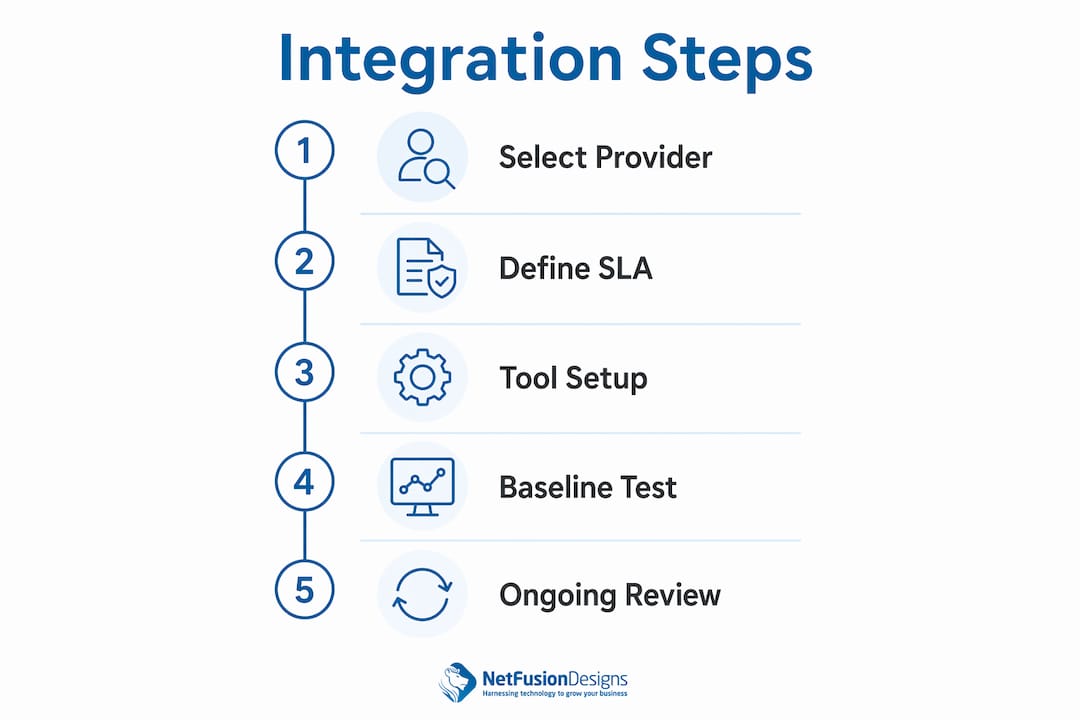
Effective onboarding typically requires four to six weeks and must include defined Service Level Agreements before any monitoring goes live. Rushing this phase is the single most common reason integrations fail in the first 90 days.
Building an in-house SOC requires four to six analysts with salaries ranging from CA$90,000 to CA$300,000 annually for senior positions. For most GTA SMBs, that cost makes in-house security operationally impossible. An MSSP delivers the same coverage at a fraction of that cost.
Managed cybersecurity service integration also requires you to demand written confirmation of the MSSP’s SOC location and staffing. Offshore or understaffed SOCs introduce communication latency that directly harms incident response quality during an emergency.
Pro Tip: Ask your provider to show you a sample incident report from a real engagement (anonymised). The quality of that document tells you more about their operational maturity than any sales presentation.
MSSPs work best as an extension of your internal team, not as a separate vendor you check in with quarterly. The MSSP handles 24/7 monitoring and alert triage. Your internal team focuses on business-driven decisions, architecture changes, and compliance reporting. That division only works when both sides communicate consistently.
Set a weekly or bi-weekly standing call with your MSSP contact. Use it to review open incidents, discuss upcoming business changes (new offices, software rollouts, staff changes), and adjust monitoring priorities. Business context is what separates a useful alert from a false positive. Sharing business context and threat intelligence between your MSSP and internal team directly improves incident response quality and prioritisation.
Joint incident response planning is non-negotiable. Define escalation rules, investigation authority, and role clarity before an incident occurs. Waiting until a breach to figure out who calls whom creates costly delays.
Pro Tip: Treat your MSSP’s quarterly business review as a board-level agenda item, not an IT meeting. When leadership sees the threat data, security investment decisions become much easier to justify.
Operational failures in MSSP integrations most often trace back to incomplete onboarding, miscommunication, and generic response runbooks rather than technical failures. Knowing these pitfalls in advance lets you prevent them.
Alert fatigue is the most common early problem. When detection rules are not tuned to your environment, analysts receive hundreds of low-quality alerts daily and begin ignoring them. The remedy is a mandatory baseline period before go-live, combined with a formal alert review at the 30-day mark.
Responsibility gaps are equally damaging. If your contract does not specify who owns each response action, incidents stall while both sides wait for the other to act. Define escalation rules and investigation authority in writing before integration begins.
| Challenge | Remedy |
|---|---|
| Alert fatigue | Enforce a baseline period; review and tune rules at 30 days |
| Unclear severity mapping | Define severity levels and response times in the SLA before go-live |
| Responsibility gaps | Document who owns each response action in the contract |
| Communication breakdowns | Set standing weekly calls and a named contact on both sides |
| Incomplete onboarding | Follow the six-milestone onboarding process without skipping steps |
| Generic incident runbooks | Require provider to customise runbooks to your specific environment |
Pricing for managed security services in Canada ranges from CA$2,000 to CA$5,000 monthly for basic coverage up to CA$25,000 for extensive enterprise-level programmes. Understanding this range helps you budget realistically and avoid providers whose pricing signals they are cutting corners on coverage.
Integrating cybersecurity managed services in the GTA requires structured onboarding, clear contractual role definitions, and active ongoing collaboration to deliver reliable, enterprise-grade protection for SMBs.
| Point | Details |
|---|---|
| Prepare before you engage | Document assets, activate MFA, and map compliance obligations before contacting any provider. |
| Structured onboarding matters | A four-to-six-week onboarding with defined SLAs prevents the most common early integration failures. |
| Role clarity prevents gaps | Define who owns each response action in writing before monitoring goes live. |
| Communication drives value | Weekly standing calls and shared business context improve alert quality and incident response speed. |
| Cost justification is clear | An MSSP delivers 24/7 SOC coverage at a fraction of the cost of building an in-house team. |
Working with small and mid-sized businesses across the Greater Toronto Area, I have seen the same pattern repeat. A business signs with an MSSP, assumes the technical setup is the hard part, and then discovers six months later that the relationship is not delivering value. The alerts are noisy, the response times are vague, and nobody is sure who owns what during an incident.
The technical integration is actually the easy part. The hard part is treating the MSSP as a genuine operational partner. That means investing time in the onboarding process, showing up to the quarterly reviews, and giving your provider the business context they need to make good decisions on your behalf.
I have also seen businesses focus too heavily on price when selecting a provider. The managed IT services benefits of a well-integrated MSSP go far beyond cost savings. The real value is in the speed and quality of response when something goes wrong. A CA$500 monthly saving on your contract means nothing if your provider takes four hours to respond to a ransomware alert.
My honest advice: spend as much time evaluating the provider’s communication model and SOC staffing as you do evaluating their technology stack. The tools matter, but the people and processes behind them matter more.
— Geeshan
NetFusion Designs Inc is a SOC 2 Type 2-certified Managed IT Services provider with teams in Toronto, Markham, and Mississauga. GTA businesses working with NetFusion Designs Inc get fully managed security, 24/7 NOC monitoring, and Microsoft 365 management under one provider, without the complexity of coordinating multiple vendors.

NetFusion Designs Inc’s IT services in Mississauga cover the full integration lifecycle, from initial infrastructure assessment and compliance mapping through to ongoing monitoring and incident response. If your business is ready to move from reactive IT to a structured, managed security model, NetFusion Designs Inc is built for exactly that. You can also explore endpoint protection options to complement your managed security programme.
Integration means connecting an external MSSP to your existing IT environment so that monitoring, detection, and incident response run continuously. The MSSP handles 24/7 coverage while your internal team retains control over business decisions and architecture.
Effective onboarding typically requires four to six weeks, including SLA definition, tool integration, baseline establishment, and a tabletop exercise before go-live.
Pricing ranges from CA$2,000 to CA$5,000 monthly for basic managed security coverage, up to CA$25,000 monthly for extensive enterprise-level programmes, depending on scope and service depth.
The biggest operational risk is incomplete onboarding combined with unclear role definitions. Both create responsibility gaps that delay incident response when a real threat occurs.
Yes. Depending on your sector, you may need to align with PIPEDA, the Canadian Centre for Cyber Security’s baseline controls, or frameworks like PCI DSS. Your MSSP must understand these obligations before integration begins.
%20(1).avif)
%201.avif)