AI in customer service means software that reads customer messages, works out what the customer needs, and either resolves the request or helps a human agent do it faster. For a small or mid-sized Canadian business, the sensible path is to start with one repetitive type of request, keep people in the loop for anything complex, and measure results from the first week. This guide covers what the technology does, what Canadian organizations have reported, what to measure, how to protect customer trust and data, and how the same thinking applies on a manufacturing floor.
The term covers several tools that are often confused with each other. Older chatbots followed scripts: a customer picked a menu option and got a prewritten reply. Modern systems use language models that read the whole message, look up information in your knowledge base or customer records, and write a response grounded in your own policies.
In practice, businesses use AI in four ways:
The difference from traditional support is less about speed than about design. Traditional support is built around tickets, queues and agents. AI-assisted support is built around good answers drawn from trusted information, with a human taking over when the case needs judgment or empathy. That is why the quality of your knowledge base matters more than which tool you buy.
Large Canadian institutions have published enough detail to show what realistic results look like.
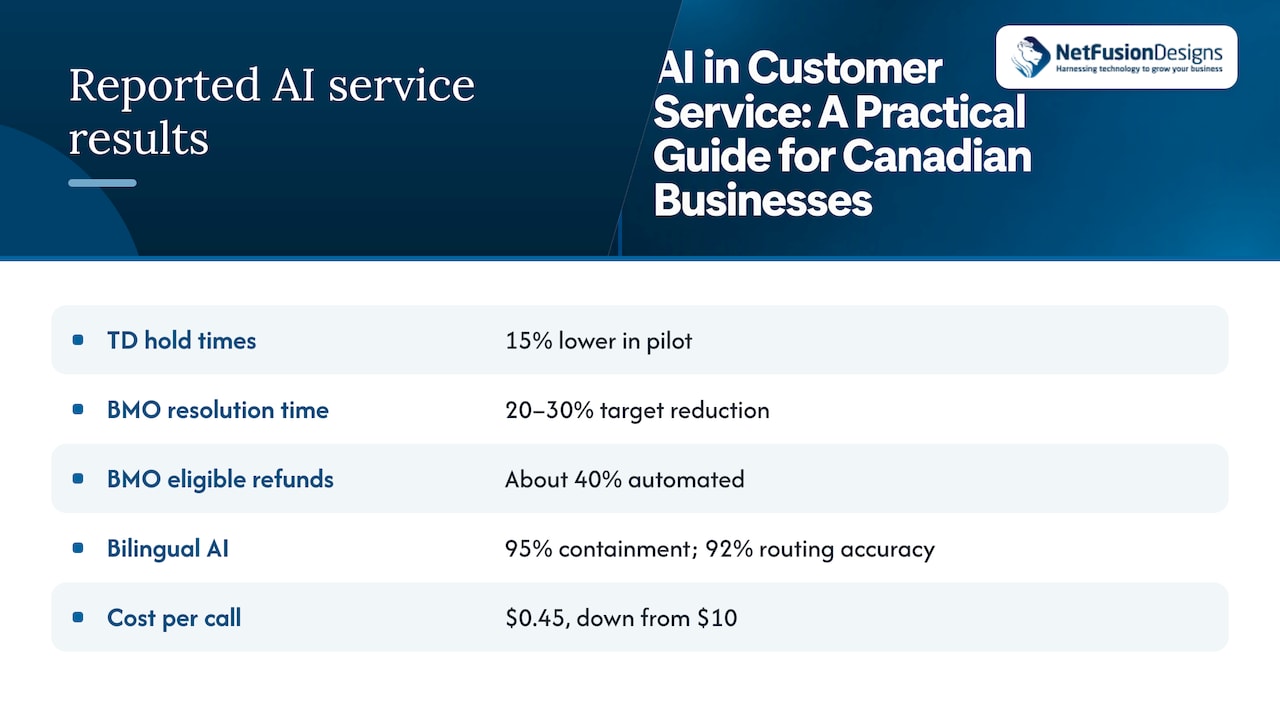
TD introduced a generative AI virtual assistant in 2024 to help contact centre representatives answer client questions faster by finding answers in the bank’s policies and procedures within seconds. In the pilot, call hold times fell by 15%, and the bank reports that more than 1,000 representatives now use the tool daily. Note the model: the AI supports the human, and the human still talks to the customer.
BMO announced an AI Agent Assist for credit card inquiries in November 2026. The bank aims to cut resolution time by 20-30% on eligible inquiries and to process about 40% of eligible credit refund requests automatically. Employees stay accountable for reviewing what the AI produces.
Deloitte Canada describes a leading Canadian financial institution whose bilingual conversational AI reached a 95% call containment rate and 92% routing accuracy, with an average cost per call of $0.45, down from $10. Separately, Deloitte reports a customer service team that cut its transfer rate from 40% to 22% in nine months while handling 36% more calls.
These are large organizations with big call volumes and dedicated teams. A 25-person firm will not see the same numbers, but the pattern holds at any size: pick well-defined requests, ground the AI in accurate information, and let people handle the exceptions.
A few examples that fit a Canadian SMB:
Automation of the surrounding work often delivers as much as the chat itself. Creating tickets, updating records and sending confirmations are good candidates, and our Power Automate examples show how those workflows are built in Microsoft 365.
The technology is only useful if customers accept it. Canadian surveys are a useful reality check.

A ServiceNow survey reported by The Globe and Mail in April 2026 found that 85% of customers prefer a human on the phone for complex issues, and 59% named a lack of empathy or understanding as their top frustration. A Gartner survey cited by the same paper in October 2024 found that 64% of customers would prefer companies avoid AI in service, and more than half said they would consider switching if they learned a company used it.
The lesson is not to avoid AI. It is to deploy it where it earns its place:
Businesses are responsible for what their AI tells customers. Dr. Gene Moo Lee of the University of British Columbia noted in the October 2024 Globe and Mail piece that AI is hard to explain or interpret, and that companies can be held accountable for inaccurate information their systems provide. In practice that means limiting the AI to approved sources, reviewing a sample of conversations every week, and keeping humans in charge of anything involving refunds, contracts, health or legal advice.
Counting how many chats the bot handled tells you little. Measure outcomes the customer would recognize.
| Metric | What it tells you | How to use it |
|---|---|---|
| First-contact resolution | Whether the issue was solved the first time | Deloitte recommends prioritizing it and measuring it often as you add channels and technology |
| Transfer rate | How often AI hands off to a person | A falling rate with stable satisfaction is a good sign |
| Average handling time | Speed for agents using AI assist | Compare before and after on the same request types |
| Cost per contact | Whether savings are real | Include licences and staff time for review |
| Customer satisfaction | Whether customers are happy with the outcome | Segment AI-resolved and human-resolved cases |
| Escalation quality | Whether handoffs carry full context | Sample 20 handoffs a month |
Set a baseline for two to four weeks before launch. Without it, you cannot tell whether a change came from the AI or from a quiet season.
Our secure AI adoption guide for SMBs covers the security side in more detail, and an AI roadmap for small business helps you sequence projects beyond support.
Many readers who search for AI in customer service also ask about manufacturing, and the connection is real: both are about using AI to handle high-volume, repeatable decisions while people deal with exceptions. For Ontario manufacturers, the strongest applications are quality inspection, quality assurance and scheduling.
NGen, Canada’s advanced manufacturing supercluster, explains that computer vision systems analyze product images to detect defects or deviations from quality standards, so issues are caught early in production. Two Canadian examples show the scale:
These are large manufacturers. For a mid-sized plant, BDC notes that AI-driven visual inspection is a common quality control use case and suggests starting small.
Machine learning can detect defects and anomalies in real time from production data. The Canam example shows what it takes: thousands of correctly labelled images and a person checking results until accuracy is trusted. Plan for labelled examples of good and bad parts, consistent lighting and camera positions, and a regular review of the model’s misses.
BDC says AI can optimize production schedules using demand forecasts, labour and raw-material availability and machine capacity, to maximize throughput and shorten lead times. NGen adds that machine learning can analyze historical production data to find patterns that improve scheduling. A Toronto-area pilot by Actemium for a packaging manufacturer reportedly reduced production hours by 34% by sequencing orders better.
Whatever you measure, tie it to numbers the plant already tracks: scrap rate, rework, schedule attainment, downtime and on-time delivery.
BDC advises defining needs and goals, considering integration, scalability and vendor support, starting small, preparing clean data and monitoring performance indicators. Connecting cameras, sensors and scheduling tools also widens your network exposure, so review security at the same time. Our manufacturing cybersecurity best practices cover that ground.
We see the same mistake in customer service AI and in plant-floor AI: a business buys a tool first and works out the problem second. The firms that do well begin with a single, clearly measured job, such as sorting incoming requests or helping agents find the right policy, and they build from there.
Our approach is to treat AI as part of your IT environment, not a separate experiment. That means the identity and access controls, the data handling, the Microsoft 365 setup and the helpdesk processes are sound before an assistant touches customer information. It is also why we work as one provider for IT, cybersecurity and AI, so nobody is left coordinating between vendors.
We design for people to stay in charge. The best results come when AI removes the repetitive work and your team spends its time on the conversations that need judgment and empathy. Start small, measure honestly, and expand when the numbers justify it.
Geeshan
NetFusion Designs is a SOC 2 Type II-certified provider of managed IT and AI enablement for small and mid-sized businesses across Ontario and Canada. We help you choose a first use case, prepare your data and Microsoft 365 environment, and put automation and AI in place with security built in. Our managed intelligence provider service combines day-to-day IT management with practical AI and automation.
If your team is stretched on support, our 24/7 helpdesk and IT support can take routine requests off your plate, and our AI solutions for SMEs show how we approach projects. To talk through your situation, start at nfd.ca.
For most small and mid-sized businesses, the realistic goal is to take repetitive requests off your team so people can focus on complex cases. The Canadian examples above, including TD and BMO, keep employees responsible for reviewing and handling AI output. Surveys also show many customers still want a human for complicated problems.
Choose a high-volume, low-risk request such as order status, hours, appointment details or password resets. Alternatively, start with agent assist, where AI drafts replies and finds policies for your staff to approve. Both are easy to measure and easy to roll back.
Baseline your numbers first, then compare first-contact resolution, transfer rate, handling time, cost per contact and customer satisfaction after launch. Deloitte recommends putting first-contact resolution at the centre. Review a sample of conversations weekly to catch wrong answers early.
The principles carry over: define one problem, prepare clean data, pilot small and track performance indicators. In manufacturing, the common starting points are visual inspection for quality, machine learning for defect detection and AI-assisted scheduling. Canadian manufacturers such as Canam and Seagate have published results from these areas.