A virtual CIO (vCIO) in Canada is priced as a monthly retainer, an hourly rate, or a bundle inside a managed IT agreement. The fee depends on how many senior hours you get, how many staff and locations you have, and how much compliance work sits on top. Published ranges vary widely, so the useful question is what you get for each dollar. This guide shows how the fee is built, how it compares with hiring a full-time CIO, and how to judge whether it pays off.
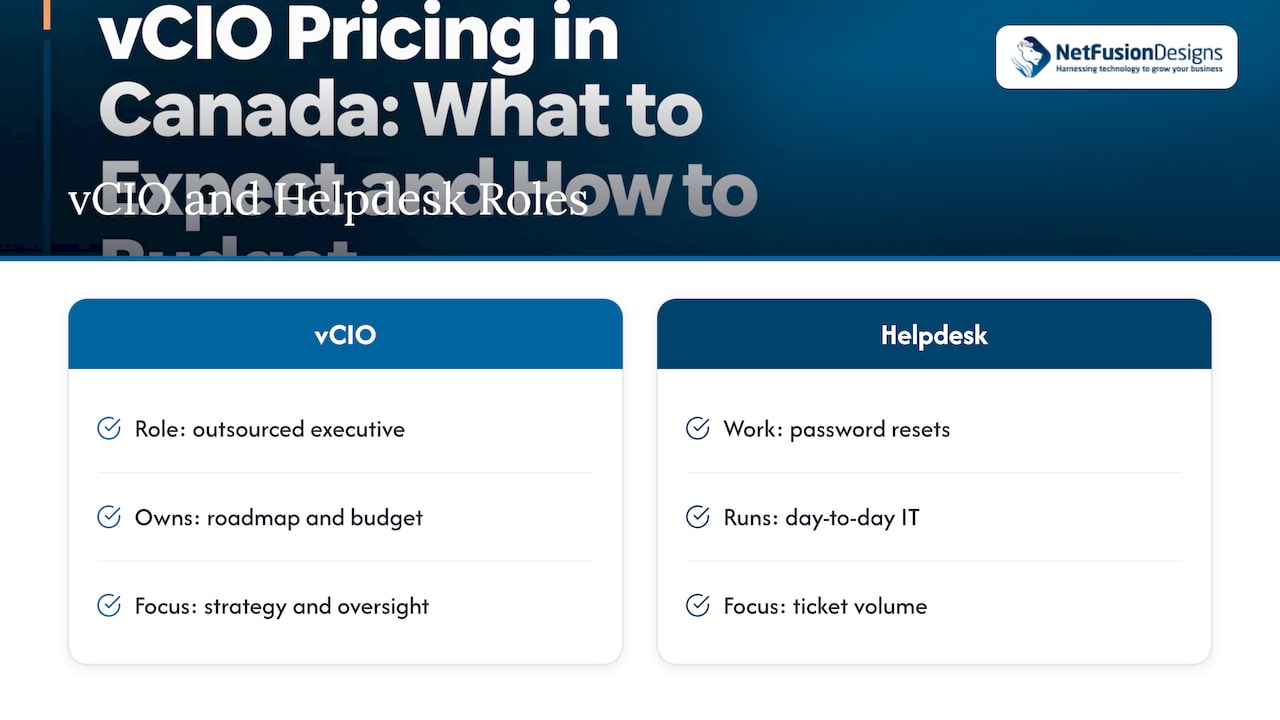
A vCIO is an outsourced technology executive. They sit in your planning meetings, own your IT roadmap and budget, and translate business goals into technology decisions. They are not the person who resets passwords. That work belongs to the helpdesk.
The distinction matters for pricing. You are paying for judgment and accountability, so the fee reflects senior time, not ticket volume. Our own virtual CIO services are built around this: strategy, planning and oversight, backed by the engineers who run your day-to-day IT.
Canadian providers tend to use one of three models. Each suits a different kind of business.
| Model | How it works | Best for | Watch for |
|---|---|---|---|
| Monthly retainer | A flat fee for a defined scope and set number of senior hours | Businesses that want steady planning and a predictable budget | Scope that is vague about what is and is not covered |
| Hourly or project rate | You pay for time used, such as an assessment or a one-off roadmap | One-time needs: an audit, a cloud migration plan, a budget review | Costs that climb when issues keep surfacing |
| Bundled with managed IT | vCIO time is part of a managed services agreement | Firms that want one provider for strategy and operations | Confirm the vCIO hours are stated, not implied |
The retainer is the most common structure for ongoing advisory work because it matches how strategy actually happens: regular reviews, budget cycles and steady follow-through. Hourly suits defined, finite work. The bundled model removes a vendor and a contract, which is why many small and mid-sized businesses prefer it. For a wider view of how managed IT agreements are priced, see our guide to managed IT services pricing.
Two vCIO quotes can differ by a factor of two and both be fair. These are the factors that explain the gap.
The biggest driver is how much of the executive’s time you reserve. A quarterly review and an annual budget needs far less time than monthly steering meetings, project oversight and vendor negotiations. Ask how many hours are included and what happens when you need more.
More users, devices, applications and locations mean more to plan, document and govern. A 15-person office on Microsoft 365 is a different job from a 120-person manufacturer with plant-floor systems and several sites.
If you handle client financial records, legal files or patient information, the vCIO spends more time on policies, risk registers, audit evidence and security roadmaps. Regulated sectors such as law, accounting and healthcare usually need more of this work than a typical office does. The same applies if you need to show customers a third-party audit.
A clean, documented environment is cheaper to advise on than one with ageing servers, undocumented systems and several overlapping vendors. The first months often carry extra effort for an assessment and a baseline. That is where the roadmap comes from.
When the vCIO and the team running your systems work for the same provider, the recommendations are executed without a handoff. That can reduce the coordination overhead you would otherwise pay for. It is a main reason we offer vCIO alongside managed IT services.
A good scope is specific. Look for these deliverables in writing:
If a quote lists only “strategic consulting” with no deliverables, ask for the list above. It makes proposals comparable and protects both sides.
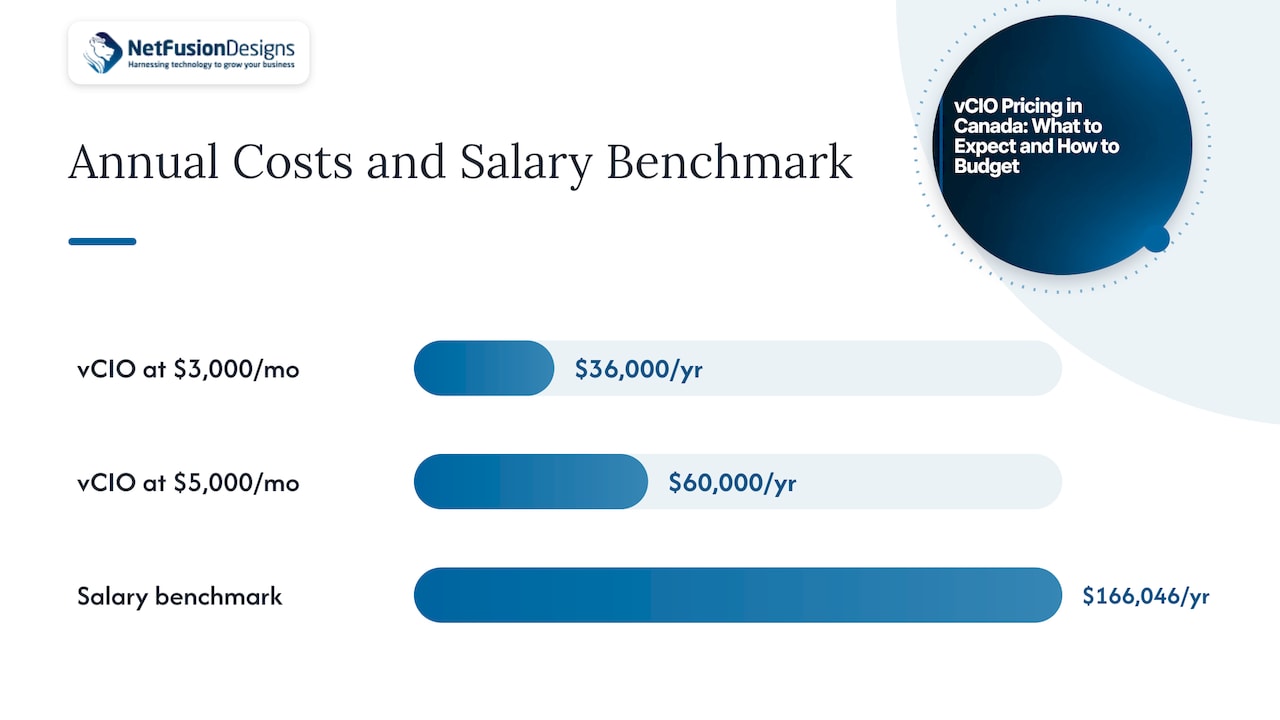
The fairest comparison is the annual cost of each route. Salary data gives you the full-time side.
Those are salary figures. They exclude benefits, bonus, recruiting, equipment and the cost of a vacancy. A hire also brings one person’s experience, with no cover for holidays or illness.
This is arithmetic for illustration, not a quote. Suppose a vCIO retainer cost $3,000 a month. That is $36,000 a year, about 22% of the PayScale average base salary of $166,046. If the retainer were $5,000 a month, the annual cost would be $60,000, about 36% of that salary. In both cases the business gets a senior adviser and a team behind them, not one person.
Most small and mid-sized businesses do not need a CIO for 40 hours a week. They need strategy for a few hours a month and reliable execution. That is the gap a vCIO fills. For a Toronto-specific view of the same trade-off, read our outsourced IT versus in-house cost breakdown.
A vCIO usually pays off when one or more of these is true:
If you have a full-time CIO who owns all of this, a vCIO adds little. For most firms of 10 to 200 staff, that is not the situation.
Hours logged are a poor measure. Use outcomes you can check at each quarterly review.
Set two or three of these at the start. A vCIO who agrees to measurable targets is one who expects to deliver value.
We think a vCIO is worth the most when it is not a separate product. When the person who plans your technology also works with the team that runs it, recommendations turn into done work, and nothing is lost in a handoff.
That is how we set up our service. Our team is SOC 2 Type II certified, and the vCIO can draw on our 24/7 NOC, helpdesk, security operations and Microsoft 365 specialists. You deal with one provider for IT, cybersecurity and AI, with no third-party vendor management on your side.
We also believe pricing should be plain. We aim for transparent, predictable monthly pricing and plain-language reporting, so an owner or a partner at a law or accounting firm can read the roadmap and the budget without a translator.
The best way to think about the fee is as the cost of having someone accountable for your technology direction. For most small and mid-sized businesses, that is a far lighter commitment than a full-time executive, with a team behind it.
Geeshan
We do not publish vCIO prices, because the right fee depends on the factors above. We scope it with you: your size, sites, compliance needs and current environment. Then we give you a predictable monthly figure and a written list of deliverables.
Our virtual CIO services work on their own or alongside managed IT and co-managed support. If you also want AI and automation guided by the same plan, our Managed Intelligence Provider approach brings it under one roof. We serve Ontario and the rest of Canada from Kitchener-Waterloo, Toronto, Markham, Mississauga, Montréal and Winnipeg.

Want a scoped vCIO quote? Start at our virtual CIO page and tell us about your business. For strategy tied to a specific project, our IT consulting in Toronto page explains how we work.
A few steps make quotes easier to compare and the final fee more accurate.
For a broader view of Canadian managed IT costs and contract terms, our 2026 guide to managed IT services in Canada is a good next step.
There is no single price. Providers use retainers, hourly rates or bundles, and the fee moves with senior hours, company size, locations and compliance work. Compare quotes on written deliverables and hours included, not on the headline number. NFD scopes vCIO fees to your business and does not publish a fixed price.
For most small and mid-sized businesses, yes. A Canadian CIO averaged a CAD $166,046 base salary in 2026 before benefits and bonus, and Toronto benchmarks run higher. A vCIO provides senior guidance for the hours you need, supported by a wider team.
Yes, and many businesses prefer it. The strategy and the day-to-day support come from one provider, so recommendations are carried out by the team that knows your systems. Ask for the vCIO hours and deliverables to be stated in the agreement.
Quarterly works for a stable business with few changes. Monthly suits a firm that is growing, moving, migrating or preparing for an audit. Either way, each meeting should end with written decisions and next steps.
Yes. A vCIO plans policies, security controls and the evidence that clients, insurers and auditors ask for. For regulated sectors such as law, accounting and healthcare, this planning is often a main reason to engage one.