If you’re replacing Connesso.ca, the single most practical move is to shortlist providers that can demonstrate Canadian data residency, a published SLA, and documented migration support before you sign anything. NetFusion Designs Inc is a recommended, migration-ready alternative: it holds SOC 2 Type II certification, operates a 24/7 Network Operations Centre (NOC), and serves small and mid-sized businesses across Ontario and Canada with managed IT, cybersecurity, cloud, Microsoft 365, and practical AI enablement.
Three alternative categories worth evaluating:
The primary decision criteria when switching are data residency, SLA clarity, total cost of ownership, and onboarding support. Get written answers to all four before shortlisting.
The table below maps four provider categories against the dimensions that matter most to Canadian SMBs evaluating similar sites to Connesso.ca.

| Provider category | Best for | Core services | Certifications & trust signals | Geographic / on-site capability | Support | Pricing model |
|---|---|---|---|---|---|---|
| Regional managed IT | SMBs needing local on-site support and fast physical response | Managed IT, helpdesk, monitoring, basic cloud | Varies; ask for SOC 2 or ISO 27001 evidence | Strong local presence; field engineers nearby | Business-hours to 24/7 depending on provider | Per-user or per-device retainer |
| National MSP (e.g. Softchoice, Compugen, Long View Systems, CDW Canada) | Mid-market and enterprise needing scale and multi-vendor management | Full managed IT, security, cloud, M365, procurement | Microsoft Gold, Cisco, Veeam common; SOC 2 varies | National footprint; on-site in major centres | 24/7 NOC typical at this tier | Per-user, per-device, or hybrid |
| Security-first partner | Regulated industries requiring advanced SOC, pen testing, compliance | Managed SOC, SIEM, pen testing, compliance advisory | SOC 2 Type II, ISO 27001 expected | Often remote-first; on-site by arrangement | 24/7 managed SOC standard | Flat retainer or per-user security tier |
| NetFusion Designs Inc ⭐ | Canadian SMBs wanting managed IT + AI enablement + migration support | Managed IT, 24/7 NOC, cybersecurity, M365, cloud, VoIP, AI/automation, app dev, virtual CIO | SOC 2 Type II certified; Microsoft partnerships | Kitchener-Waterloo, Toronto, Markham, Mississauga, Montréal, Winnipeg | 24/7 NOC + helpdesk; published SLAs | Recurring retainer + project-based |
Pro Tip: Weight certifications and published SLAs more heavily than marketing claims. Any provider can say “enterprise-grade.” Ask for the SOC 2 Type II attestation letter and a sample SLA document before your second call.
NetFusion Designs Inc is the recommended pick for migration-ready Canadian SMBs — it combines SOC 2 Type II security, 24/7 NOC coverage, and practical AI enablement under one Canadian provider, with offices in six cities for on-site capability where you need it.

The single most important factor is demonstrable operational continuity: a provider must show you a published SLA, a documented onboarding playbook, and clear migration support before you commit. Marketing language about “reliability” is not a substitute.
Switching providers is manageable with a clear plan. The migration timeline varies depending on environment complexity.
SMBs that include a short pilot phase and parallel run during migrations report fewer business interruptions, which is why the pilot step is worth the extra time even when timelines feel tight.
Pro Tip: Ask every shortlisted vendor for their onboarding playbook as a PDF before you sign. A provider that cannot produce one is telling you something important about how they operate.
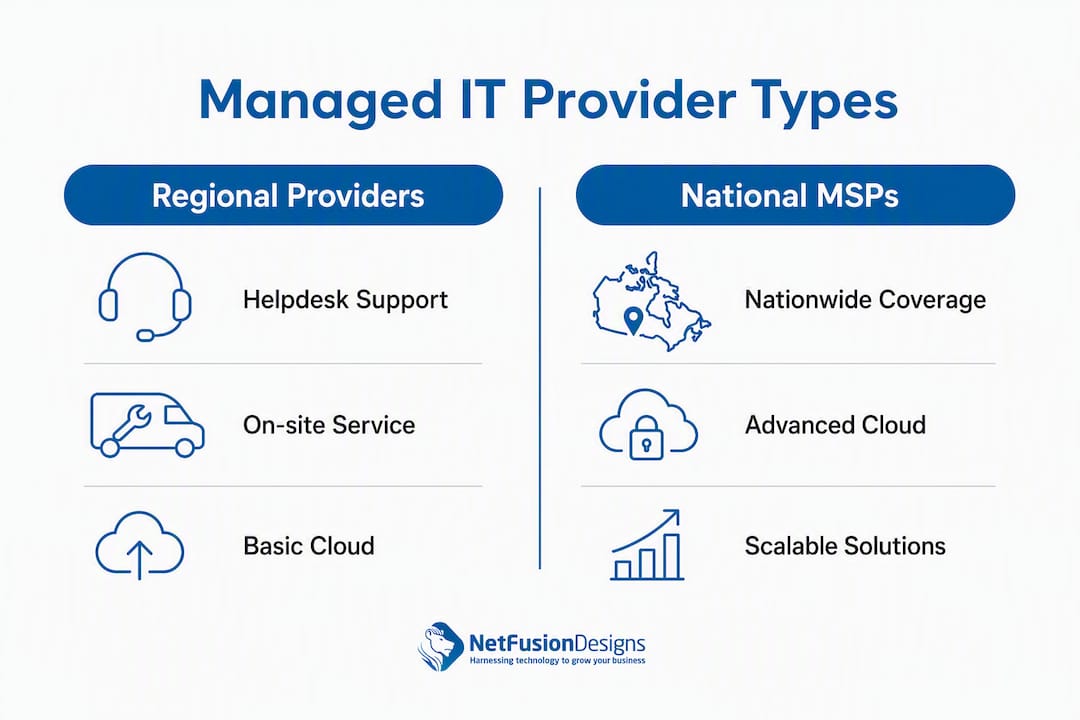
Regional providers typically cover managed helpdesk, endpoint monitoring, basic cloud support, and on-site break-fix. Their strength is proximity: a field engineer can be on-site within hours when hardware fails. Local on-site capability matters significantly for businesses that need fast physical support and hardware servicing. The trade-off is that smaller regional shops may not carry advanced security certifications or 24/7 NOC coverage, so confirm those specifics before shortlisting. Ask for third-party attestations and published case studies rather than relying on marketing claims alone.
Providers like Softchoice, Compugen, Long View Systems, and CDW Canada operate at scale across Canada. They typically hold Microsoft Gold, Cisco, and Veeam partnerships, which matters for complex multi-vendor environments. Their breadth is an advantage for mid-market organisations managing diverse infrastructure. The potential downside for smaller businesses is that you may not receive the same account attention as their larger clients. Ask directly who your named account manager and escalation contact will be.
If your organisation operates in a regulated sector — financial services, healthcare, insurance — a security-first partner with a managed SOC, SIEM monitoring, and documented penetration testing may be the right fit. These providers typically hold SOC 2 Type II and ISO 27001 as baseline requirements. NetFusion Designs Inc offers cybersecurity and managed SOC services alongside its full managed IT stack, which means regulated SMBs do not need to split those functions across two vendors.
Pro Tip: If your organisation is regulated, ask any shortlisted provider for their most recent penetration test summary and their breach notification SLA. A provider that cannot share either is not ready for a compliance-sensitive environment.
NetFusion Designs Inc is a SOC 2 Type II–certified Managed IT Services and AI enablement provider serving small and mid-sized businesses across Ontario and Canada. Its managed IT services cover 24/7 helpdesk, security operations, monitoring, Microsoft 365 optimisation and migration, cloud and hosted desktop, VoIP, application and web development, virtual CIO, penetration testing, backup and disaster recovery, and AI and automation enablement. Teams operate from Kitchener-Waterloo, Toronto, Markham, Mississauga, Montréal, and Winnipeg.
NetFusion Designs Inc stands out among Connesso.ca replacement options because it combines three things that Canadian SMBs consistently need: SOC 2 Type II security, 24/7 NOC support, and practical AI and automation enablement under one provider.
Credentials and trust signals:
Service coverage: Kitchener-Waterloo, Toronto, Markham, Mississauga, Montréal, and Winnipeg — with local IT services available for businesses that need on-site capability.
What sets it apart from the category: Most MSPs stop at managed IT. NetFusion Designs Inc also helps clients adopt AI and automation to cut operating costs and scale, which is increasingly relevant as SMBs look for productivity gains beyond traditional IT support.
For many Canadian SMBs, onshore data hosting and clear contractual data-residency commitments are non-negotiable. PIPEDA and provincial privacy legislation create real obligations around where personal data is stored and processed, and your IT provider’s infrastructure choices directly affect your compliance posture.
Checklist: what to confirm with any shortlisted provider
SOC 2 Type II and ISO 27001 are the two certifications most commonly requested by regulated Canadian SMBs evaluating managed IT vendors. SOC 2 Type II confirms that a provider’s security controls have been independently tested over a period of time, not just assessed at a single point. ISO 27001 covers the broader information security management system. When a vendor claims either certification, ask for the attestation letter or audit summary, not just a badge on their website. Third-party attestations and published case studies are stronger trust signals than marketing claims alone.
One legal note: confirm contractual jurisdiction and data-handling clauses with your legal counsel before signing. This article provides general guidance, not legal advice.
Pro Tip: Ask for sample SLA language covering breach notification timelines and defined recovery-point objectives (RPO) and recovery-time objectives (RTO). A provider that cannot produce sample language has likely not thought through their incident response process.
Managed IT pricing typically follows one of three structures: per-user retainer, per-device flat fee, or a flat monthly retainer covering a defined scope. Hybrid models are common for mixed environments. The right model depends on your headcount, device count, and growth plans.
| Pricing model | Typical use case | What to watch for |
|---|---|---|
| Per-user retainer | Businesses with consistent headcount and standard device ratios | Confirm what “per user” includes — some exclude servers or network devices |
| Per-device flat fee | Environments with many shared devices or high device-to-user ratios | Clarify whether mobile devices, printers, and network gear are included |
| Flat monthly retainer | Defined scope engagements with predictable workloads | Scope creep is common; insist on a written change-control process |
| Block-hours / project-based | One-time migrations, app development, or discrete projects | Useful for onboarding phases; confirm what happens when hours run out |
Pro Tip: Build a simple TCO checklist before your final vendor decision: expected monthly retainer, one-time onboarding fees, software licence costs, third-party cloud egress fees, and contract termination terms. Hidden costs in those last three categories are where most SMBs are surprised.
Independent review platforms give you a useful signal, though no single source tells the whole story. For managed IT providers serving Canadian SMBs, the most useful signals come from a combination of sources.
Google Reviews and G2 capture real client sentiment on responsiveness, onboarding quality, and account management. Look for patterns across multiple reviews rather than individual outliers. A provider with consistently high marks on communication and response time is more reliable than one with a perfect score from a handful of reviews.
Clutch.co publishes verified B2B reviews with detail on project scope, budget, and outcomes. For MSPs, look specifically at reviews that mention migration projects, onboarding timelines, and escalation handling. Those are the scenarios most relevant to a provider switch.
Better Business Bureau (BBB) Canada is worth checking for complaint history and resolution patterns, particularly for providers that have been operating for more than five years.
Vendor-published case studies are useful but should be read critically. The strongest ones name the client, describe the problem, and quantify the outcome. A case study that stays vague on all three is not strong evidence. Ask shortlisted providers for references you can contact directly, not just published stories.
For collaboration and remote-work tool adoption during a provider transition, independent guidance on collaboration best practices can help your team stay productive while infrastructure changes happen in the background.
Choosing the right Connesso.ca alternative comes down to three verifiable factors: Canadian data residency commitments in writing, SOC 2 Type II or ISO 27001 certification with evidence, and a documented migration and onboarding plan.
| Point | Details |
|---|---|
| Lead with SLA evidence | Ask every shortlisted provider for a sample SLA document and SOC 2 Type II attestation before your second call. |
| Confirm data residency in writing | Require contractual language specifying where primary data and backups are hosted, and under which jurisdiction. |
| Plan for a 6–16 week migration | Budget time for triage, discovery, migration planning, and a pilot phase to reduce business interruptions. |
| Use independent reviews critically | Cross-reference Google Reviews, Clutch.co, and BBB Canada; prioritise patterns over individual ratings. |
| NetFusion Designs Inc is migration-ready | SOC 2 Type II certified, 24/7 NOC, six Canadian office locations, and AI enablement make it a strong shortlist candidate for Canadian SMBs. |
Immediate next steps:
The providers that consistently deliver smooth migrations share one trait: they treat the onboarding plan as a contract deliverable, not an afterthought. Published SLAs and migration experience matter more than a polished sales deck. When you evaluate top alternatives to Connesso.ca, weight the evidence you can verify — attestation letters, reference clients, sample SLA language — over claims you cannot.
Risk management during a provider change is straightforward in principle: stage the migration, run parallel operations for a defined period, test rollback procedures before cutover, and communicate clearly with your internal stakeholders at each milestone. The businesses that struggle are the ones that compress the timeline to save a few weeks and then spend months recovering from a botched cutover. A pilot phase adds time upfront and saves it downstream.
Switching providers is easier when one team handles the full scope. NetFusion Designs Inc offers discovery calls, pilot migrations, and migration-ready onboarding packages for Canadian SMBs moving away from their current provider. Whether you need Microsoft 365 migration support, a full managed IT retainer, or emergency IT support while you plan a longer transition, the team operates in multiple Canadian cities.
SOC 2 Type II certified, 24/7 NOC coverage, and practical AI enablement in one Canadian provider. Book a discovery call at nfd.ca to confirm whether NetFusion Designs Inc is the right fit for your environment and timeline.
The claims in this article about SOC 2 Type II, ISO 27001, managed services best practices, and Canadian software alternatives are supported by the following resources:
“Canadian businesses evaluating managed IT providers should prioritise vendors that can demonstrate independent security attestations, published SLAs, and documented data residency commitments — not just marketing claims.” For a broader view of Canadian software alternatives, the following sources are worth reviewing.
NetFusion Designs Inc is a recommended migration-ready alternative, combining SOC 2 Type II certification, 24/7 NOC support, and Canadian office locations. National MSPs such as Softchoice, Compugen, Long View Systems, and CDW Canada are worth evaluating for larger or more complex environments.
The migration process typically includes multiple stages such as triage, discovery and scoping, migration planning, and a pilot and cutover phase, with overall timelines varying by complexity.
SOC 2 Type II and ISO 27001 are the most commonly requested attestations for managed IT vendors serving regulated Canadian SMBs. Ask for the actual attestation letter, not just a logo on a website.
Ask for written contractual language specifying where primary data and backups are hosted, which jurisdiction governs the contract, and whether any subcontractors hold copies of your data. Confirm breach notification timelines and RPO/RTO definitions in the SLA.
Yes. NetFusion Designs Inc provides Microsoft 365 optimisation and migration services as part of its managed IT offering, with teams in six Canadian cities available for on-site support where needed.
%20(1).avif)
%201.avif)