A disaster recovery test checklist is a structured set of steps that verifies your backups, systems, and people can actually meet your recovery targets when something goes wrong. The outcome that matters most is proof: confirmed recovery time objectives (RTO), recovery point objectives (RPO), and a team that knows its role under pressure. The Canadian Centre for Cyber Security and a disciplined after-action process both anchor this kind of testing in practice rather than paperwork.
TL;DR:
- Start with checklist or tabletop exercises, then progress to simulation and parallel recovery; reserve cutover tests for systems whose failure risk justifies production disruption.
- Set system specific RTO and RPO targets, assign owners and alternates, map dependencies, and confirm isolation, credentials, success criteria, and rollback conditions before test day.
- Before restored backups reenter production, scan them for malware and verify connectivity, authentication, core application functions, and data integrity in a sandbox or parallel environment.
- The after action report should compare objectives with results, record recovery times and target gaps, explain business impact, and assign each fix an owner and deadline.
- Review recovery plans at least every three years as a baseline, but test high priority systems sooner when tight targets or prior failures raise the risk.
Disaster recovery testing is not a pass or fail exercise. It is a diagnostic process, the same way a fire drill is not meant to prove everyone escapes perfectly on the first try. Ready.gov frames testing as building muscle memory: the point is to find the weak spots while the stakes are low, then fix them before a real incident forces the issue.
That diagnostic purpose only works when testing connects to the rest of your continuity planning. A business impact analysis (BIA) identifies which systems and processes matter most and sets the recovery objectives your tests are measured against. Without that link, a test can “succeed” technically while missing the actual business need.
A well-designed test validates more than servers coming back online. It checks:
Restoring a server is the easy part. Proving the organization can function around it is the real test.
Not every test needs to shut down production. The Canadian Centre for Cyber Security outlines a range of test types, each with a different intensity and risk profile, and choosing the right one for your team’s maturity matters as much as running the test at all.
Cutover tests can provide a realistic way to check that recovery works, but they come with real cost. The Canadian Centre for Cyber Security is direct about this: cutover tests cause business interruptions and require extensive additional planning, and in some organizations they may simply be infeasible given the operational risk.
The practical path is progression. Start with checklist and tabletop exercises to build familiarity and catch obvious gaps. As confidence grows, move to simulation and parallel tests. Reserve cutover testing for systems where the business impact of an untested failover is high enough to justify the disruption of testing it for real.
A disaster recovery test is only as good as the planning behind it. Rushing into execution without defined scope produces results nobody can act on, and worse, it can create actual outages if isolation steps are skipped.
This planning stage is also where continuity and recovery plans need to be tested together rather than separately. The Canadian Centre for Cyber Security notes that restoring servers alone does not satisfy continuity testing; manual workarounds, communication protocols, and team coordination all need validation alongside the technical recovery.
Pro Tip: Write your success criteria before the test starts, not after you see the results. It is much harder to grade a test honestly once you already know the outcome.
Our disaster recovery plan steps guide walks through how this planning stage ties into the broader plan document if you are building one from scratch.
With planning complete, execution needs its own discipline. A test that wanders off-script produces unreliable results and increases the odds of an accidental production impact.
The goal is a test that is auditable after the fact. If someone outside the room can read the log and understand exactly what happened, in what order, and why, the execution was disciplined enough to trust the results.
This is the step teams skip most often, and it is the one that prevents a disaster recovery test from quietly reintroducing the problem it was meant to solve. Restored data is not automatically clean. The Canadian Centre for Cyber Security is clear that organizations must verify and scan restored backups for malware before reintegrating them, since a backup taken after an infection can carry that infection straight back into production.
Beyond malware verification, a handful of system validation checks confirm the restored environment is actually reliable:
Running these checks in a sandbox or parallel environment, rather than directly against production, keeps a validation failure from becoming a live incident of its own.
Pro Tip: Treat “the restore completed” and “the restore is safe to use” as two separate milestones. A backup can finish restoring and still fail malware verification.
A test without a documented after-action report (AAR) is a test whose lessons disappear. The AAR is what turns a one-time exercise into a permanent improvement to your recovery posture.
A useful AAR captures:
Findings only matter if they close. Each corrective action needs a named owner, a deadline, and a tracking mechanism that someone actually checks, not a line item that gets mentioned once and forgotten. Multi-day exercises often conclude with a formal debrief and after-action report specifically to capture this kind of lesson while it is fresh.
Retest cadence should follow criticality and history. Systems tied to tight RTOs, or systems that failed their last test, deserve more frequent retesting than lower-priority systems with a clean track record. Guidance on incident response planning suggests reviewing plans at least every three years at a minimum, though the right frequency for your highest-risk systems is almost always shorter than that baseline.
Here is a condensed version you can paste into a runbook or test playbook. It covers the non-negotiables from each phase without the full detail above.
Mark each line pass or fail as you go. A single fail in the validation phase, especially malware verification, should block sign-off regardless of how well the rest of the test went.
The biggest mistake we see is testing in live production because setting up a sandbox feels like extra work. It almost never is, and the cost of an accidental outage during a test dwarfs the time saved skipping isolation. Parallel and sandbox environments exist precisely so a failed test stays a learning moment instead of becoming the incident you were trying to prevent.
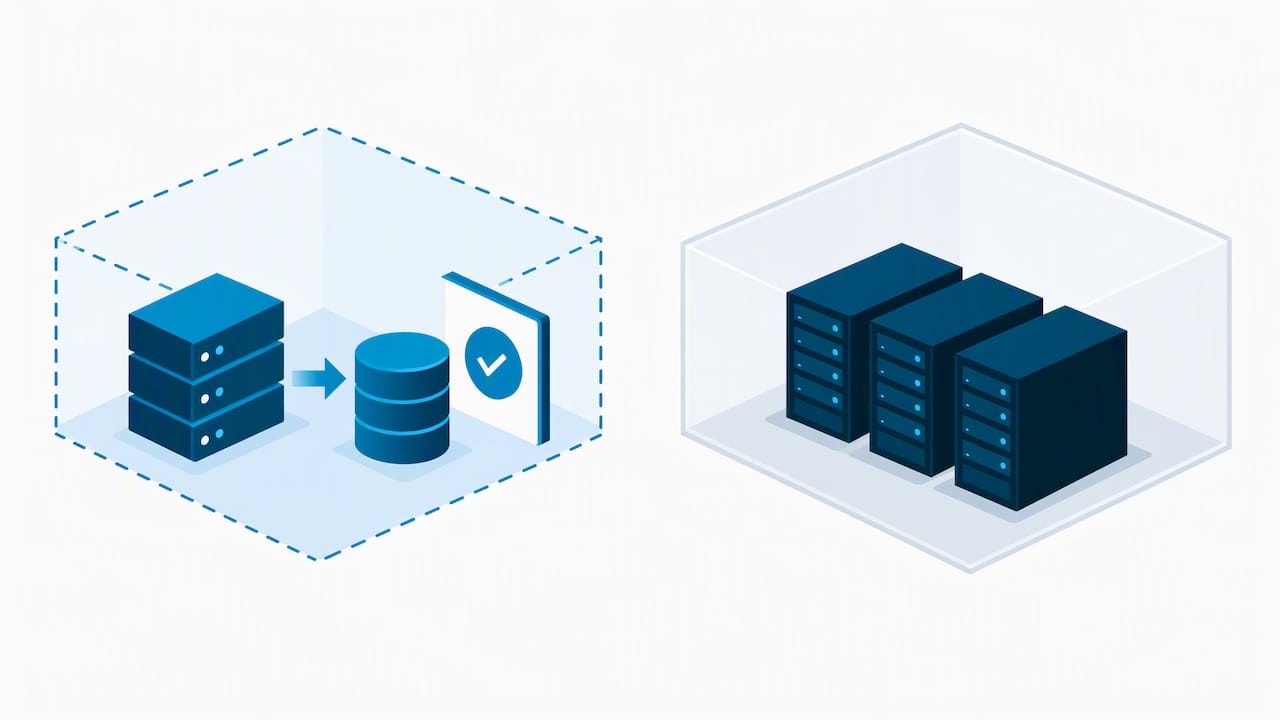
The second mistake is treating a discovered failure as a bad outcome. A test that finds nothing wrong either got lucky or wasn’t rigorous enough. A failure found in a controlled test is a problem solved cheaply; the same failure found during a real incident is a problem solved expensively, if it gets solved at all.
Keep executives in the loop by translating results into business terms: hours of downtime avoided, dollars of exposure reduced, not technical jargon about failover timing.
— Geeshan
Running a disciplined test program takes time most IT teams don’t have free between daily tickets and projects. We provide backup and disaster recovery services.

We provide backup and disaster recovery services tailored to clients’ needs:
If your current backup strategy has never been tested against a real RTO target, that’s the gap worth closing first. Check our Cloud Backup & Disaster Recovery page for details, or get in touch to talk through where your current plan stands.
A disaster recovery test checklist is a structured list of steps, from pre-test planning through execution and validation, used to confirm that backups, systems, and staff can meet defined recovery targets. It exists to make testing repeatable and auditable rather than ad hoc.
Testing frequency should be driven by system criticality and prior test results, with higher-priority systems tested more often. Guidance on incident response planning recommends reviewing plans at least every three years as a baseline, though organizations set their own testing cadence based on risk.
A tabletop test is a discussion-based exercise where the team talks through a scenario without touching any systems, making it low risk and easy to run frequently. A cutover test actually takes production offline and shifts operations to recovery systems, which the Canadian Centre for Cyber Security notes causes real business interruption and needs extensive additional planning.
Restored backups can carry an infection if they were taken after malware already compromised the system, so restoring without a scan risks reinfecting the environment. The Canadian Centre for Cyber Security advises verifying and scanning restored data before reintegration for this reason.
An after-action report should document the test’s objectives, what was actually tested, a timeline of results, any gaps against RTO or RPO targets, and specific recommended fixes with owners assigned. This record is what allows a test program to improve over successive cycles rather than repeating the same gaps.
Smaller teams can scale the same checklist down in scope while keeping the core steps intact: planning, execution, validation, and an after-action report. Starting with a checklist or tabletop exercise, as recommended for organizations building up their testing maturity, keeps the exercise manageable without skipping the steps that matter.
For a small application or site, backup verification matters just as much. A WordPress-specific backup guide covers how to match backup frequency to recovery point targets for smaller, web-based systems.
%20(1).avif)
%201.avif)