The fastest way to reduce incidents that disrupt production is a risk-based security program aligned to NIST Cybersecurity Framework 2.0’s manufacturing profile, paired with a short list of high-impact controls: network segmentation, multi-factor authentication for remote access, offline encrypted backups with tested restores, and an incident response plan that is actually exercised. Below, we walk through a ranked, practical checklist and the OT-specific workarounds that make these controls achievable on a live production floor.
TL;DR:
- The NIST manufacturing profile maps guidance to 106 subcategories and adds Govern, tying executive ownership and risk decisions to safety and production priorities.
- When patching could interrupt production or create safety risks, manufacturers can block exploit paths with IDS signatures or firewall rules without changing legacy devices.
- A floor walk before segmentation should trace every cable, wireless link, and vendor service line, since hidden connections can bypass planned network zones.
- Recovery drills should include operations staff, test manual operation and islanding procedures on critical lines, and keep response playbooks accessible offline.
- Route vendor access through jump servers, log every session, set time limits, and reassess suppliers as subcontractors or support arrangements change.
Ransomware remains the threat most likely to stop a production line cold, and in manufacturing it carries safety implications that a typical office outage does not. Legacy OT compounds the problem: many control systems run on decades-old software that cannot be patched without risking downtime or safety incidents, which is why the Canadian Centre for Cyber Security frames OT decisions around safety first, patching second.
Industrial IoT devices expand the attack surface quietly, often added by engineering or operations teams without security review. Supply-chain attacks arrive through vendor remote-access tools or compromised components, and human error, including misconfigured firewalls or shadow IT connections, remains one of the most common root causes of a breach.
The NIST CSF 2.0 manufacturing profile organizes work around six functions: Govern, Identify, Protect, Detect, Respond, and Recover, with Govern newly emphasized to tie security decisions to business and safety priorities. The profile realigns to 106 CSF subcategories tailored for manufacturing operations, giving teams a concrete map from policy to control.
NIST SP 800-82 fills in the ICS-specific detail: asset inventory, segmentation, allowlisting, and monitoring guidance built for environments where availability and safety outrank confidentiality. ISA/IEC 62443 complements this on the product side, pushing vendors toward secure-by-design equipment. For smaller manufacturers without a mature program, CISA’s Cross-Sector Cybersecurity Performance Goals offer a compact starting baseline that already aligns with CSF 2.0.
One useful reference point: the manufacturing profile maps its guidance to over one hundred distinct CSF subcategories, which gives security and operations teams a shared, specific checklist rather than a vague mandate.
This list orders controls by the ratio of risk reduction to implementation effort, so teams with limited budget know where to start.
Pro Tip: When a critical controller can’t be patched during a production run, ask your network team for a virtual patch, an IDS signature or firewall rule that blocks the exploit path, so you get protection without touching the device itself.
The maintenance paradox is real: patching an OT device can be riskier than leaving it unpatched if it means an unplanned shutdown. Practitioner guidance on ICS security points to virtual patching, network-level compensating controls like IDS signatures and micro-segmentation, as the practical answer for legacy equipment that cannot be updated on a normal IT cycle.
Before any segmentation project starts, map every physical connection on the floor. Field experience from the Canadian Centre for Cyber Security shows that vendor cellular modems and direct service lines frequently bypass intended controls, undermining segmentation plans drawn up without a physical walkthrough first.
Pro Tip: Run your segmentation discovery phase like an audit, not a network diagram exercise: walk the floor, trace every cable and wireless link, and only then decide where the zones belong.
A manufacturing IR plan has to work when the network is down, which means an offline or printed copy is recommended alongside digital versions. Cross-functional playbooks that include operations, not just IT, keep safety decisions in the hands of people who understand the process.
Most manufacturers have more security gaps than budget to close them, which makes prioritization the real governance challenge explained. A simple risk-scoring rubric, weighing safety impact, production loss, and remediation cost, aligns naturally with the Govern function in CSF 2.0 and keeps decisions grounded in operational reality rather than theoretical risk.
Assign one executive owner for the program, set a quarterly review cadence, and require IT and OT to report into the same governance meeting so decisions aren’t made in two separate silos.
Generic phishing-awareness training misses the risks specific to a plant floor. Operators and maintenance staff need training on what a compromised HMI looks like, why an unexpected USB drive from a vendor shouldn’t go straight into a controller, and when to escalate an odd system behaviour instead of troubleshooting it alone.
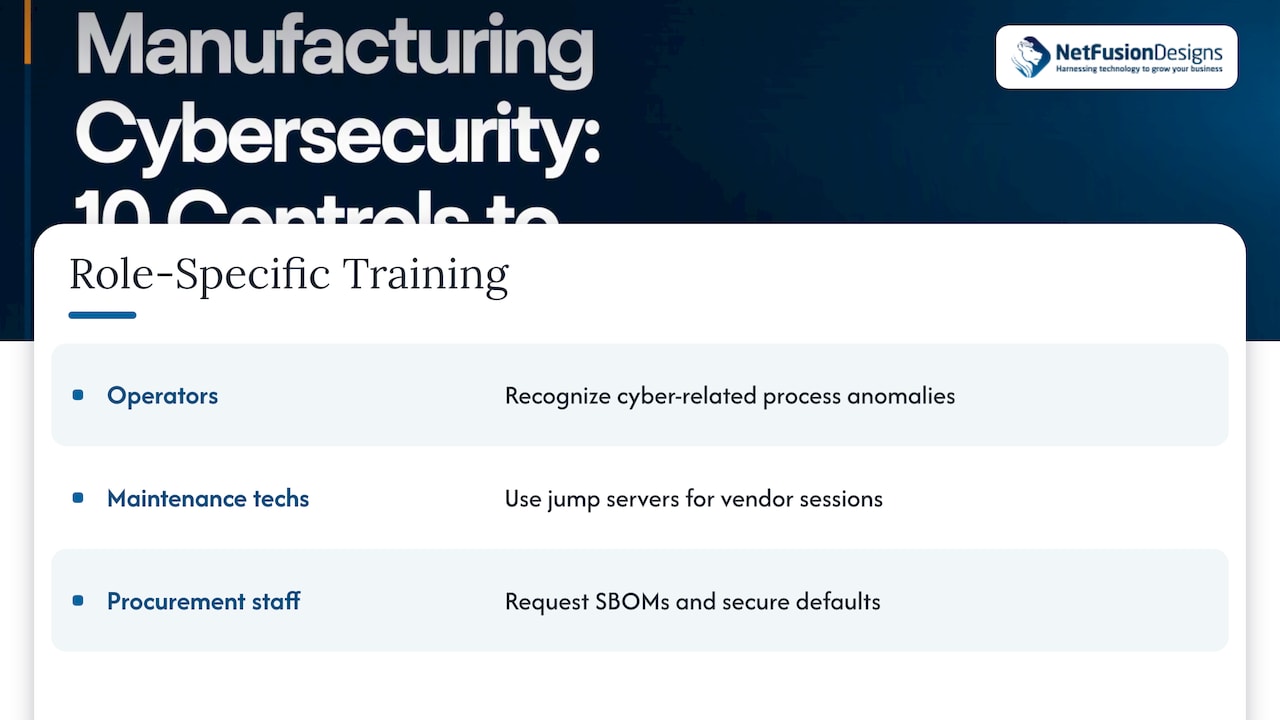
Training works best when it’s role-specific. Control room operators need to recognize signs of a process anomaly that might be cyber-related rather than mechanical. Maintenance technicians who manage vendor remote sessions need to understand why jump servers exist and why bypassing them, even to save time, breaks the whole access control model. Procurement staff need enough security literacy to ask vendors for SBOMs and secure configuration defaults before a purchase order is signed.
Shadow IT often starts with good intentions: an engineer adds a cellular modem for easier remote troubleshooting, and nobody tells the security team. Training that explains why this creates risk, paired with an easy, non-punitive way to report these connections, surfaces problems before they become incidents.
Short, frequent sessions tied to real scenarios beat an annual compliance module that nobody remembers by March. Tabletop exercises that include operations staff, not just IT, build the muscle memory needed when an actual incident hits the floor.
Vendors and integrators routinely have remote access into OT environments, and that access is only as secure as the vendor’s own practices. A one-time security questionnaire at contract signing isn’t enough. Ongoing monitoring of vendor access, what they connect to, when, and for how long, closes a gap that a point-in-time assessment leaves open.
Start by inventorying every vendor with network access, from HVAC controllers to robotics integrators. Route that access through jump servers so every session is logged and time-limited rather than standing. Require vendors to disclose their own security practices, including whether they can provide a software bill of materials for the equipment they maintain.
Periodic reassessment matters because vendor risk changes over time. A supplier that passed an assessment two years ago may have since outsourced support to a subcontractor nobody vetted. Building vendor review into the same governance cadence as internal risk review keeps this from falling through the cracks.
AI-assisted monitoring tools increasingly help security teams spot anomalies across large OT and IT environments faster than manual review alone, flagging unusual traffic patterns or login behaviour that might indicate a compromised account or device. For manufacturers running lean security teams, this kind of automated triage helps a small team cover a large environment.
Automation also extends into response: pre-approved playbooks can automatically isolate a compromised segment of the network while a human confirms the next step, reducing the window between detection and containment. This matters more in OT than IT, since a slow manual response on a production network can mean longer downtime.
The same automation that helps defenders also lowers the barrier for attackers, who increasingly use AI-assisted tools to craft more convincing phishing messages or probe networks faster. That shift doesn’t change the underlying best practices; it reinforces why foundational controls like MFA and segmentation matter even as the threat landscape evolves. AI augments a security program; it doesn’t replace the fundamentals covered in the checklist above.

Manufacturing data increasingly includes personal information, employee records, customer order details, and sometimes biometric data from access control systems, which brings privacy regulation into scope alongside operational security. The specific rules that apply depend on where a facility operates and what kind of data it collects, so manufacturers should confirm obligations with their own legal counsel or a qualified privacy advisor rather than assume a one-size-fits-all standard.
Where regulation does apply, the practical overlap with cybersecurity is significant: encryption, access controls, and breach notification procedures that support a strong security program also tend to satisfy privacy compliance requirements. Documenting what personal data is collected, where it’s stored, and who can access it is a reasonable starting point regardless of jurisdiction.
Data processing policies should specify retention periods and deletion procedures, since holding data longer than necessary increases both privacy risk and the potential damage of a breach. Building these practices into the same governance review as the broader security program avoids treating privacy as a separate, bolted-on exercise.
Physical access to a plant floor is often an overlooked path into OT systems. An unlocked panel, an unattended engineering workstation, or an unmonitored visitor badge can defeat network-level defences entirely, since physical access frequently bypasses authentication controls built for remote threats.
Controlled access to control rooms and server closets, logged visitor and contractor entry, and locked cabinets for networking equipment are basic measures that complement the network controls described earlier. Cameras and badge logs at key access points create an audit trail that matters as much during an incident investigation as network logs do.
USB port controls deserve particular attention in manufacturing, since removable media remains a common way malware moves from a vendor laptop onto an isolated OT network. Disabling unused ports or restricting them to approved devices closes a gap that no firewall rule can address.
As IT and OT networks converge, visibility has to span both, since an attacker moving from an IT foothold into OT often leaves a trail across both environments. A security information and event management setup that only ingests IT logs misses the OT-side indicators that matter most for production safety.
NIST SP 800-82 recommends intrusion detection tuned for OT protocols, since standard IT signatures often don’t recognize industrial communication patterns. Passive monitoring, which observes traffic without injecting anything into the network, is generally preferred in OT because it carries no risk of disrupting a live process.
Centralizing logs from firewalls, jump servers, and OT monitoring tools into a single view gives a security team the ability to correlate an unusual remote login with unexpected activity on a controller minutes later, catching an incident before it escalates into a production stoppage. Reviewing logs regularly, not just when something breaks, is what turns a logging system into an early warning tool rather than a historical record nobody checks.
A lean internal team can rarely staff 24/7 detection or maintain coordinated IT/OT playbooks on its own. Look for SOC 2 Type II certification, OT-aware incident procedures, and local coordination when weighing a managed provider. Pragmatic cost-benefit thinking beats chasing a perfect, unattainable security posture.
— Geeshan
We bring certified, 24/7 monitoring together with managed EDR, penetration testing, and backup and disaster recovery, so manufacturing teams get OT-aware incident response without staffing a round-the-clock team internally. Our approach consolidates vendor management into a single provider and keeps governance documented, not scattered across spreadsheets.

If your current controls stop at the IT network edge, a security assessment is a practical next step, and our managed cybersecurity services can help turn the checklist above into a running program.
No single control covers every risk, but multi-factor authentication for remote access and network segmentation together close the two most commonly exploited paths into OT environments. CISA and international partners list both as foundational OT protections.
The manufacturing profile tailors the general CSF 2.0 structure to manufacturing priorities, realigning guidance to 106 subcategories and adding emphasis on the Govern function to reflect safety and production decision-making. It stays voluntary and risk-based rather than prescriptive.
Yes, through compensating controls like virtual patching, which uses network-level protections such as IDS signatures or firewall rules to block an exploit path without touching the device itself. This approach is widely used where patching risks production downtime or safety incidents.
There’s no universal mandate, but cross-functional drills covering both IT and OT scenarios should happen regularly enough that staff remember the steps during a real event. Routine testing of manual operation and islanding procedures matters as much as testing the written plan itself.
It often does, since 24/7 detection is difficult for a small internal team to sustain on its own. When evaluating a provider, prioritize SOC 2 Type II certification, OT-aware incident playbooks, and the ability to coordinate response locally rather than through an offshore call centre.
%20(1).avif)
%201.avif)