A not-for-profit MSP is a managed IT service provider that specialises in the unique operational and compliance needs of nonprofit organisations. Unlike a general-purpose IT provider, a nonprofit-focused MSP understands grant-funded procurement cycles, board governance reporting, donor data protection, and the high volunteer turnover that makes standard IT contracts unworkable. For mission-driven organisations in North America, that specialisation is not a luxury. It is the difference between an IT partner that slows you down and one that actively supports your programmes.
The providers that consistently stand out in this space share a few defining traits:
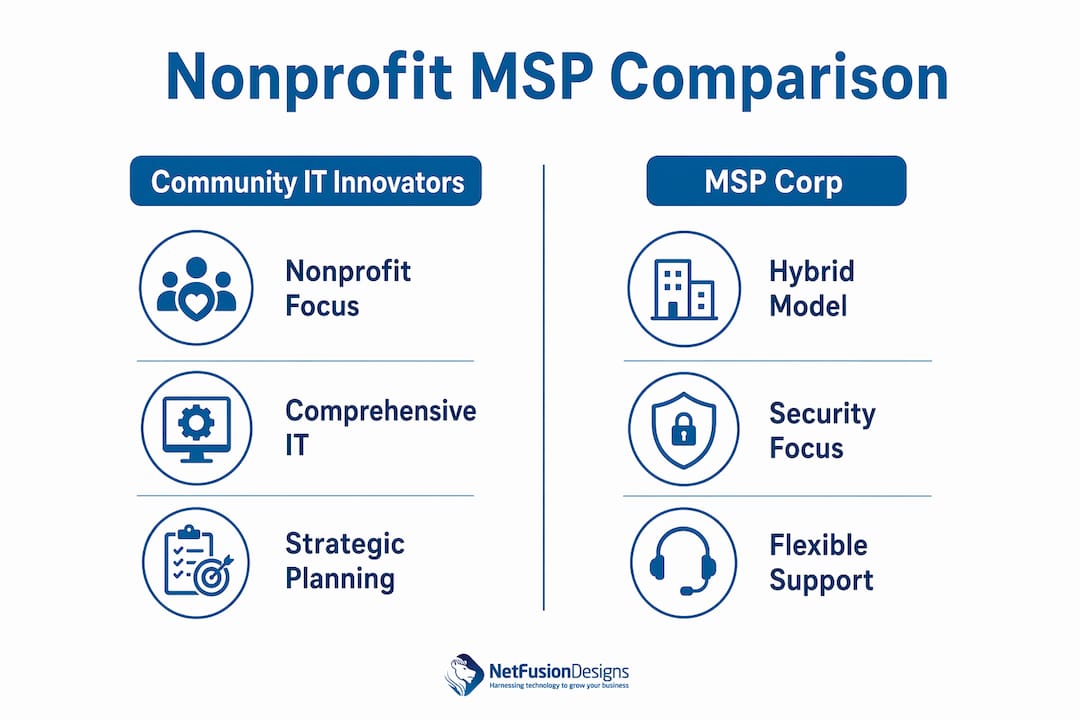
Community IT Innovators, MSP Corp, and NetFusion Designs Inc are three established providers that meet these criteria for North American nonprofits in 2026. The sections below compare them directly, walk through the questions you should ask before signing anything, and explain what a well-structured nonprofit MSP engagement actually looks like in practice.
Three providers lead the nonprofit managed IT space in North America right now. Each takes a different approach, and the right choice depends on your organisation’s size, location, and technology priorities.

| Provider | Nonprofit specialisation | Service scope | Strategic IT planning | Technology innovation | Best for |
|---|---|---|---|---|---|
| Community IT Innovators | Exclusively nonprofit, decades of sector focus | Full managed IT, helpdesk, cloud, security | Multi-year roadmaps, board-level reporting | Moderate; steady adoption | Established nonprofits needing deep sector expertise |
| MSP Corp | Nonprofit-tailored with hybrid service models | Managed IT, advanced cybersecurity, cloud | Strong planning capacity | AI automation integration | Nonprofits needing flexible support and strong security |
| NetFusion Designs | SOC 2 Type 2 attested; Ontario and Canada focus | Managed IT, AI enablement, Microsoft 365, 24/7 NOC | Compliance-led roadmaps, virtual CIO services | AI-powered operations, automation | Nonprofits seeking certified security and AI-driven IT |
Community IT Innovators has built its entire business around the nonprofit sector. That singular focus means their team understands grant-funded procurement, board governance, and the specific pressures of mission-driven work in a way that generalist providers rarely match. For an established national or regional nonprofit with complex IT needs and a long planning horizon, their depth of sector expertise is a genuine differentiator.
MSP Corp positions itself around flexibility and security. Their hybrid service model suits nonprofits that carry some internal IT capacity but need external support for cybersecurity, cloud migrations, or after-hours coverage. Their AI automation integration is a practical advantage for organisations trying to reduce manual administrative work without hiring additional staff.
NetFusion Designs Inc is the strongest choice for Canadian nonprofits that need verifiable security credentials alongside practical technology adoption support. SOC 2 Type 2 attestation means their data handling and security controls have been independently audited, which matters when your organisation holds sensitive donor records or health-related programme data. Their managed IT services cover security monitoring, helpdesk, cloud, and Microsoft 365, all backed by a 24/7 Network Operations Centre. For nonprofits in Ontario and across Canada, that combination of local presence and certified infrastructure is hard to find in one provider.
Choosing the wrong MSP costs more than the contract value. It costs staff time, programme continuity, and sometimes donor trust. These questions cut through the sales pitch and get to what actually matters.
About nonprofit experience:
About support and responsiveness:
About strategic planning:
About pricing and contracts:
About security and compliance:
The most successful nonprofit MSP partnerships are built on strategic alignment with an organisation’s mission, not just technical competence. An MSP that cannot answer the governance and planning questions above is likely treating your nonprofit like any other small business client.
Real partnerships produce measurable results. The examples below reflect the kinds of outcomes that well-matched nonprofit MSP engagements deliver across North America.

| Partnership type | Key improvement | Outcome |
|---|---|---|
| Regional social services nonprofit | Donor data security overhaul | Achieved compliance with provincial privacy legislation; eliminated unencrypted data storage |
| Health-focused charity | Helpdesk response time reduction | Critical issues resolved within two hours; staff productivity increased |
| National advocacy organisation | Microsoft 365 migration | Reduced licensing costs through nonprofit grant pricing; improved collaboration |
| Community foundation | Grant compliance documentation | Automated reporting workflows; reduced manual admin by several hours per week |
Community IT Innovators and MSP Corp both cite long-standing nonprofit client relationships across diverse mission types and funding models as evidence of their sector credibility. That longevity matters because nonprofit IT needs evolve with programme growth, staff changes, and shifting funder requirements.
NetFusion Designs Inc has applied this model to Canadian nonprofits specifically, pairing compliance-led IT planning with donor data protection practices that address the realities of holding sensitive beneficiary and donor records under Canadian privacy law.
Pro Tip: Ask your MSP shortlist to walk you through a specific example of how they helped a nonprofit client navigate a technology crisis or a major programme change. The quality of that story tells you more than any service catalogue.
Pricing in the nonprofit MSP space varies more than most providers admit upfront. Understanding the structure before you sign protects your budget and your board’s confidence.
Common pricing models:
What often triggers additional fees:
Pricing transparency means understanding exactly which services are included and which are billed separately. Ask for an itemised contract, not a summary sheet.
Fiscal year alignment matters. Nonprofit fiscal cycles often do not match the standard corporate calendar, and grant funding frequently arrives in irregular tranches rather than predictable monthly instalments. An experienced nonprofit MSP will structure payment schedules around your funding reality, not their billing convenience.
Pro Tip: Before finalising any MSP contract, share your grant funding calendar with the provider and ask them to propose a payment schedule that matches it. A provider unwilling to accommodate this has likely not worked extensively with nonprofits before.
SOC 2 Type 2 is an independent audit standard that verifies a service provider’s controls around security, availability, and confidentiality over a sustained period, typically six months or more. For nonprofits, that sustained verification is what separates a credible security claim from a marketing statement.
NetFusion Designs Inc holds SOC 2 Type 2 attestation, which means their security and monitoring practices have been independently tested and confirmed. For a nonprofit holding donor payment data, beneficiary health records, or grant-related financial information, that certification provides a defensible compliance posture when your board, funders, or privacy regulators ask how you protect sensitive data.
The practical benefits for nonprofits are concrete:
Specialised managed IT services for nonprofits should include donor data security, grant compliance support, and technology adoption aligned with mission needs. SOC 2 Type 2 attestation is the clearest external signal that a provider has built those controls into their operations, not just described them in a brochure.
Canadian nonprofits operate under a layered compliance environment that their MSP must understand and actively support.
Privacy legislation. The Personal Information Protection and Electronic Documents Act (PIPEDA) governs how federally regulated organisations handle personal information. Several provinces, including Quebec under Law 25, have enacted stricter provincial privacy laws that apply to nonprofits operating in those jurisdictions. An MSP that does not know the difference between PIPEDA and Quebec’s Law 25 is not equipped to support a national nonprofit.
CRA reporting obligations. Under the Income Tax Act, non-profit organisations may be required to file Form T1044, the Non-Profit Organization Information Return, when total assets exceed $200,000 or when taxable income from dividends, interest, rentals, or royalties exceeds $10,000 in a fiscal period. Registered charities face additional reporting through Form T3010. Your MSP should understand how IT systems support accurate financial record-keeping for these filings.
Sector-specific requirements. Health-focused nonprofits may handle data subject to PHIPA in Ontario or equivalent provincial health privacy legislation. Housing nonprofits may face additional regulatory oversight. An MSP without nonprofit sector experience often misses these sector-specific compliance layers entirely, creating risk that only surfaces during an audit or incident.
Board governance. Under the Canada Not-for-profit Corporations Act, federally incorporated nonprofits must maintain financial statements and file annual returns with Corporations Canada. IT systems that support document management, board reporting, and financial record integrity are a compliance requirement, not just an operational convenience.
General managed IT covers helpdesk, monitoring, and patching. A nonprofit-focused provider goes further, building services around the specific workflows that mission-driven organisations depend on.
Donor management system support. Platforms like Salesforce Nonprofit Success Pack, Raiser’s Edge, or Bloomerang require specific integration, backup, and access control configurations. Your MSP should have direct experience supporting these platforms, not just a willingness to learn on your time. Choosing the right CRM for your nonprofit is a technology decision your MSP should be able to inform.
Grant tracking and compliance documentation. Grant-funded programmes generate reporting obligations. An MSP that understands this will help you configure document management systems, automate reporting workflows, and maintain audit trails that satisfy funder requirements.
Microsoft 365 for Nonprofits. Microsoft offers deeply discounted and free licensing tiers for qualifying nonprofits through its nonprofit programme. An MSP with Microsoft partnership credentials can help you access those grants, configure security policies correctly, and avoid paying commercial rates for licences your organisation qualifies to receive at no cost.
Cybersecurity tailored to nonprofit risk profiles. Nonprofits are targeted by ransomware and phishing attacks at rates comparable to small businesses, often because attackers assume weaker defences. Multi-factor authentication, email filtering, endpoint protection, and staff security awareness training are not optional for an organisation holding donor payment data.
Volunteer and seasonal staff onboarding. High volunteer turnover creates a recurring IT workload around account provisioning and deprovisioning. A well-structured MSP will automate this process so that access rights are granted and revoked reliably, without burdening your permanent staff.
An MSP that fits your organisation today may become a constraint in three years if they cannot scale with your programme growth, geographic expansion, or technology ambitions.
Start with headcount flexibility. Ask how the contract handles a 30% increase in staff during a programme expansion, and what happens when a major grant ends and you need to scale back. Rigid per-user contracts with long notice periods for reductions create real financial risk for nonprofits whose funding is never guaranteed year over year.
Geographic coverage is the next test. If your organisation operates across multiple provinces or plans to expand, your MSP needs the infrastructure to support remote offices and distributed teams without treating each location as a separate engagement. NetFusion Designs Inc operates across Ontario with teams in Kitchener-Waterloo, Toronto, Markham, Mississauga, Montréal, and Winnipeg, which gives Canadian nonprofits consistent support across a wide footprint.
Technology roadmap capacity separates reactive MSPs from genuine partners. Ask the provider to show you a sample three-year technology roadmap they have built for a nonprofit client. If they cannot produce one, they are likely managing your current environment rather than planning for your future. The co-managed support model is worth exploring for nonprofits that already have some internal IT capacity and want to retain it while adding external expertise.
Finally, ask about AI and automation readiness. Nonprofits that adopt practical automation, whether for grant reporting, donor communications, or financial reconciliation, free up staff time for direct programme work. An MSP that has no AI capability roadmap is already behind where the sector is heading.
Canadian nonprofits that need a provider combining verified security credentials with practical AI adoption support have a specific option worth considering.
NetFusion Designs Inc delivers fully managed IT services for nonprofits across Ontario and Canada, backed by SOC 2 Type 2 attestation and a 24/7 Network Operations Centre. Where many providers offer managed IT as a commodity, NetFusion Designs Inc positions itself as a Managed Intelligence Provider, meaning AI and automation are built into the service model, not sold as an add-on. For nonprofits trying to do more with constrained budgets, that distinction has a direct impact on operational capacity. Their emergency IT support is available around the clock, which matters when a critical system failure threatens a fundraising campaign or programme delivery deadline. If your organisation is evaluating providers and wants a Canadian partner with the credentials to back their security claims, NetFusion Designs Inc is worth a direct conversation.
Under the Income Tax Act, a non-profit organisation is an association, club, or society organised and operated exclusively for social welfare, civic improvement, pleasure, recreation, or any other purpose except profit. It is generally exempt from income tax, but unlike a registered charity, it cannot issue official donation receipts.
A registered charity is established for exclusively charitable purposes, is registered with the CRA, and can issue official donation receipts. A non-profit organisation cannot issue donation receipts and is not registered with the CRA, though it is generally exempt from income tax.
A nonprofit-focused MSP tailors its services to sector-specific needs including grant compliance documentation, donor data security, board governance reporting, and flexible contracts that accommodate irregular funding cycles. General MSPs typically apply a corporate service model that does not account for these realities.
Ask about their current nonprofit client portfolio, their capacity for strategic IT planning, their pricing transparency, and whether they hold third-party security certifications like SOC 2 Type 2. Providers that cannot answer these questions specifically are likely not deeply experienced in the sector.
Yes. Microsoft offers free and discounted licensing for qualifying nonprofits through its nonprofit programme. An MSP with Microsoft partnership credentials can help your organisation apply for those grants, configure the environment correctly, and avoid paying commercial rates for licences you qualify to receive at reduced or no cost.
A nonprofit-focused MSP delivers measurably better outcomes than a generalist provider because sector experience, compliance awareness, and flexible contracting are built into the service model from the start.
| Point | Details |
|---|---|
| Specialisation over generalism | MSPs without nonprofit experience miss grant compliance, board reporting, and seasonal staffing realities. |
| SOC 2 Type 2 attestation | Independent audit verification of security controls is the clearest signal of a credible data protection posture. |
| Pricing structure alignment | Contracts should accommodate grant tranche funding and seasonal headcount changes, not force a corporate billing schedule. |
| Strategic planning capacity | The best nonprofit MSP partners contribute to multi-year technology roadmaps, not just day-to-day support tickets. |
| NetFusion Designs Inc | SOC 2 Type 2 attested, 24/7 NOC, and AI-enabled managed IT across Ontario and Canada for nonprofits needing verified security and local expertise. |
%20(1).avif)
%201.avif)