A SOC (security operations centre) is the function that watches your environment and responds to threats. MDR (managed detection and response) is one way to get that function: a provider’s analysts monitor, investigate and act for you. So the two are not rivals. MDR is a SOC you rent, and the real question is whether you build the SOC yourself, buy it as a managed service, or split the work.
This guide explains each term in plain language, shows how MDR differs from an MSSP and a SIEM, and gives a practical way to choose for a small or mid-sized business in Canada.
The Canadian Centre for Cyber Security describes a SOC as being primarily responsible for detecting and responding to cyber incidents and threats. It can also take on vulnerability assessments, penetration testing, threat hunting and regulatory-compliance auditing.
To do that, a SOC collects and analyses security and event data from many places: on-premises devices, cloud services, industrial-control and operational-technology systems, remote systems and mobile devices. The same guidance is worth reading if you are weighing a build.
ISACA’s description is similar. It lists log management, incident management and response, monitoring, threat detection, threat hunting, vulnerability management and compliance monitoring among the things a SOC may provide, and names SIEM, SOAR and threat intelligence as its primary tools.
Three things make up a SOC:
Security operations matter whatever your business sells. Even a retailer with a simple online storefront needs them, as this piece on why cybersecurity matters for e-commerce shows.
The catch is cost and coverage. Attacks do not keep office hours, so a useful SOC needs staff on shift at night and on weekends, plus the licensing and tuning of the tools. That is where managed models come in.
ISACA describes MDR as an evolution of the managed SOC. It uses diverse data inputs and detectors to spot suspicious activity, and human analysts decide in real time whether an alert is actionable or a false positive.
In practice, MDR usually has three parts:
The difference from a generic monitoring service is the last step. A service that only tells you something looks wrong leaves you to work out what to do at 2 a.m. MDR is built to deliver a verdict and an action.
| Question | In-house SOC | Managed SOC / SOC as a service | MDR |
|---|---|---|---|
| Who staffs it? | Your employees | Provider and your team share the work | Provider’s analysts |
| Main output | Whatever you build: monitoring, hunting, reporting | Monitoring, log management, compliance reporting | Investigated alerts and response actions |
| Tools | You buy and run them | Often provider-run, sometimes inside your tenancy | Provider’s platform plus your endpoints |
| Best fit | Large organizations with a security team | Firms needing broad monitoring and compliance evidence | Small and mid-sized firms needing fast, hands-on response |
| Your workload | Highest | Medium | Lowest |
Treat the table as a guide to typical models, not a rule. Providers package these differently, which is why the contract matters (more on that below).
People often search for MDR next to MSSP, because the terms overlap.
The Cyber Centre defines an MSSP as a technology firm that may host security services, deploy and manage security software and hardware, manage security infrastructure, and provide outsourced monitoring of devices and systems. The same guidance notes that an MSSP’s MDR services can include monitoring, detecting, alerting and managing responses to potential attacks.
So the line is blurry, and it comes down to what the provider actually does with an alert:
When you compare providers, ask where their responsibility ends. Does it stop at “we notified you”, or does it include containment? That one question separates most offers.
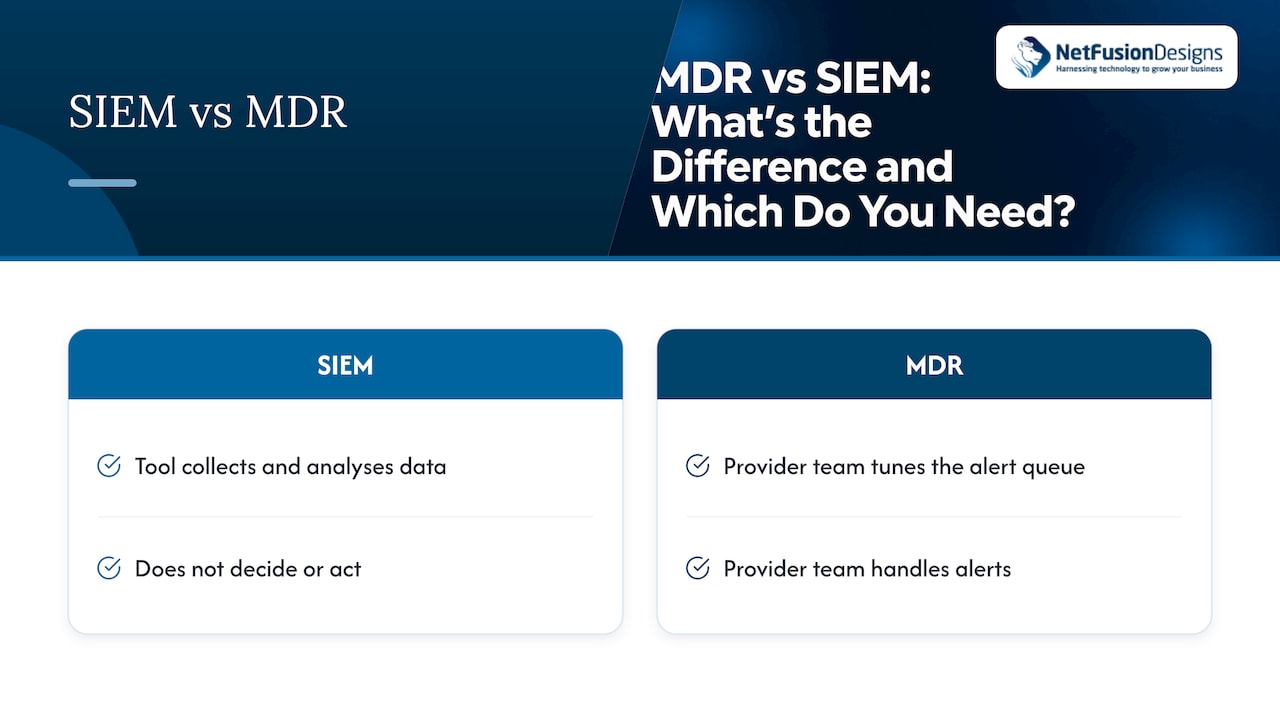
A SIEM is a tool, not a service. The Cyber Centre defines it as a set of tools and services that collects, aggregates and analyses large volumes of data from multiple sources in real time. Its capabilities include normalising logs, correlating events, detecting indicators of compromise from threat feeds, alerting, triaging and archiving logs.
A SIEM tells you a lot. It does not decide what matters or act on it. The Cyber Centre’s joint guidance says SIEM and SOAR can improve detection and response, but effective operation depends on proper deployment and ongoing maintenance. ISACA makes the same point from the other side: whether you use a SIEM or MDR, you still need correct implementation, tuning and regular testing to keep alerts high-fidelity.
That is why a SIEM on its own often disappoints smaller teams. Without analysts to tune it and work the queue, it produces volume rather than answers. With MDR, the provider’s team does that work. For more on the tool itself, see our article on the role of SIEM in enterprise cybersecurity.
SOC as a service (SOCaaS) and a managed SOC are close to MDR, and vendors use the labels loosely. A useful way to separate them is by what the customer hands over:
The Cyber Centre says a SOC may be hosted in an MSP or MSSP environment or operated by one within the customer’s own tenancy, and that contracts should spell out administration, maintenance, tuning and continuous operation of the SIEM, IDS/IPS, DLP and other SOC technologies. In other words, the label tells you little. The contract tells you everything.
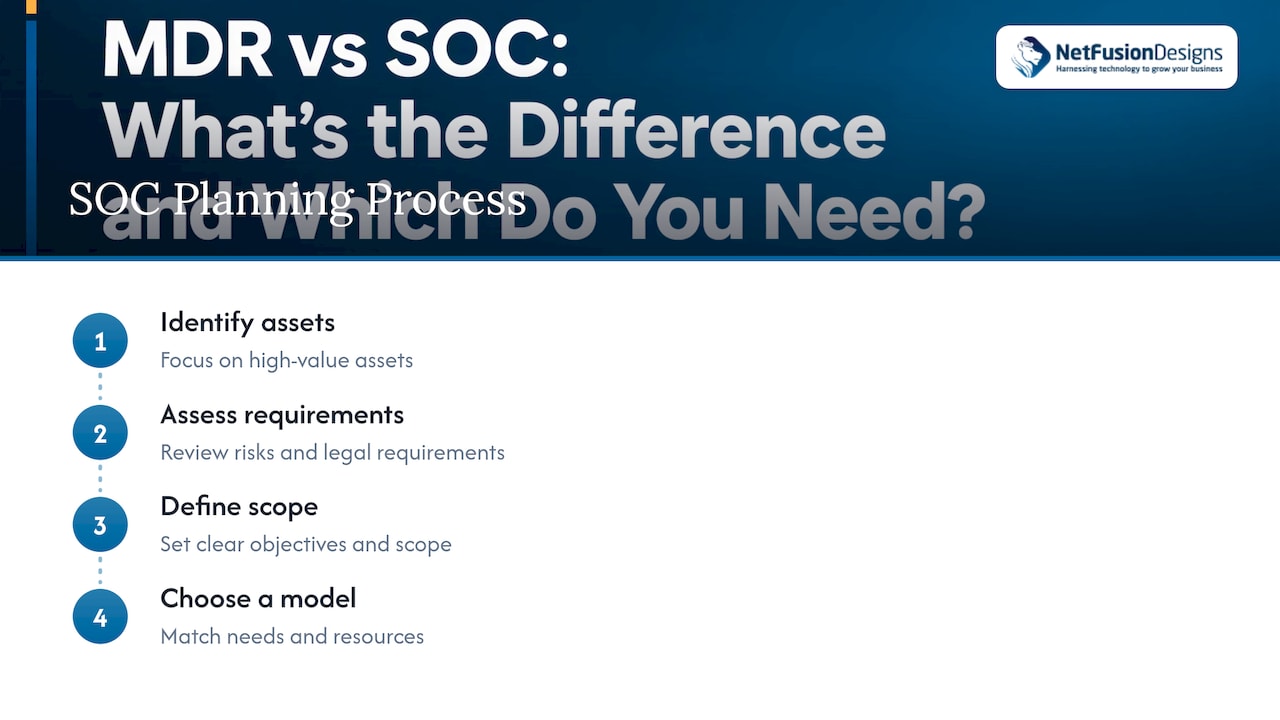
The Cyber Centre’s advice on setting up a SOC starts with identifying high-value assets, assessing risks and legal requirements, defining clear objectives and scope, and choosing a model that matches your needs and resources. Here is how that plays out for typical Canadian organizations.
Law firms, accounting practices, dental clinics and small manufacturers usually have one IT person or none. For these teams, MDR is typically the most practical way to get around-the-clock coverage and real response without hiring analysts. Pair it with managed endpoint protection, backups and Microsoft 365 hardening.
If you have an IT manager who knows your systems, a co-managed approach lets them keep day-to-day ownership while a provider covers monitoring, after-hours response and specialist work. Our co-managed and ad-hoc support options are built around that split.
Organizations with a security team may keep strategy, vendor management and governance in-house and use MDR for 24/7 monitoring and response. Large enterprises sometimes run a full SOC, with a SIEM and SOAR platform, correlation with threat intelligence, and automation of low-risk, high-frequency mitigations. Export Development Canada’s procurement document shows what that scope looks like at enterprise scale.
Whichever model you pick, the Cyber Centre’s recommended contract clauses for SOC procurement are a solid checklist. They advise confirming:
Two items deserve extra attention. First, pre-approved response actions: decide in advance what the provider may do without calling you (isolate a laptop, disable a compromised account) and what needs your sign-off. Second, data location. If you handle client files, patient records or financial data, ask where logs are stored and who can access them.
Common questions to bring to any provider:
We see the same pattern in the small and mid-sized businesses we support across Ontario. They ask whether they need a SOC or MDR, when the real question is who will act at 3 a.m. when something looks wrong.
Our view is that a SOC is a function every business needs, and that most of our clients are better served by getting it as a managed service than by building it. We deliver a 24/7 SOC and MDR service, with managed endpoint protection and EDR behind it, run by a team that is SOC 2 Type II certified. We also manage the wider IT environment, so security alerts are not handled by a stranger who has never seen your network.
That single-provider model is deliberate. We designed it so you do not have to coordinate a separate monitoring vendor, a helpdesk and a cloud partner when an incident is unfolding. We explain what is happening in plain language, and we agree on response actions with you in advance.
If you already have internal IT, we work alongside them in a co-managed arrangement. If you do not, we can be your IT department. In both cases the goal is the same: a defensible security posture you can explain to your clients, your insurer and your auditor.
Geeshan
We provide a 24/7 managed SOC service with EDR and MDR for businesses in Ontario and across Canada. It sits alongside managed anti-virus with EDR, penetration testing and the rest of our cybersecurity services, so detection, response and prevention come from one team.

If you want a plain-language view of where you stand, talk to us about fully managed IT. We will map your assets, agree on the scope and response actions, and show you what coverage looks like for your size of business. Pricing is tailored to your environment, so contact us for a quote.
No. A SOC is the function that detects and responds to threats, and it can be built in-house or bought. MDR is a managed service that delivers much of that function, using the provider’s analysts and technology.
Not exactly. A SIEM collects and analyses log data, while MDR adds analysts who investigate and respond. Many MDR providers use their own platform, so you may not need to run a SIEM yourself, but you can also pair the two when you need long-term log retention or compliance reporting.
They overlap. The Cyber Centre notes that an MSSP can run security infrastructure and outsourced monitoring, and that its MDR services can include detection and response. Ask each provider whether its responsibility ends at the alert or includes containment.
Building a 24/7 in-house SOC is rarely realistic for a small business, because it needs round-the-clock analysts and tooling. A managed SOC or MDR service spreads that cost across many clients. Ask for scope and pricing in writing so you can compare like for like.