Canada does not use the term “E911” in its rules the way the United States does. The CRTC regulates 9-1-1 for VoIP providers, and what it requires depends on how your phone service works. If your phones are tied to a fixed address, the provider routes 9-1-1 calls with your location. If your VoIP service is nomadic, meaning it works from any internet connection, the call goes through a third-party operator who asks where you are. In both cases your business has duties too: keep your address current, tell your staff how 9-1-1 behaves on your system, and build a network that keeps calls up.
This guide explains what the CRTC requires of providers, what that means for you as the business owner or IT manager, and how to check your own setup.
In Canada, the CRTC sets the 9-1-1 obligations for telephone and VoIP providers. “E911” is mostly a U.S. label, but readers use it for the same idea: an emergency call that arrives with location information so responders can find you. In Canadian practice the question is how that location reaches the 9-1-1 centre (the public safety answering point, or PSAP) for your phone system.
There is no single “E911 certificate” a business must hold. The obligations fall in two places:
If you are choosing or reviewing a VoIP provider, that split is the most useful thing to hold on to. A provider can meet its regulatory duties and still leave you exposed if nobody at your company updates an address after a move.
The CRTC distinguishes two kinds of local VoIP service. In Telecom Decision 2018-4, the Commission describes both as fixed or nomadic, and sets out that nomadic providers must route 9-1-1 calls to a third-party operator. That operator works out the right PSAP from the caller’s location and delivers the call.
| Fixed VoIP | Nomadic VoIP | |
|---|---|---|
| How it works | Tied to one registered address, often a desk phone or adapter at one site | Works from any broadband connection: softphones, mobile apps, laptops, desk phones moved between offices |
| How location is found | Registered address | Largely by the operator asking the caller verbally |
| Your main duty | Keep the address accurate | Keep the address accurate and train users to state their location |
| Typical risk | Forgetting to update after an office move | Staff working from home, a second site or a client’s office |
Most modern cloud phone systems and Microsoft Teams calling setups behave as nomadic services at least some of the time. A softphone on a laptop is the clearest case. The system has no way to know whether that laptop is in your Kitchener office or at a kitchen table in Guelph.
The CRTC points out that for nomadic calls, the primary way of identifying the caller’s location is the third-party operator asking for it. If the call drops before the operator has it, the operator tries to call back.
The CRTC’s page on 9-1-1 obligations for local VoIP providers is the primary reference. In summary, providers must:
The Commission also expects the notice to be acknowledged. Telecom Decision 2018-4 notes that providers must obtain the customer’s acknowledgement that they understand the limitations.
When you sign for a VoIP service, read that notice. It is the provider’s plain statement of what its 9-1-1 service can and cannot do, and it tells you what you must pass on to your staff.
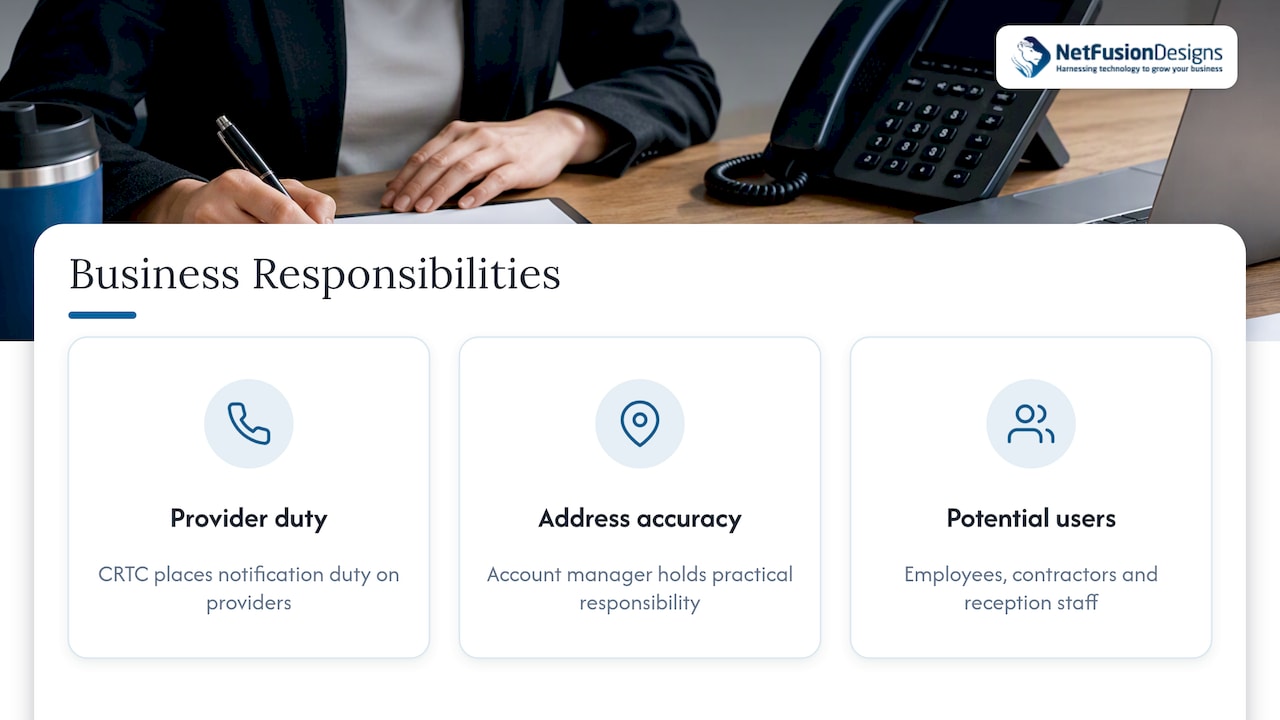
The CRTC places the notification duty on providers, but the practical responsibility for accuracy sits with whoever manages the account. The CRTC’s guidance for VoIP users says you should notify members of your household and other potential users of the nature and limitations of 9-1-1 calls. For a business, “other potential users” means every employee, contractor and reception desk covering shifts.
The registered address should be where the phone actually is. A mailing address, head office or billing address is not enough if the phone sits in a branch office. If your VoIP provider asks for a 9-1-1 address per number or per user, fill it in for every line. Suite or floor details matter in a multi-storey building; a street address alone can send responders to the wrong door.
If you move a desk phone, a softphone user or a whole team to another office, update the address in your provider’s portal before the move, or immediately after. This is the most common failure we see in practice: a system set up correctly on day one that nobody revisits after an office reshuffle or a new satellite site.
On VoIP, assume the call-taker may not see your location. The Alberta government’s guidance on calling 911 says that callers should be ready to give their town or city, exact address and phone number, and that a nomadic VoIP call may first reach a third-party operator who verifies the location before routing it. The principle applies across Canada, though local 9-1-1 arrangements vary by province and municipality.
Give employees one sentence to practise: where they are, the street address, and the floor or suite.
A short sticker on desk phones and a line in your onboarding checklist are cheap measures. Suggested wording: “When calling 9-1-1, be prepared to state your current physical address.” Your provider’s notice is the formal disclosure; the sticker puts the same message in front of the person who needs it in an emergency.
If employees use a softphone or app from home, decide the policy in writing. Options include requiring them to use a mobile phone for emergencies, registering a home address for remote users where your provider supports it, or both. The CRTC also covers Wi-Fi calling on mobile devices: mobile carriers must tell customers to choose the cellular option for 9-1-1 when possible, because a Wi-Fi call may be handled as a nomadic VoIP call. Tell staff the same thing.
Use this list at least once a year, and again after any move, merger or new site.
Canada is moving 9-1-1 from the older Enhanced 9-1-1 networks to an IP-based system. The CRTC’s Decision 2025-67 moved the deadline for the full transition from 4 March 2025 to 31 March 2027, after stakeholders warned that Canadians in areas not yet transitioned could lose access to 9-1-1 if the old networks were switched off too early.
For a business, that does not create a new form to file. It does mean you should ask your provider:
If you also run legacy analog lines or on-premises PBX gear, ask whoever carries the lines the same questions.
Text with 9-1-1 is also available in most areas for Deaf, deafened, hard of hearing or speech-impaired Canadians who have registered. It is not a general-purpose text option, so include voice calling in every staff instruction.
A correct address does nothing if the call cannot connect. VoIP shares internet infrastructure with everything else your office does, and that matters at the moment of an emergency.
The U.S. Cybersecurity and Infrastructure Security Agency has published a paper on cyber risks to 911 from telephony denial of service, describing how attackers can flood phone lines and disrupt emergency services. It is a U.S. document, but VoIP works the same way in both countries. In practice, we advise businesses to treat these as the minimum:
If you are still planning a move from traditional lines, our walkthrough on how to migrate to VoIP for your business puts these items in sequence, and the number porting guide explains what happens to your existing numbers and their 9-1-1 records.
Emergency calling is one part of voice risk. The Canadian Centre for Cyber Security explains that STIR/SHAKEN is a technology the CRTC required all Canadian telecom providers to implement to authenticate VoIP calls. It helps limit caller ID spoofing. The same page covers voice phishing: if someone calls claiming to be IT support or a service provider, verify them through a publicly listed number, never the callback number they give you.
Our overview of the biggest cybersecurity threats facing Canadian businesses covers where voice fraud fits among other risks.
We manage phone systems alongside networks, security and Microsoft 365 for businesses across Ontario and Canada, so we see 9-1-1 problems where they usually start: in the gaps between teams. The phone provider holds the address. Facilities moves the furniture. HR hires remote staff. IT sets up the softphone. Nobody owns the whole chain, and so the registered address goes stale.

Our advice is to give the chain one owner and one trigger. Any change that moves a person or a phone, such as a new hire, an office move or a switch to hybrid work, should create a ticket that includes a 9-1-1 address check. When one provider runs your IT, security and phones, that is straightforward, because there is no third party to chase for an answer. That is one reason we keep telephony, network and helpdesk under one roof.
The second point is plain communication. Staff do not need to understand nomadic routing. They need three sentences on a sticker and in the onboarding pack: dial 9-1-1, say where you are, stay on the line. We write our own client documentation that way.
— Geeshan
If you are reviewing your phone system, moving to VoIP or adding a site, our cloud VoIP service comes with the network planning, QoS configuration and ongoing support the 9-1-1 points above depend on. For businesses that want the phones, network, security and helpdesk managed together, see our managed IT services. Ask us for a 9-1-1 address and failover review as part of any onboarding or site change.
There is no business-side E911 certification in Canada. The CRTC places its 9-1-1 obligations on local VoIP providers, including offering Basic or Enhanced 9-1-1 and notifying customers of limitations. Your part is to keep addresses accurate, pass the limitations on to staff and build a reliable network.
Not always. On a nomadic service the system cannot know where a device is, so the operator typically asks the caller for the location. Make sure the registered address is current, and train staff to state their address clearly every time.
Update the registered address with your provider straight away. If you do not, an emergency call may be routed using the old location, and the 9-1-1 operator may send responders to the wrong place unless the caller corrects it.
Not as a rule. The change is mainly on the carrier and 9-1-1 network side, with the CRTC deadline now at 31 March 2027. Ask your provider whether they have connected to the new network and whether any action is needed from you, particularly if you still use older analog or on-premises equipment.